Squids are everywhere in the living ocean and strangely hard to see in deep time. That is the useful tension in PBS Eons' Where Are All The Squid Fossils? The video starts from a public mismatch: cephalopods as a whole have a rich fossil record, but the modern-looking squid body sits in the least cooperative part of that record, where soft tissue, small hard parts, and postmortem decay decide what can survive long enough to be collected.[1][2][3]
That mismatch matters because a missing fossil record can be mistaken for a missing animal. Ammonites, nautiloids, and belemnites left shells, guards, and other durable structures that make them easier to recognize across Paleozoic and Mesozoic rocks.[3][5] Squids shifted toward a more lightly built, fast-swimming body plan, and that success in life created trouble after death. A living squid is muscle, skin, arms, eyes, ink, chitinous beak, gladius, hooks, statoliths, and chemistry. In most sedimentary settings, those materials do not enter the archive equally.[2][4]
The video is worth watching because it treats absence as a scientific object rather than a shrug.[1] Its best lesson is not that squid fossils are simply rare. It is that the record splits into three layers: ordinary hard-part preservation, exceptional soft-tissue preservation, and newly recoverable hidden material. Those layers do different kinds of work. A belemnite guard can make a squid-like relative common in museum drawers; a Solnhofen soft-bodied fossil can preserve a body outline and ink sac; a rock scanned by high-resolution methods can reveal tiny beaks that were physically present but visually inaccessible.[2][4][5][6]
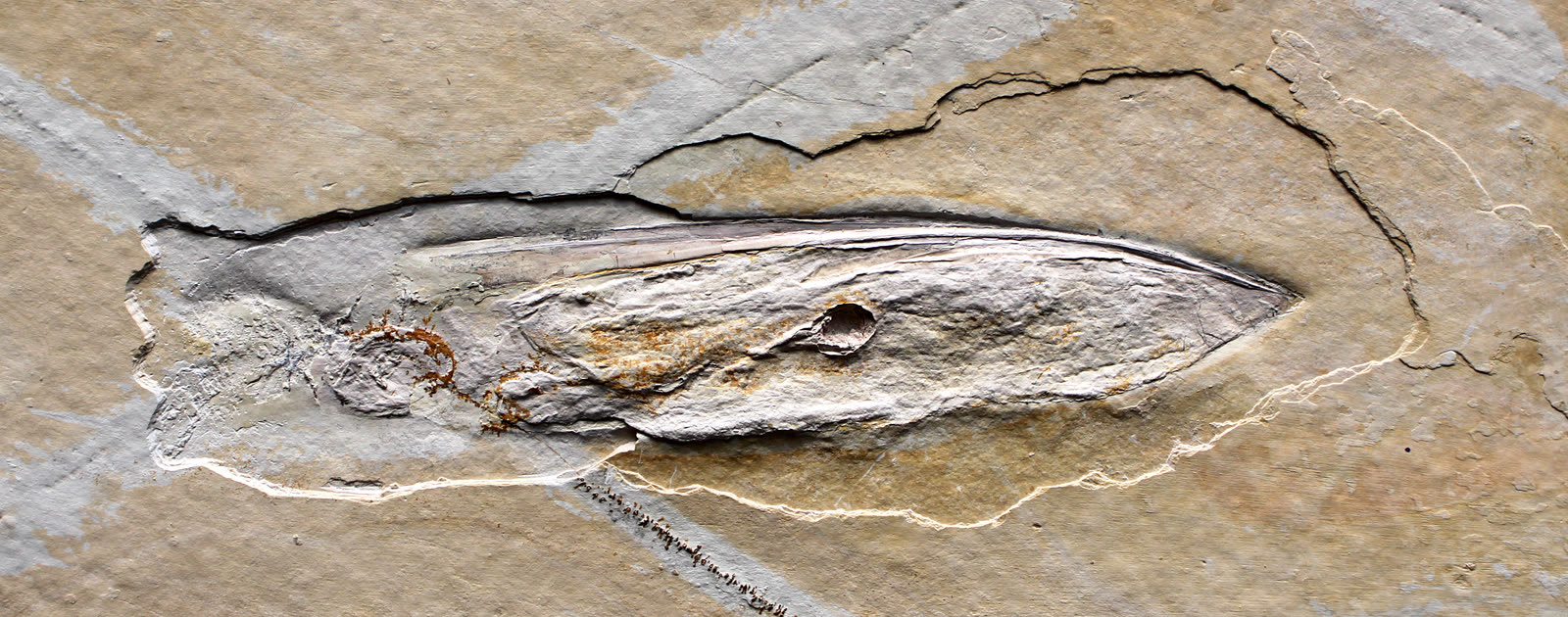
Image context: the cover uses a real Wikimedia Commons photograph of Plesioteuthis prisca, a Jurassic fossil from Solnhofen held at the Museum für Naturkunde Berlin.[6] It is an appropriate lead image because it shows the exception that proves the rule: soft-bodied coleoids become readable only when preservation, preparation, and display all line up.
Around 0:20, the video makes the right first move: separate cephalopods from squids
The opening correction is taxonomic and material at the same time. Cephalopods are not absent from the fossil record. In many rocks they are among the most visible marine fossils, especially when the animal carried a shell or a robust internal structure.[1][3][5] The National Park Service's fossil-mollusk guide puts the contrast clearly: older shelled cephalopods and belemnites fossilize far more readily than today's mostly soft-bodied octopuses and squids.[3] The Smithsonian's belemnite specimen page points in the same direction, describing squid-like animals whose internal hard parts give paleontologists a durable handle on otherwise soft anatomy.[5]
That distinction prevents the article from turning into a generic "soft things decay" lesson. Squids are not missing because cephalopods fail as fossils. They are difficult because their particular body architecture gives the fossil record fewer large, obvious pieces to keep. The video explains the durable candidates: beaks, hooks, shells or shell remnants, and other small resistant parts.[1] Those pieces are scientifically valuable, but they are also selective. They preserve the mouth, the armature, or a support structure more readily than they preserve the animal's full outline, behavior, skin, and ecology.
This is where a museum visitor's intuition can go wrong. A bullet-shaped belemnite guard looks like a complete fossil because it is clean, heavy, and common. In life, though, it was a hard internal part of a larger squid-like animal.[3][5] The fossil can be abundant while the body remains largely invisible. That is the central habit of mind the video teaches: read each fossil as a preserved part of a once-larger biological system, not as a complete substitute for that system.[1]
Around 2:30, the key question becomes chemical, not cinematic
The most vivid squid fossils come from exceptional preservation, but the video is careful not to let "exceptional" become magical.[1] Kear, Briggs, and Donovan's 1995 study is still useful here because it asks what happens to modern coleoid tissues as they decay and which organs resist decay long enough to matter. Their experiments tracked beaks, radulae, suckers, gladii, statoliths, eye lenses, mantle tissue, and other structures over time, then compared those results with Jurassic fossil coleoids.[2]
The lesson is narrow and powerful. Soft-tissue preservation depends on decay sequence, microbial activity, mineral replacement, buoyancy, reproductive condition, and burial environment.[2] In some Jurassic fossils, calcium phosphate records tissues such as muscle, tunic, intramuscular fibers, and ink; in other cases, much of that anatomical signal disappears.[2] The fossil record therefore does not passively accept a squid. It edits the animal through chemistry.
That edit explains why the Solnhofen image is more than a pretty fossil photograph.[6] A specimen like Plesioteuthis gives the eye a body outline, internal darkness, and a sense of animal shape. Yet that very readability is unusual. It depends on a preservational window tight enough that the absence of comparable fossils elsewhere should not be overread as biological absence. Many squids could have lived, fed, spawned, and died in places where their soft bodies were simply converted back into sedimentary noise.
Around 5:00, the fossil record stops being only what a collector can see
The most important update to bring to the 2021 video comes from research published in 2025. Ikegami and colleagues used "digital fossil-mining" to scan Cretaceous carbonate rocks and recover more than 250 fossil squid beaks across 40 species.[4] The implication is direct: part of the squid record was not absent from the rocks. It was hidden at a scale and in a form that older collecting habits could not see.
This does not make earlier paleontologists careless. It changes the detection apparatus. A preparator splitting slabs, a collector walking a quarry, and a museum curator cataloging visible fossils all operate with human-scale surfaces. Digital fossil-mining treats the rock volume itself as a searchable archive, turning concealed beaks into three-dimensional models.[4] That matters because squid beaks are small but evolutionarily loud. The 2025 paper argues that squids originated and radiated by roughly 100 million years ago, before the end-Cretaceous extinction, and that early squids had already formed large populations.[4]
Placed beside the video, that study changes the emphasis. The older public question, "Where are all the squid fossils?", becomes more precise: which parts of squid anatomy are durable, which depositional settings preserve them, and which search methods are capable of noticing them? The answer is no longer only "in rare lagerstätten." It is also "inside ordinary-looking rocks, if the method can read small concealed remains."[1][4]
What the video leaves behind
The best paleontology videos do not merely deliver facts about a strange animal. They improve the reader's sense of evidence. This one does that by making absence feel structured.[1] Squids are not invisible in deep time because they lacked evolutionary importance. They are hard to see because their bodies ask the fossil record to preserve materials that decay quickly, scatter easily, or survive as small parts that require the right search image.[2][3][4]
That is why the squid record is a good antidote to fossil-record literalism. A shell-rich archive can make some clades look dominant because they are easy to preserve. A soft-bodied lineage can look late or marginal because its evidence is chemically fragile or physically hidden. The 2025 digital beak work does not erase the preservation problem; it makes the problem more interesting. It shows that a sparse record can contain a recoverable signal once the scale of looking changes.[4]
So the video's title should be read less as a complaint than as a method. Asking where the squid fossils are means asking what counts as a fossil, what body part survived, what kind of rock kept it, and what technology finally made it visible. That is a better question than whether squids were missing. It keeps the animal, the sediment, and the observer in the same frame.[1][2][4]
Sources
- PBS Eons, "Where Are All The Squid Fossils?," YouTube video (2021).
- Amanda J. Kear, Derek E. G. Briggs, and Desmond T. Donovan, "Decay and fossilization of non-mineralized tissue in coleoid cephalopods," Palaeontology 38, no. 1 (1995).
- National Park Service, "Fossil Mollusks."
- Shin Ikegami, Yusuke Takeda, Jörg Mutterlose, and Yasuhiro Iba, "Origin and radiation of squids revealed by digital fossil-mining," Science 388, no. 6754 (2025).
- Smithsonian Q?rius, "Belemnite" specimen page.
- Wikimedia Commons, "File:Plesioteuthis prisca 01.jpg" (lead image source page).