
Fossil Butte is easy to misread because its fossils look too finished. A Green River fish slab, a delicately spread stingray, or a mass mortality plate can seem like nature obligingly made display objects for a visitor center. Wyoming PBS's short Our Wyoming segment on Fossil Butte is worth slowing down because it keeps returning the spectacle to place: a butte in southwestern Wyoming, an ancient lake, quarry work, and a public museum where split stone becomes evidence rather than decoration.[1]
The useful frame is preservation mechanics. The National Park Service describes Fossil Lake as a large freshwater lake in what is now southwest Wyoming about 52 million years ago, with fossils in the upper layers of Fossil Butte preserving organisms that lived in and around that lake.[2] The site is famous for abundance and beauty, but those are outcomes, not explanations. The stronger question is how a lake could hold fish, stingrays, insects, plants, birds, bats, reptiles, and small mammals in enough detail for paleontologists to read an ecosystem instead of a handful of lucky deaths.[2][3]
That is why this video works as an annotated viewing rather than a travel postcard. Watch it for the movement between landscape and specimen. The butte is not just scenery behind the fossils. It is the remaining edge of a depositional system whose chemistry, bottom conditions, microbial films, and laminated limestone decided what would survive into the present.[2][4] The clip's best service is to make that system feel local and physical before the written sources tighten the mechanism.
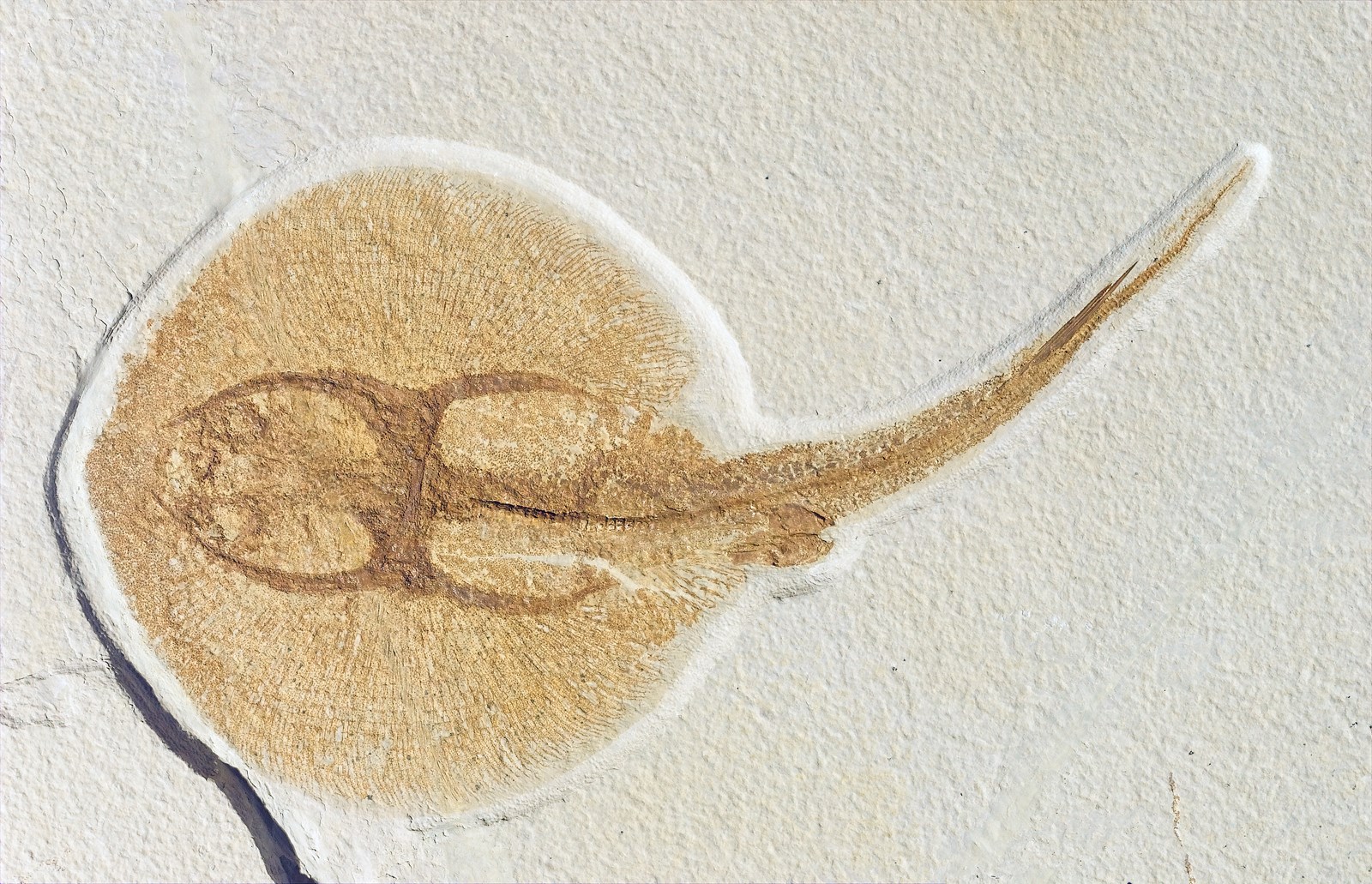
Image context: the cover uses a real National Park Service photograph of Asterotrygon maloneyi, an articulated freshwater stingray from Fossil Butte National Monument.[3] It is an unusually good visual anchor because stingrays have cartilaginous skeletons, so complete fossil preservation is exceptional. The image makes the article's central claim visible at once: Fossil Butte matters because a lake-bottom process preserved whole bodies with enough fidelity to support ecological inference.
The landscape is the first specimen
The first thing to carry from the video is the physical scale mismatch. Fossil Butte today is a dry, sagebrush-and-butte landscape, but the record it exposes belongs to a warm Eocene lake system.[1][2][4] The NPS geology page places the Green River Formation as a layered record of three former lakes, with Fossil Lake represented at the monument.[4] That matters because the fossils do not float free from their rock. Their abundance depends on repeated lake deposition, not on one disaster layer that conveniently trapped every animal in the same moment.
The NPS fossil overview gives the essential mechanism in three linked conditions. Fossil Lake had saltier water near the bottom, little oxygen in that bottom layer, and microbial mats growing on the lake floor.[2] Each condition matters separately, but the preservation power comes from the combination. Saltier bottom water could exclude many freshwater animals and scavengers. Oxygen-poor conditions slowed the biological cleanup that usually dismantles carcasses. Microbial mats could grow over remains and hold them in place while decay gases would otherwise break bodies apart.[2] The result is not simply "good preservation." It is articulation: bones, scales, and body outlines remaining close to life position instead of being scattered into sedimentary noise.[2]
That mechanism changes how the video should be watched. A fossil fish slab is not only a specimen. It is a record of a body passing through a layered lake, sinking into a chemically hostile bottom zone, and being pinned into place by microbial growth and fine sediment.[2][4] The beauty of Fossil Butte fossils therefore comes from a severe environmental filter. The lake preserved so well because parts of it were difficult places for living and dead organisms alike.
Around the fish cases, abundance becomes ecology
The video's museum sequences are strongest when read against the NPS fish inventory. Fossil fishes are the most common fossils from the Fossil Butte Member, and the park lists 27 identified fish species from that unit.[3] That number is useful because it prevents a common collector's mistake: treating each fish slab as a standalone trophy. Fossil Butte's power lies in quantity and variation. Abundance lets paleontologists compare body sizes, stomach contents, mass mortality patterns, juvenile and adult distributions, and ecological roles across a lake system.[3]
The fish page makes the lake feel populated rather than merely fossiliferous. It describes articulated freshwater stingrays, including specimens that preserve embryos or baby rays; a paddlefish species often preserved with fish in the stomach; gar species whose scales and jaw forms indicate different feeding styles; and Diplomystus, a primitive herring relative whose specimens can occur from embryonic size to full-grown adults.[3] Those details matter because they turn a pretty wall of fossils into a food web. Predators, bottom-feeders, schooling fish, possible migrants, and reproductive stages all show up as evidence that the lake can be read biologically, not just lithologically.[3]
The visitor center's Fish Wall sharpens the same point for a public audience. NPS notes that the exhibit displays 16 fish species and 49 fossils, including mass mortality plates, with many originals rather than only casts.[5] That is the right museum choice for Fossil Butte. A cast can teach outline, but repeated original slabs teach pattern: some animals recur in groups, some occur alone, some preserve meals, and some mark specific positions in the ancient lake. The exhibit is not merely showing the best-looking fossils. It is teaching that preservation becomes scientific when specimens remain numerous enough to compare.[3][5]
The best clue is what the lake does not preserve equally
The video gives Fossil Butte a welcoming surface, but the written record keeps the site from becoming too tidy. Fossil Lake preserved an astonishing range of organisms, yet it did not preserve every habitat, behavior, or life stage evenly.[2][3] The fish page repeatedly marks this unevenness. Crossopholis magnicaudatus, for example, is most commonly found in shallow-water deposits, while very few juveniles are known, suggesting spawning or early life may have involved connecting rivers before adults entered the lake.[3] Notogoneus osculus presents a different puzzle: very young juveniles and large adults are the main specimens, and NPS discusses the possibility of migration between Fossil Lake and connected streams.[3]
That is where Fossil Butte becomes more than a high-quality fossil quarry. It becomes a lesson in preservation bias. The lake's bottom conditions made complete fossils possible, but the same system selected what reached the bottom, where it died, how long it floated, whether it was eaten, and whether it entered deep or shallow deposits.[2][3][4] A mass mortality plate is therefore not a simple census. It is a filtered event. A rare bird or bat is not proof that such animals were absent most of the time; it is proof that only certain routes from life to sediment leave readable remains.
This boundary is important because Fossil Butte fossils are so visually persuasive. Their clarity can make interpretation feel automatic. It is not. Good paleontology at a site like this keeps asking which signals come from the living ecosystem and which signals come from the preserving environment. Schooling behavior, predator-prey relationships, reproductive stages, lake stratification, microbial mat activity, and quarry sampling all press on the final picture.[2][3][5]
What the video leaves behind
The best reason to watch the Wyoming PBS segment is that it restores the middle scale between fossil slab and deep time. It lets Fossil Butte be a place before it becomes a cabinet: road, butte, visitor center, quarry history, stone, and people explaining why these objects matter.[1] The stronger interpretation then comes from the NPS pages, which show how much mechanism sits beneath the beauty: saltier bottom water, low oxygen, microbial mats, laminated limestone, diverse fish faunas, mass mortality plates, and exhibits built around comparative abundance.[2][3][4][5]
That combination is the article's main point. Fossil Butte is not important because it gives paleontology unusually attractive fish. It is important because it turns a short slice of Eocene lake life into a disciplined evidence system. The fossils look finished because the lake did so much work before humans ever split the stone. Once that is understood, the prettiness stops being a distraction. It becomes the visible surface of a preservation machine.
Sources
- Wyoming PBS, "Fossil Butte - Our Wyoming," YouTube video.
- National Park Service, "Fossils - Fossil Butte National Monument" (lake conditions, microbial mats, fossil diversity, and preservation overview).
- National Park Service, "Fossil Fish Species - Fossil Butte National Monument" (fish diversity, ecology, and source page for the lead Asterotrygon photograph).
- National Park Service, "Geology - Fossil Butte National Monument" (Green River Formation and former Fossil Lake context).
- National Park Service, "Visitor Center Exhibits - Fossil Butte National Monument" (Fish Wall, original fossils, and mass mortality plates).