Hell Creek usually reaches the public as a mood before it reaches us as a formation. The mood is easy to recognize: Tyrannosaurus rex at the edge of impact time, a bad sky, a river margin, the last afternoon of the dinosaurs compressed into one postcard. The formation itself is broader and more useful than that image. Fastovsky and Bercovici call the Hell Creek Formation the global standard for understanding terrestrial K-Pg extinction because it preserves an abundant latest Cretaceous biota in direct stratigraphic company with the earliest Paleocene Fort Union Formation.[1] That makes Hell Creek valuable as a stacked record, not as a single apocalyptic snapshot.
Once that shift is made, the field report sharpens. Hell Creek is a fluvially derived siliciclastic unit laid down on a low coastal plain near the retreating Western Interior Seaway, with meandering rivers, moist soils, floodplains, ponds, and a biota that ranged from flowering plants to insects, fish, turtles, crocodilians, mammals, and dinosaurs.[1][2] The formation matters because these ecological layers can still be followed toward the K-Pg boundary with better terrestrial resolution than almost anywhere else. The harder question is never just which famous dinosaur lived there. The harder question is how much time, transport, and environmental change are mixed into the outcrops before the extinction horizon even arrives.
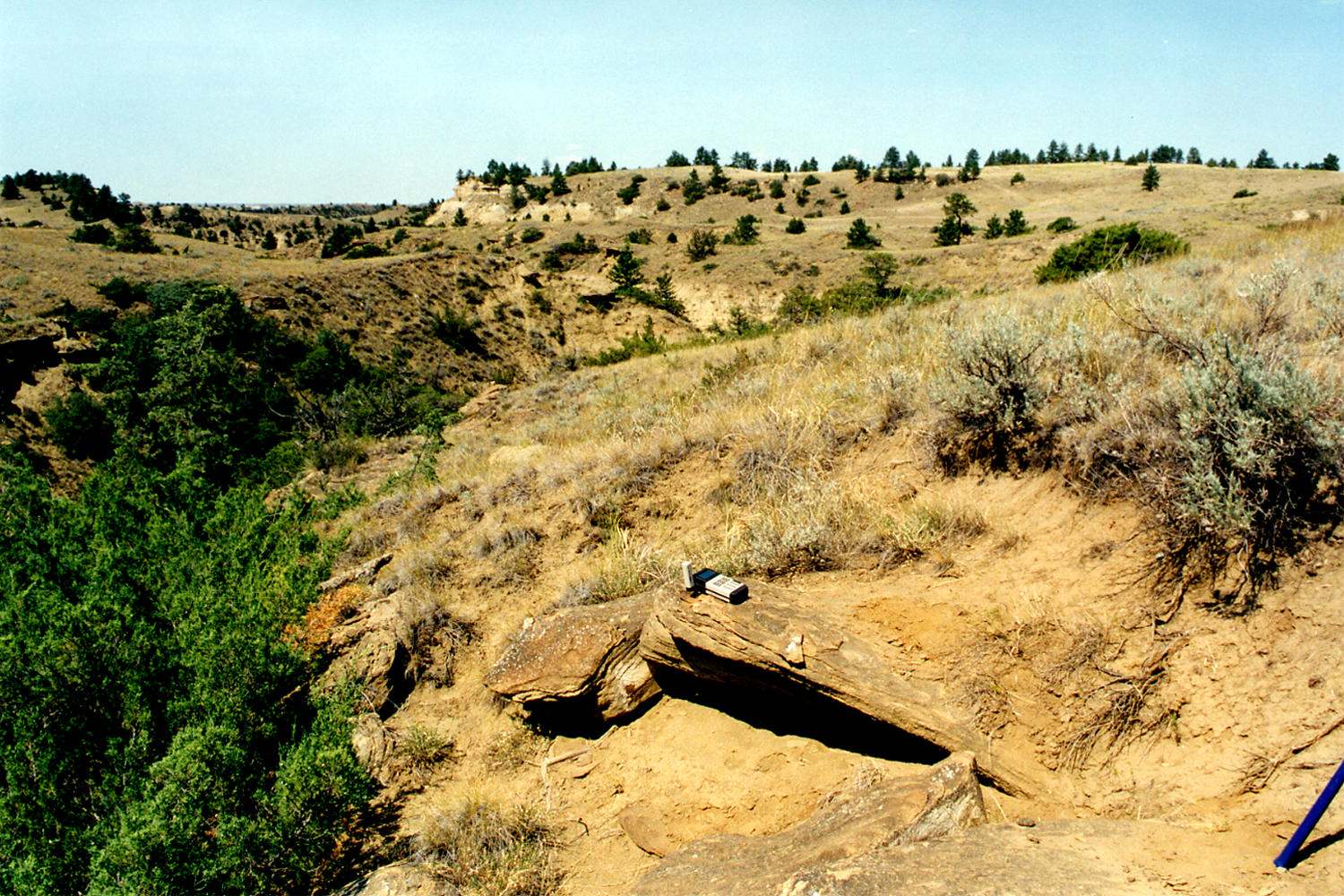
Image context: the cover uses a real photograph of the Fox Hills-Hell Creek contact in Garfield County, Montana. It belongs here because Hell Creek begins as a landscape replacement problem before it becomes a dinosaur story: marine sandstone gives way to nonmarine floodplain deposits, and that transition sets up the fossil archive the article is trying to read.[2][6]
Hell Creek is a coastal plain archive before it is an extinction stage
Fowler's 2020 stratigraphic review is a useful corrective because it puts the formation back into sedimentary space.[2] The Hell Creek was deposited on a coastal plain bordering the Western Interior Seaway during the Maastrichtian, and its beds respond to accommodation, river position, and changing base level rather than to the tidy layer-cake logic readers often want from a famous formation.[2] In other words, the unit that later yielded dinosaur skeletons and leaf floras was built by ordinary shifting river systems. That is one reason the fossils feel so grounded. They belong to channels, levees, crevasse splays, flood basins, swamps, and soils rather than to one theater set built for extinction.
Fastovsky and Bercovici describe the preserved formation as roughly 100 meters thick and representing only the last slice of the latest Cretaceous, perhaps less than the final 1.4 to 1.5 million years before the boundary.[1] That is short enough to make ecological change legible and long enough to defeat any casual "one day in Hell Creek" narrative. A formation made by migrating rivers cannot be read like a sealed varve stack. Its scientific value comes from repeated sampling across facies, not from pretending every slope exposes the same instant.
Correlation is hard precisely because the record is real
The classic difficulty of Hell Creek is that its beds are highly lenticular and cross-cutting.[1][2] Fastovsky and Bercovici call stratigraphy the formation's historical Achilles' heel, and Fowler argues that sequence-stratigraphic framing can push correlation farther than lithostratigraphy alone.[1][2] That sounds technical, but the underlying point is simple. Hell Creek is not messy because researchers failed to organize it. It is messy because rivers built it that way.
That is why field discipline matters so much here. You cannot treat every bonebed, leaf lens, or mudstone bench as if it sits on one continuous flat timeline. The formation has to be pieced together by facies, palynology, boundary clay, magnetostratigraphy, and carefully placed local sections.[1][2] The reward for that slow work is unusual terrestrial resolution, but the cost is giving up the fantasy that one dramatic quarry can stand in for the whole formation.
The boundary stays powerful because so many records overlap there
Hell Creek's status did not come only from dinosaurs. It came from overlap. The 2016 primer emphasizes that the formation contains fossil floras, palynomorphs, vertebrates, invertebrates, non-palynomorph microfossils, trace fossils, and critical geochemical markers, all within a sequence that can be assessed in paleoenvironmental context.[1] That is why the formation keeps dominating K-Pg arguments. It lets paleontologists compare biological turnover with sedimentary and geochemical change inside one terrestrial archive.
Pearson and colleagues' North Dakota work shows how fine that overlap can become without pretending to impossible precision.[3] Their surveys produced more than ten thousand specimens from vertebrate microsites and additional dinosaur skeleton material, with common faunal elements extending to within 2.37 meters of the K-T boundary.[3] The stratigraphically highest fossil in their study sat 1.77 meters below the boundary, while the fine-grained uppermost 2 meters of Hell Creek were nearly barren of fossils, probably because channel deposits disappear there.[3] That is a strong field lesson. A thinning fossil signal near the top does not automatically mean ecological collapse; sometimes it means the depositional setting stopped preserving the same way.
Plants tell a similarly sharp story across the boundary. Wilson Deibel, Wilson Mantilla, and Stromberg found that 63% of latest Cretaceous plant taxa disappeared across the K-Pg boundary in northeastern Montana, with Paleocene floras initially less rich before recovering later.[5] Read beside the primer's discussion of abrupt floral turnover and the palynological usefulness of the boundary, the result keeps Hell Creek from collapsing into a dinosaur-only extinction narrative.[1][5] The floodplain record was botanical as well as vertebrate, and the boundary cut both.
Hell Creek works best when it resists the final-afternoon myth
This is where the older Sheehan et al. paper still matters.[4] Their three-year field study found no evidence for a gradual decline of dinosaurs at the end of the Cretaceous in the Hell Creek Formation of Montana and North Dakota, after controlling for facies and sampling bias.[4] The point is not that every extinction question is finished forever. The point is that Hell Creek became central because it was sampled hard enough to challenge the comforting story that dinosaurs simply faded away long before the asteroid.
Fastovsky and Bercovici make the same larger point in more synthetic form: Hell Creek remains the single most important terrestrial indicator of what happened at the K-Pg boundary, even while representing only one geographic data point.[1] That combination is exactly why the formation should be read as a time stack. Its power comes from concurrency: floodplain sedimentation, floral turnover, vertebrate survivorship, palynological markers, and boundary signals occupying the same overall archive. Its weakness is the same thing every great terrestrial formation suffers from. It is local, river-built, facies-bound, and never as temporally flat as its fame suggests.
The best field-report conclusion is therefore the least cinematic one. Hell Creek does not need a perfect final day to matter. It matters because one latest Cretaceous coastal plain was preserved densely enough that paleontology can still watch a terrestrial world approach the boundary in multiple registers at once.[1][2][3][5] Dinosaurs are part of that record, but they are not the whole logic of the site. The whole logic is stratified floodplain time.
Sources
- David E. Fastovsky and Antoine Bercovici, "The Hell Creek Formation and its contribution to the Cretaceous-Paleogene extinction: A short primer," Cretaceous Research 57 (2016).
- Denver Fowler, "The Hell Creek Formation, Montana: A Stratigraphic Review and Revision Based on a Sequence Stratigraphic Approach," Geosciences 10, no. 11 (2020).
- Dean Pearson, Terry Schaeffer, Kirk R. Johnson, Douglas J. Nichols, and John P. Hunter, "Vertebrate biostratigraphy of the Hell Creek Formation in southwestern North Dakota and northwestern South Dakota," Geological Society of America Special Papers 361 (2002).
- Peter M. Sheehan, David E. Fastovsky, Raymond G. Hoffmann, Claudia B. Bergbaus, and Diane L. Gabriel, "Sudden extinction of the dinosaurs: Latest cretaceous, upper great plains, U.S.A.," Science 254, no. 5033 (1991).
- Paige K. Wilson Deibel, Gregory P. Wilson Mantilla, and Caroline A. E. Stromberg, "Plant taxonomic turnover and diversity across the Cretaceous/Paleogene boundary in northeastern Montana," Paleobiology 50, no. 4 (2024).
- Wikimedia Commons, "File:Fox Hills-Hell Creek formational contact (GeoDIL number - 112).jpg" - outcrop photograph used as the lead image.