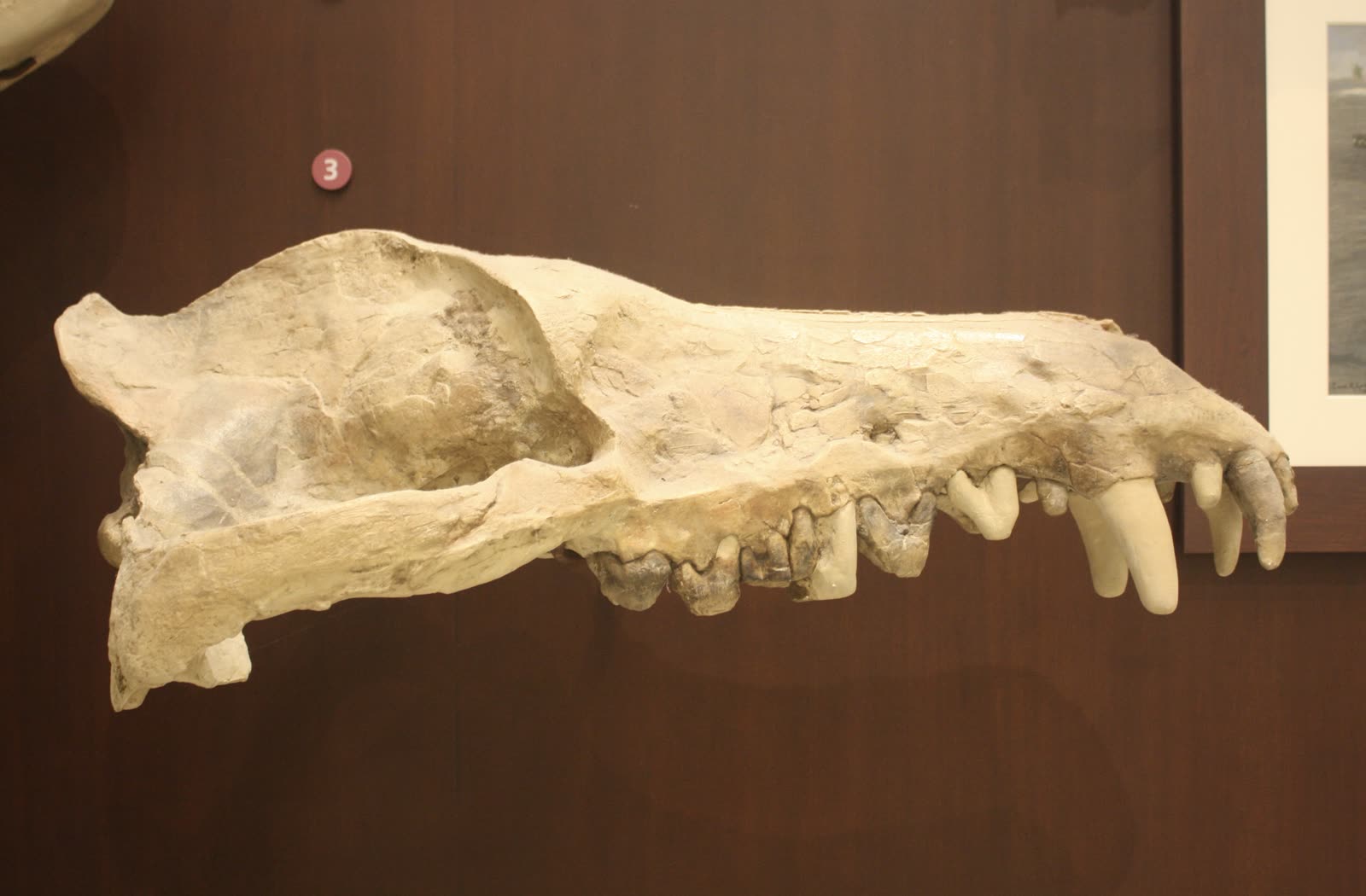
Andrewsarchus mongoliensis is usually introduced as a solved spectacle: a giant wolfish predator from the Eocene, scaled up until it can dominate a plain that nobody has actually seen it walk across.[1][2] The trouble is that the fossil does not give paleontology that much. What it really gives is one enormous skull from Irdin Manha in Inner Mongolia, discovered in 1923 by Kan Chuen Pao during the American Museum of Natural History's Central Asiatic Expeditions.[2] That is enough to make Andrewsarchus famous. It is not enough to make the rest of the animal obvious.
That is why the specimen is most useful as a skull-boundary fossil. The cranium is real, large, and anatomically forceful. The body attached to it remains inferred through comparison, scaling, and shifting ideas about relationship.[2][3][4][6] When people talk about Andrewsarchus as if its proportions, gait, and lifestyle were already pinned down, they are letting the reconstruction outrun the stone.
Image context: the cover uses a real photograph of the skull at the American Museum of Natural History rather than a life reconstruction.[5] That choice matters because the article's whole argument turns on an evidentiary limit. We can inspect the cranium itself. We cannot inspect the shoulders, spine, pelvis, or limbs that most popular versions of the animal pretend to know.
The skull really is enormous, but size is the beginning of the problem
The museum's own summary still captures the shock value cleanly. At nearly three feet long, the skull was massive, and its teeth were huge.[2] That alone explains why Henry Fairfield Osborn's original 1924 description announced Andrewsarchus as a giant mesonychid of Mongolia.[1] The fossil does not look like a small ecological experiment. It looks like an animal that could bite hard and advertise that fact from across a floodplain.
But a close reading has to linger one step longer. The skull in the AMNH photograph does not read like a neat sabre-toothed cutter or a purely gracile pursuit hunter.[5] The snout is long, the front teeth are large and attention-grabbing, and the back of the tooth row carries a broader, more workmanlike chewing surface than a simple fantasy of "largest land carnivore" would suggest.[2][5] Even before later phylogenetic arguments entered the story, the specimen was already asking for a mixed reading.
That mixed reading was present at the discovery itself. Roy Chapman Andrews took the skull as carnivorous. Walter Granger, the expedition's lead paleontologist, thought it belonged to an extinct pig-like omnivore.[2] That disagreement matters because it shows the fossil's ambiguity is not a late academic complication added by modern revisionism. It was there from the moment experienced paleontologists first tried to decide what kind of head they were looking at.
The first debate was not about fame. It was about what this head was for
Popular retellings often compress Andrewsarchus into one ecological role: apex predator, full stop. The specimen itself does not force that simplicity. A skull can tell you a great deal about bite, feeding surface, tooth placement, and facial architecture. It does not automatically sort an animal into one modern-looking niche, especially when no associated postcranial skeleton survives.[2][6]
This is where the old discovery disagreement becomes more valuable than the later myth. If one senior museum figure saw a carnivore and another saw something closer to a giant omnivorous ungulate, the right lesson is not that one of them must be turned into a fool for the sake of a cleaner headline. The right lesson is that Andrewsarchus carried a combination of visible features that resisted instant reduction.[2] The skull is dramatic, but its drama is interpretive before it is cinematic.
That is also why the cover image works so well for this article. A reader can see the long rostrum and the oversized front teeth immediately, but the photograph also stages the problem honestly: this is a head without a securely known body.[5] The fossil can command attention and still keep its life habits partly out of reach.
The second debate moved from diet to family placement
The larger reset came later, when Andrewsarchus stopped sitting comfortably inside the old mesonychian story. Osborn's original classification treated it as a giant member of that extinct carnivorous hoofed group.[1] Subsequent morphological analyses complicated that placement. Geisler's 2001 study on artiodactyl, cetacean, and mesonychid relationships put Andrewsarchus into a much broader problem about how whale relatives and hoofed mammals were related to one another.[3] Spaulding, O'Leary, and Gatesy in 2009 described Andrewsarchus as a relatively incomplete Mongolian fossil that had been historically difficult to classify, and their enlarged total-evidence analysis clustered it with entelodontids and Achaenodon rather than leaving it as a simple mesonychian stereotype.[4]
The AMNH now summarizes that shift in the plainest public language: Andrewsarchus is not a mesonychid, but recent evolutionary analysis suggests it is still a whale cousin, inside the broader artiodactyl world that includes hippos as well as cetaceans.[2][6] That change is not a trivial taxonomic footnote. It alters the comparative template people use when they imagine the missing body.
This is the central boundary in the specimen. If the closest reference frame changes, then the most confident drawings should change with it. A head first announced as mesonychian and later discussed as a close whale-relative cannot carry one timeless body silhouette through every revision.[2][3][4][6]
Why the missing skeleton matters more than the legend
AMNH says it directly on both the blog post and the cetaceans hall page: only a single skull is known.[2][6] From that one fact, almost every responsible limit in the article follows. Shoulder height estimates, trunk length estimates, gait, and overall build all depend on scaling from relatives or from older phylogenetic assumptions. The famous six-foot-shoulder and twelve-foot-length figures are museum-level estimates, not a body preserved in articulation.[2]
That does not make Andrewsarchus weak evidence. It makes it strong evidence of a particular kind. The fossil securely tells us that a very large-headed mammal with formidable dentition lived around 45 million years ago and that its relationships matter for how we reconstruct the early branching around whales and other artiodactyl lineages.[2][4][6] What it does not do is grant permission for total anatomical confidence.
That is why Andrewsarchus has shelf value. It keeps paleontology honest about the difference between a spectacular skull and a complete animal. The head is real. The historical argument over feeding was real. The phylogenetic reassignment away from a tidy mesonychian label was real. The rest remains bounded by absence.[1][2][3][4][6] For a famous fossil, that is not a disappointment. It is the reason the specimen is still worth reading carefully.
Sources
- Henry Fairfield Osborn, Andrewsarchus, giant mesonychid of Mongolia. American Museum Novitates no. 146 (1924), Biodiversity Heritage Library record for the original description.
- American Museum of Natural History, "Andrewsarchus, 'Superb Skull of a Gigantic Beast'" - discovery context, only-known-specimen status, and the museum's summary of the shift away from Mesonychia toward a whale-cousin placement.
- Douglas H. Geisler, "New Morphological Evidence for the Phylogeny of Artiodactyla, Cetacea, and Mesonychidae," American Museum Novitates 3344 (2001) PDF.
- Michelle Spaulding, Maureen A. O'Leary, and John Gatesy, "Relationships of Cetacea (Artiodactyla) Among Mammals: Increased Taxon Sampling Alters Interpretations of Key Fossils and Character Evolution," PLOS ONE 4, no. 9 (2009).
- Wikimedia Commons, "File:Andrewsarchus skull at AMNH.jpg" - museum photograph of the skull used for the article image.
- American Museum of Natural History, "Cetaceans" - exhibition page noting that Andrewsarchus mongoliensis is known from a single skull discovered in 1923 and presenting it as a close whale relative.