Dimetrodon is usually introduced as a correction before it is introduced as an animal. It was not a dinosaur. It lived tens of millions of years before the first dinosaurs. It sat on the synapsid line, the larger branch that eventually includes mammals.[1] All of that is true, but it still leaves a second mistake intact: once the animal is placed on the mammal line, public imagination starts dragging it forward toward fur, warm-blooded expression, and a half-mammalian body it did not have. This note begins from the opposite boundary. Dimetrodon matters because several evolutionary signals arrive in one body at once: a skull already organized around the synapsid opening, teeth that are no longer doing one repetitive job, a predatory head with reconstructable sensory equipment, and new comparative scale evidence that keeps early synapsids visually anchored in a scaly Permian world.[1][2][3][4]
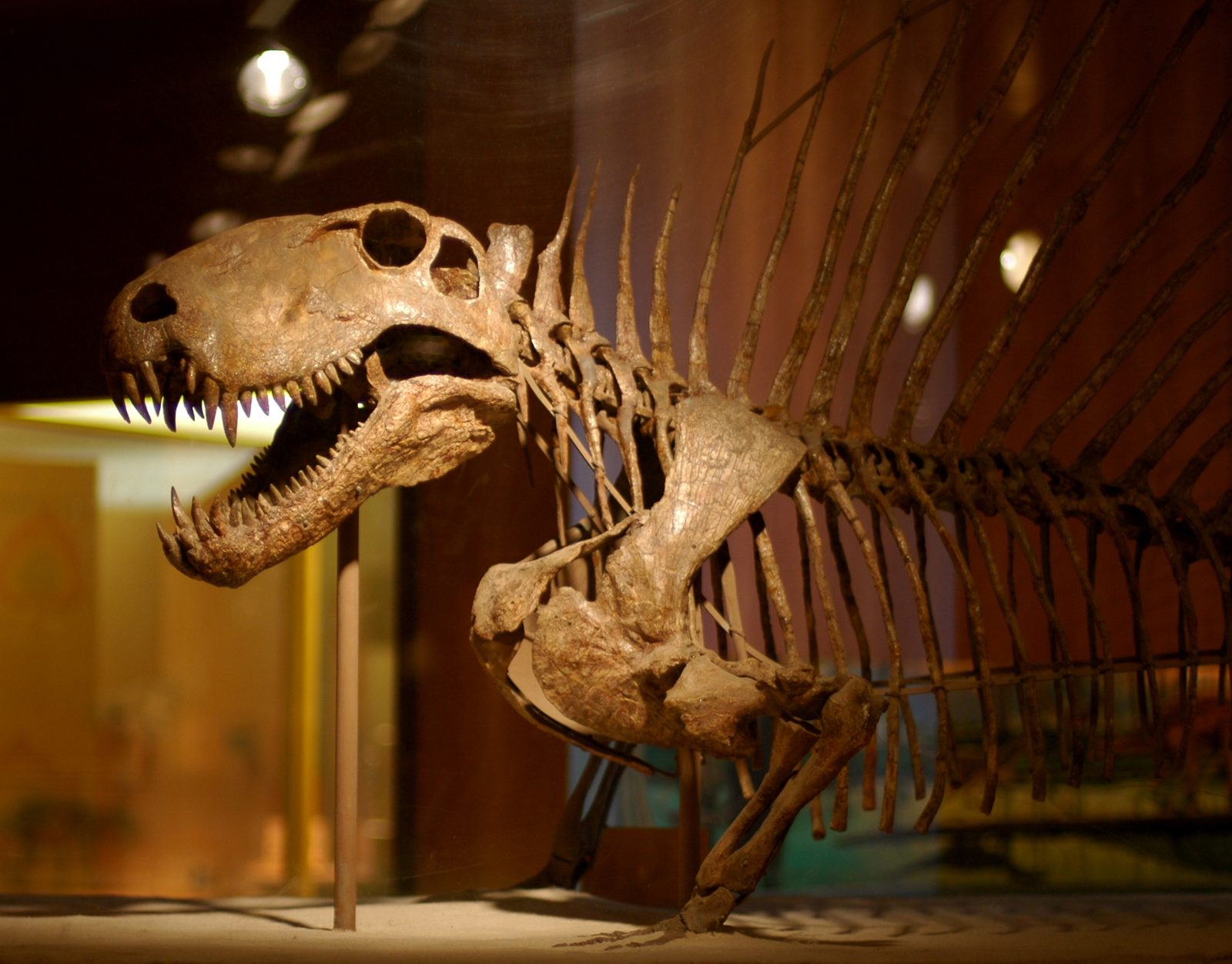
That is why the sail has to be reduced before the animal can come back into focus. The sail is real, spectacular, and worth keeping in frame. It just should not be allowed to monopolize the profile. Museum interpretation keeps the animal tied to the Early Permian red-bed world of north-central Texas, and the mounted skeleton still gives the clearest first impression: a large head, a powerful trunk, relatively short limbs, and the famous series of hyperelongate neural spines rising from the back.[5][6] Once the whole body is visible again, the sail stops functioning as a logo and returns to what it actually is, one anatomical structure inside a much older synapsid experiment.
Image context: the cover uses a real photograph of a mounted Smithsonian Dimetrodon skeleton from Wikimedia Commons.[6] It belongs here because the article's main claim is visual as well as conceptual: the skull and tooth row matter as much as the dorsal silhouette, and a museum mount lets those features stay in the same frame rather than turning the animal into a floating spine-wall.
1) The head is the real center of gravity
The Field Museum's synapsid collection page puts the basic point plainly: Dimetrodon is a synapsid, and the temporal opening behind the eye socket is one of the structural markers that separate this broader lineage from other early amniotes.[1] That opening is not a decorative label. In museum interpretation it is tied directly to the organization of head and jaw musculature.[1] For a public audience that has been trained to see Dimetrodon as a reptile-like detour, this is the first useful reset. The skull is already carrying one of the structural themes that later mammal evolution will elaborate in very different directions.
The teeth sharpen that reset. Brink and Reisz's 2014 study argued that Dimetrodon and allied sphenacodontids were the oldest known fully terrestrial apex predators, and that the genus showed much more dental variation than older shorthand allowed.[3] The paper is valuable because it moves beyond the vague claim that the animal had "big sharp teeth." Different parts of the tooth row were already doing different things, and the larger species carried true denticles, the earliest ziphodont cutting edges recognized in the fossil record.[3] That does not make Dimetrodon a mammal in any ordinary sense. It does make the predator scientifically richer than the stock image of a sail-backed generic carnivore. Feeding style was changing inside the head faster than the old silhouette suggests.
2) The sail stays important by staying unresolved
The temptation is to make the sail solve the whole animal. Popular summaries keep returning to a short list of possibilities: temperature regulation, display, intimidation, mate attraction.[5] The problem is not that those hypotheses are foolish. The problem is that the animal becomes less interesting when one is chosen too quickly and allowed to swallow everything else.
The better reading is narrower. The sail is a real anatomical commitment built from dramatically elongated neural spines, and it must have had physiological, ecological, or social consequences of some kind.[5][6] But the profile becomes stronger when the sail is treated as a question rather than as a finished answer. If the teeth show a predator experimenting with slicing efficiency, and the skull opening points to the synapsid architecture of the head, then the sail belongs beside those structures, not above them. It is one more sign that Early Permian synapsids were already evolving conspicuous body plans without needing to be recast as dinosaur previews or proto-mammalian dress rehearsals.
3) New sensory work makes the predator more exact
The 2023 paleoneurological reconstruction adds another layer that the old classroom version of Dimetrodon never had to carry.[2] Bazzana-Adams, Evans, and Reisz described the first detailed reconstruction of its neurosensory anatomy and argued that the animal shows adaptations consistent with a predatory lifestyle.[2] Their result is especially useful because it narrows one of the easiest places for speculation to drift. The paper suggests Dimetrodon could hear a broader range of frequencies than earlier expectations allowed, even though it lacked the impedance-matching ear of much later forms.[2]
That finding does not turn Dimetrodon into a stealth hunter reconstructed down to the last behavior. The paper is more disciplined than that.[2] What it does provide is a better sense of how much of the predatory package was being assembled in the skull. This was not merely a large-bodied animal with big teeth and an eye-catching back. It was an early terrestrial apex predator whose head preserves sensory and functional evidence that can now be modeled in more detail than older descriptions allowed.[2][3]
4) The mammal line did not begin by looking mammalian
This is where the newest scale evidence matters so much. In public imagination, anything on the mammal line is always at risk of being pulled forward too quickly into fur, warm-blooded expressiveness, and vaguely mammalian skin. The 2025 Current Biology paper on Early Permian synapsid impressions pushes against that habit.[4] Marchetti and colleagues described full-body impressions from a sphenacodontid-grade synapsid and argued that they preserve the oldest known epidermal scales in synapsids, long before the acquisition of hair.[4]
The paper is not a direct full-body portrait of every species of Dimetrodon, and it should not be used that way.[4] Its value is comparative and boundary-setting. It reminds us that being on the mammal line is a phylogenetic fact, not an instruction to visualize a furry half-mammal too early. A Dimetrodon-grade predator could combine a synapsid skull, specialized cutting teeth, and a body covering that still belonged to a scaly early amniote world.[1][3][4] That mixture is precisely what makes the animal so informative. Evolutionary packages do not arrive all at once.
Put all of this together and a cleaner boundary note emerges. Dimetrodon was an Early Permian sphenacodontid synapsid, grounded in the red-bed ecosystems of what is now North America, with a skull already marked by the synapsid opening, a dentition showing real functional differentiation, a predatory head whose sensory anatomy can now be reconstructed in detail, and a famous sail whose exact role remains open.[1][2][3][5] The newer skin evidence makes the external boundary clearer too: early mammal-line animals did not need to look mammalian to matter for mammal history.[4]
That is why Dimetrodon stays durable. It is not just the animal that proves a trivia point about dinosaurs, and it is not a furry preview of mammals either. It is a body in which several evolutionary timelines overlap without synchronizing neatly. Teeth, hearing, skin, and display-grade anatomy are all moving, but they are not moving at the same speed. The result is better than a mascot. It is one of the clearest early snapshots of how the mammal line was assembled through mismatch: mammal-line skull architecture, predator-grade teeth, unresolved display anatomy, and an external surface that still belongs to a much older scaly world.
Sources
- Field Museum, "The Fossil Non-mammalian Synapsid Collection at The Field Museum."
- Kayla D. Bazzana-Adams, David C. Evans, and Robert R. Reisz, "Neurosensory anatomy and function in Dimetrodon, the first terrestrial apex predator" (2023), iScience.
- Kirstin S. Brink and Robert R. Reisz, "Hidden dental diversity in the oldest terrestrial apex predator Dimetrodon" (2014), Nature Communications.
- Lorenzo Marchetti, Antoine Logghe, Markus Buchwitz, and Jörg Fröbisch, "Early Permian synapsid impressions illuminate the origin of epidermal scales and aggregation behavior" (2025), Current Biology.
- Texas Science & Natural History Museum, "Paleontology Gallery."
- Wikimedia Commons, "File:Dimetrodon skeleton.jpg" - museum photograph used as the lead image.