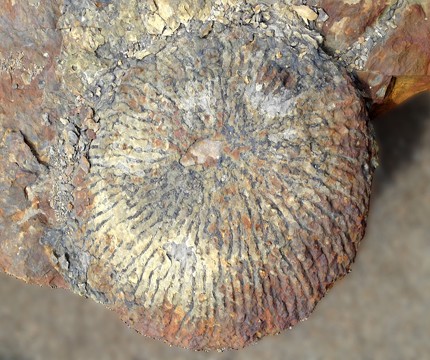
Gilboa is easy to flatten into a record-book phrase: one of Earth's earliest fossil forests. That label is useful, but it is also a little too smooth. The site is more interesting when the reader starts at the ground. The famous Gilboa material is not just a plant name or a Devonian date. It is a set of stump casts and rooting structures preserved close enough to life position that the forest can be read as a floor plan before it is imagined as scenery.[1]
The cover image follows that argument. It shows a photographed Eospermatopteris stump from Gilboa, not a reconstruction or diagram, because the article depends on the fossil surface itself: rounded base, root zone, and the stubborn physical scale of a plant that occupied a real patch of Middle Devonian ground.[6]
The first thing to protect is the distinction between "forest" and "modern forest." Gilboa does not need to look like an oak stand, a conifer slope, or a coal-swamp lycopsid thicket to matter. Its importance is that it catches early tree-sized plants while they were still experimenting with architectures that later forests would not simply copy.
The Stump Floor
The Gilboa stumps were found in New York's Catskill region during nineteenth-century work around the Gilboa dam and reservoir, and they quickly became central to the public and scientific story of very early forests.[1] Their old fame came from an unusually direct kind of evidence: stump bases set in a surface rather than isolated plant fragments swept into a channel. That rooted context is why Gilboa has had such staying power. A forest is not only a taxonomic list. It is spacing, substrate, disturbance, shade, anchorage, decay, and the repeated fact of plants returning to the same ground.
The name Eospermatopteris was attached to the stump casts long before paleobotanists had a complete plant to attach to them. For decades, the bases were the scene and the mystery at the same time. They told researchers that tree-sized plants stood there, but not what the crown looked like. That gap matters. If the reader imagines a familiar tree crown too quickly, the fossil becomes a prop for a modern landscape. Gilboa asks for the reverse habit: begin with the stump, then earn the canopy.
A Tree Without Familiar Treehood
The 2007 reconstruction changed the way the stumps could be read. Stein, Mannolini, Hernick, Landing, and Berry linked the Gilboa stumps to giant cladoxylopsid trees, resolving the old problem of what kind of plant produced the bases.[2] The result was not a hidden ancestor of maples or pines. It was a tall Devonian organism with a trunk-like axis and a crown architecture unlike seed-plant trees. In broad terms, the Gilboa tree was tree-sized without belonging to the later design vocabulary that dominates living forests.
That is the core pleasure of the fossil. It separates size from familiarity. Eospermatopteris could make vertical space and could form a standing forest, but it did so with cladoxylopsid anatomy rather than modern wood, broad leaves, seeds, or the branching systems most readers associate with trees. The word "tree" remains valid because it describes ecological role and gross form: an elevated, self-supporting photosynthetic plant. But the fossil keeps correcting the image behind the word.
This is where a close reading helps. The stump is not a failure to preserve the whole plant. It is a preserved argument about how early trees solved the problem of standing, spreading, and returning biomass to land. The canopy reconstruction gives the stump a body, but the stump keeps that body honest.
Roots As Engineering
Gilboa's later study also complicated the old picture of a simple grove. The 2012 Nature paper described a surprisingly complex Mid-Devonian plant community at the site, with Eospermatopteris joined by other plant forms rather than standing as a single-species monument.[3] That matters because early forest floors were ecological mixtures, not just rows of iconic trunks. The rooting systems, sediment surface, and plant associations are evidence for a living environment, not a display case of individual specimens.
The roots are especially important because they make the forest an engineering problem. Early forests changed how sediment was held, how water moved through soils, how organic matter accumulated, and how surfaces responded to floods or storms. But Gilboa's roots should not be turned into modern root systems by habit. Eospermatopteris roots were part of a different structural solution, probably less like the deep woody frameworks of later seed-plant forests and more like a shallow anchoring system repeatedly renewed around the base. That still counts. A shallow system can shape a surface, trap sediment, and define a plant's stability limits.
The fossil therefore records both capability and constraint. These plants could stand tall enough to make a forest. They could occupy a wet Devonian surface in repeated positions. They could participate in a mixed community. Yet their rooting and crown architecture also imply vulnerability: height without the same underground infrastructure that Archaeopteris-type trees would later bring into Devonian landscapes.
Cairo Keeps Gilboa Honest
The nearby Cairo fossil forest sharpens this point. Work on the Cairo site reported Archaeopteris root systems in a Mid-Devonian paleosol, with roots much more reminiscent of later forest engineering.[4] Cairo has often been discussed as an older or more structurally consequential forest surface, and recent work from southwest England has pushed the record of known forested landscapes still further back.[5] Those updates do not make Gilboa obsolete. They rescue it from being valued only as a title holder.
If "oldest" is the only reason to care about a fossil forest, the story becomes fragile every time a slightly older surface is described. Gilboa remains powerful because it preserves a different forest experiment. It captures Eospermatopteris and its associates in a real Devonian setting, showing that early forests were not a single march toward modern trees. They were a set of competing and overlapping solutions to height, rooting, reproduction, and disturbance.
That is why the best reading of Gilboa is comparative rather than triumphal. Cairo helps show what a more Archaeopteris-centered root revolution looked like. Somerset helps remind readers that the earliest known forest record is still being revised. Gilboa, meanwhile, keeps its own value as a ground-level record of cladoxylopsid forest architecture.
What The Fossil Can Say
Gilboa can say that Middle Devonian landscapes already supported tree-sized plants in place. It can say that Eospermatopteris was not merely an isolated form known from scattered fragments, but a plant that could organize a forest floor. It can say that early forests included more than one plant type and that rooting systems were already altering the physical behavior of terrestrial environments.[3]
Gilboa cannot say that the first forests were modern forests in disguise. It cannot make seed-plant wood, leaves, deep roots, or later canopy ecology appear ahead of their time. It should not be asked to prove a simple ladder from primitive stump to familiar tree. Its evidence is stranger and better than that.
The fossil's strength is the preserved contact between plant and ground. The rounded stump bases are not decorative remnants. They are the starting points for reconstructing a world in which tree height had arrived before many of the modern tree solutions had settled into place. Gilboa is most convincing when the canopy stays tethered to the floor.
Sources
- New York State Museum, "Re-Examining the Earth's Oldest Trees"
- W. E. Stein, F. Mannolini, L. V. Hernick, E. Landing, and C. M. Berry, "Giant cladoxylopsid trees resolve the enigma of the Earth's earliest forest stumps at Gilboa," Nature
- W. E. Stein et al., "Surprisingly complex community discovered in the mid-Devonian fossil forest at Gilboa," Nature
- W. E. Stein et al., "Mid-Devonian Archaeopteris roots signal revolutionary change in earliest fossil forests," White Rose Research Online
- N. S. Davies, W. J. McMahon, and C. M. Berry, "Earth's earliest forest: fossilized trees and vegetation-induced sedimentary structures from the Middle Devonian (Eifelian) Hangman Sandstone Formation, Somerset and Devon, SW England," Crossref DOI chooser
- Wikimedia Commons photograph of an Eospermatopteris textilis fossil tree trunk from Gilboa