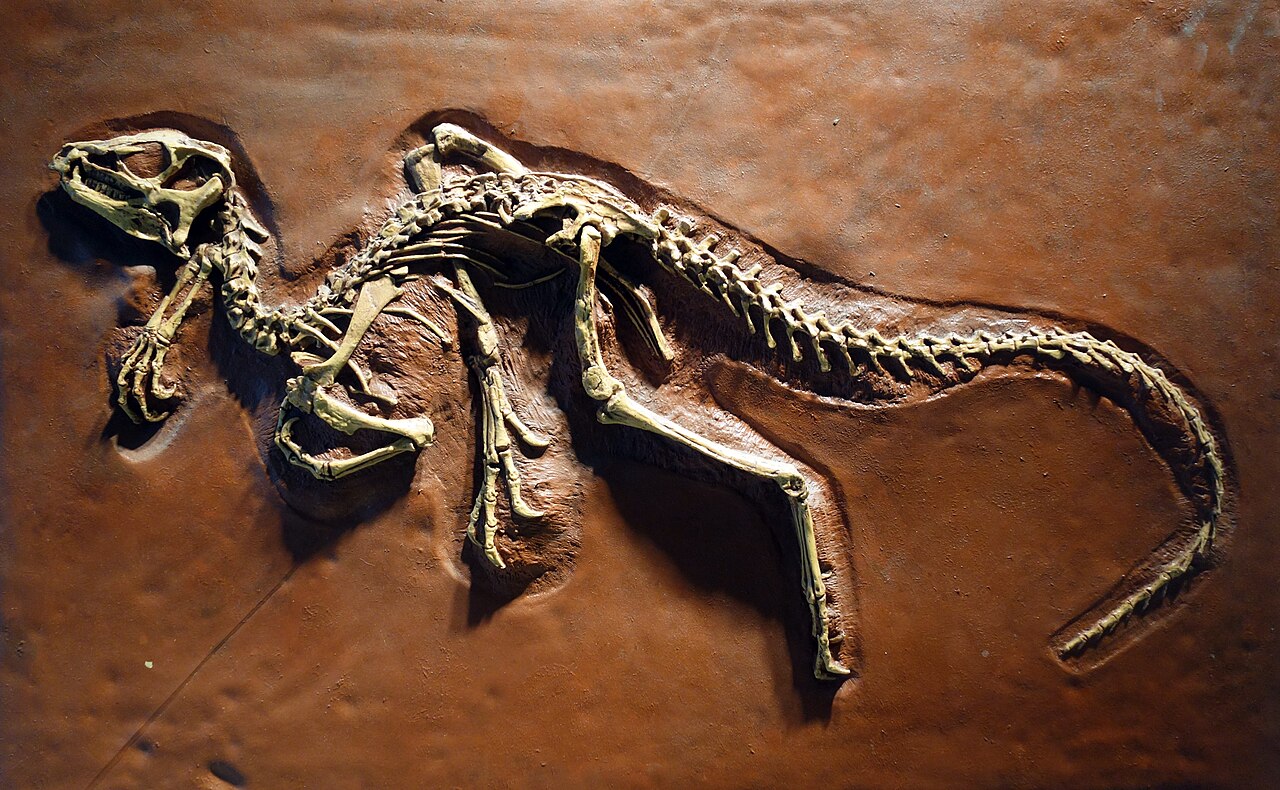
Heterodontosaurus tucki has one of those names that can accidentally make the animal smaller. "Different-toothed lizard" sounds like a museum-label curiosity, and the usual public hook is even narrower: a small plant-eating dinosaur with tusks. The tusks are real, but they are the least interesting way to stop. The stronger reading begins when the caniniform teeth, cheek teeth, jaw joint, wear facets, and tooth-replacement pattern are treated as one feeding system.[1][2][3]
That system matters because Heterodontosaurus sits close to the early history of Ornithischia, the dinosaur branch that would later include armored dinosaurs, horned dinosaurs, duckbills, and many other herbivorous lineages. It was not a late, specialized hadrosaur with a huge dental battery. It was a small Early Jurassic heterodontosaurid from southern Africa, already carrying a surprisingly elaborate dental toolkit at a point where ornithischian feeding systems were still being assembled.[1][4][5]
Image context: the lead image is a directly photographed museum cast at the University of California Museum of Paleontology.[6] It is not a diagram or a generated reconstruction. The cast photograph fits the article because the animal's small body and compact skull help prevent the tusks from becoming outsized in the reader's imagination. The real story is not one dramatic tooth. It is how the whole skull processed food.
The tusks are evidence, but not the whole argument
The caniniform teeth are the first things most readers notice. They are also the easiest feature to overinterpret. In an animal otherwise known as an early ornithischian herbivore, large pointed teeth invite lazy narratives: display, combat, sexual dimorphism, omnivory, defense, or some combination of all of them. The fossil record does not let any one of those explanations win cleanly by appearance alone.
The 2008 juvenile skull paper is useful exactly because it blocks one attractive shortcut. Butler, Porro, and Norman described a juvenile Heterodontosaurus skull from the Stormberg deposits of southern Africa and noted that well-developed caniniform teeth were present even in the juvenile specimen.[3] That matters because if tusks were only adult male ornaments, the juvenile should make that hypothesis easier to defend. Instead, the caniniforms appear earlier in life than a simple sexual-display story would like.[3]
This does not settle function. Juvenile tusks do not prove diet, combat, or display by themselves. They do something narrower and better: they make the caniniforms part of the basic body plan rather than a late decorative add-on. A good anatomy reading therefore keeps the tusks in the skull, not above it as a mascot. They are one element in a jaw that also carried cropping teeth at the front and closely packed cheek teeth farther back.[1][3]
The cheek teeth make the herbivore mechanically interesting
The cheek teeth are where Heterodontosaurus becomes more than a tusked oddity. Sereno's 2012 review of heterodontosaurids emphasized the taxon's masticatory function and argued that marked tooth wear in mature specimens is best explained by long-axis rotation of the lower jaw during occlusion.[1] Put more plainly: the lower jaw did not simply chop up and down like a hinge in a toy skeleton. Its movement likely created sustained contact between opposing tooth surfaces, producing low-angled wear facets.[1]
That is a serious claim for a small early ornithischian. Later dinosaur herbivores evolved famous high-throughput feeding tools, including complex batteries and repeated replacement systems. Heterodontosaurus shows a different early solution: fewer, more individually important teeth arranged so that wear itself helped create a working cutting surface.[1][2]
The 2023 dental histology paper sharpens that point from inside the tooth. Calvert and colleagues described Heterodontosaurus as having a suite of complex dental features: morphological and proportional heterodonty, sub-hypsodont cheek teeth, occlusion, and extensive low-angled wear facets.[2] Yet the enamel did not behave like the thick, elaborate tissue system one might expect from a later grinding specialist. Instead, the paper found relatively simple enamel and a striking band of wear-resistant dentine contributing to the functional cutting crest.[2]
That result is important because it shifts the focus from "this dinosaur had unusual teeth" to "this dinosaur had an unusual way of making teeth work." The cutting edge was not just a static shape. It was produced by tooth tissue, jaw contact, and wear interacting over time.[1][2]
Slow replacement changes the cost of chewing
Tooth replacement is the hidden constraint in the animal. Many dinosaurs solved tooth wear by replacing teeth continuously and often. Heterodontosaurus appears to have done something more restrictive. The juvenile skull study reported that CT scans found no replacement teeth in either juvenile or adult specimens, while tooth-size differences between juvenile and adult material still imply that replacement occurred during growth.[3] In other words, replacement was not absent from life history, but it was not operating as a simple high-speed conveyor behind every functional tooth.[3]
That makes the wear facets more consequential. If teeth are not being swapped rapidly, then each functional tooth has to remain useful for longer. The 2023 histology paper fits this picture by showing that modified dentine, not only enamel, helped form the working crest.[2] The feeding system becomes an economy of durable contact surfaces rather than a system of disposable crowns.
This is where Heterodontosaurus differs from the more familiar dinosaur-herbivore story. In hadrosaurids or ceratopsians, the drama often lies in dense replacement and large tooth batteries. In Heterodontosaurus, the drama is smaller and more exact: a compact skull, differentiated teeth, limited visible replacement, occlusal wear, and a jaw motion capable of making those surfaces meet productively.[1][2][3]
The body keeps the skull from floating away
The skull can dominate the animal so strongly that the rest of the body vanishes. That is a mistake. The classic 1976 Nature paper on a complete skeleton helped make Heterodontosaurus a whole dinosaur rather than a dental puzzle.[5] The Natural History Museum's public profile keeps the scale clear: this was a small, agile-looking dinosaur from southern Africa, not a big-bodied browser with industrial jaw hardware.[4]
That scale matters for feeding interpretation. A small animal can exploit low vegetation, selective plant parts, seeds, invertebrates, or mixed resources in ways that do not map neatly onto later giant herbivore categories. The fossil evidence most strongly supports a specialized dental apparatus inside an herbivorous or primarily plant-processing frame.[1][2][4] It does not require the animal to be imagined as a miniature version of later ornithopods.
The limbs also caution against overbuilding the diet from teeth alone. A skull tells us about processing capacity. It does not, by itself, tell us every item selected, every seasonal behavior, or every defensive role the caniniforms may have played. The best method is to hold the pieces together without letting one feature swallow the others.
The real lesson is early experimentation
The reason Heterodontosaurus still deserves attention is not that it looks contradictory. It is that the contradiction is structured. A tusked face sits beside a plant-processing cheek-tooth system. Simple enamel sits beside functionally important wear-resistant dentine. Limited visible replacement sits beside heavy wear. Small body size sits beside a skull doing surprisingly complex work.[1][2][3]
That combination makes early ornithischian herbivory look less like a smooth prelude to later dinosaur success and more like a field of experiments. Some lineages would later solve plant processing through larger batteries and faster tooth turnover. Heterodontosaurus shows another route: make different kinds of teeth, move the jaw so surfaces meet, and let wear itself help build the cutting geometry.[1][2]
The tusks are still worth noticing. They give the animal its immediate visual charge. But the scientific value lies behind the first glance. Heterodontosaurus is strongest when read as a feeding-system fossil: a small dinosaur whose teeth only make sense when morphology, tissue, wear, replacement, and jaw mechanics stay in the same frame.
Sources
- Paul C. Sereno, "Taxonomy, morphology, masticatory function and phylogeny of heterodontosaurid dinosaurs," ZooKeys 226 (2012) - open-access review covering heterodontosaurid anatomy, jaw function, wear, and phylogeny.
- Cecilia E. Calvert, Tyler C. Hunt, Niall S. Whalen, Jonah N. Choiniere, Mark A. Norell, and Gregory M. Erickson, "Enamel microstructure and dental histology in a heterodontosaurid dinosaur: Heterodontosaurus tucki," Acta Palaeontologica Polonica 68, no. 4 (2023).
- Richard J. Butler, Laura B. Porro, and David B. Norman, "A Juvenile Skull of the Primitive Ornithischian Dinosaur Heterodontosaurus Tucki from the 'Stormberg' of Southern Africa," Journal of Vertebrate Paleontology 28, no. 3 (2008).
- Natural History Museum, London, "Heterodontosaurus" - dinosaur directory page giving taxonomic, size, diet, and locality overview.
- A. P. Santa Luca, A. W. Crompton, and A. J. Charig, "A complete skeleton of the Late Triassic ornithischian Heterodontosaurus tucki," Nature 264 (1976).
- Wikimedia Commons file page for the photographed Heterodontosaurus tucki cast at the University of California Museum of Paleontology used as the article image.