Sivatherium giganteum has always been a difficult animal to imagine cleanly. The name points to India and to the Siwalik Hills. The skull suggests a huge ruminant with extravagant headgear. Older reconstructions made it look moose-like, ox-like, deer-like, or almost elephantine. The better profile is narrower and stranger: Sivatherium was a giant giraffid that became large without becoming a long-necked modern giraffe.[1][2][4]
That distinction matters because the living giraffe family is visually misleading. Today it has two familiar endpoints, the tall open-country giraffe and the forest-dwelling okapi. The fossil family was much wider. NOVA's summary of recent sivathere work notes that giraffids once included more than 50 species across Africa and Eurasia, ranging from small to very large forms and carrying varied ossicones, the bony horn-like structures distinctive to giraffids.[4] Sivatherium belongs in that lost diversity. It is not a failed giraffe and not a disguised deer. It is one answer to the question of how many ways there were to be a giraffid before the modern survivors narrowed the picture.
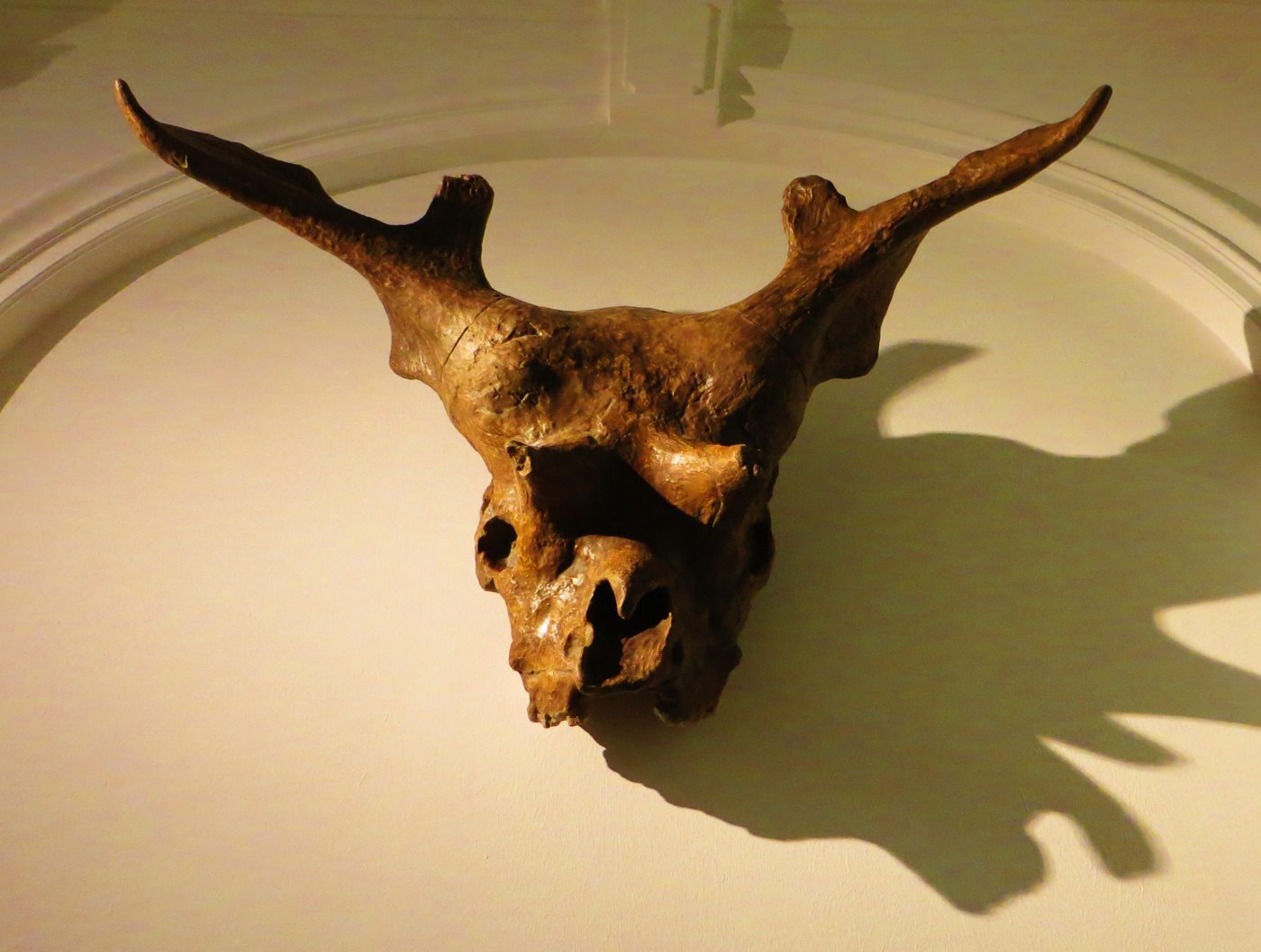
Image context: the cover uses a real photograph of a Sivatherium giganteum skull displayed at the Museum of Paleontology in Tuebingen.[5] That choice keeps the article anchored to fossil anatomy. A full-body reconstruction can make the animal look like a fantasy hybrid; the skull makes the problem more exact. Head mass, ossicone placement, and a short-faced but massive ruminant architecture have to be read before any life restoration is trusted.
1) The first correction is size, not spectacle
The old public image of Sivatherium leaned hard on excess. Nineteenth-century and early twentieth-century accounts could treat it as a prehistoric monster close to elephant scale, a hoofed animal made impressive chiefly by bigness and oddity.[2] Basu, Falkingham, and Hutchinson reset that claim in 2016 by building a three-dimensional composite skeletal reconstruction and estimating body mass volumetrically.[1]
Their result is the best starting point because it makes the animal large without making it absurd. The Dryad record for the study gives an estimated adult body mass of 1,246 kilograms, with a range from 857 to 1,812 kilograms.[1] That does not approach a modern African elephant, but it does confirm a huge giraffid and possibly the largest ruminant mammal yet known.[1] Riley Black's National Geographic report put the same revision in public language: Sivatherium had to be downsized from the elephant comparison, while still remaining at least as heavy as a large bull giraffe or a common hippo.[2]
That is not a disappointment. It is the scientific profile becoming stronger. A one-ton-plus ruminant is already extraordinary. What matters is not whether Sivatherium wins a theatrical size contest, but what kind of body carried that mass. The 2016 study also found a discrepancy between the volumetric estimate and a bivariate scaling estimate from humeral circumference, implying that the humerus was unusually robust for the reconstructed body mass.[1] The authors speculated that this could relate to a cranial shift in the center of mass.[1]
That single detail changes the animal. The forelimbs and shoulder region are not just supports under a generic heavy body. They may be part of the cost of carrying an unusually heavy head and neck package. The profile therefore begins to move sideways: not taller, not elephantine, but front-loaded and skull-driven.[1][2]
2) It became giant by a different giraffid route
Modern giraffes make size visible through height. Long limbs and a long neck turn mass into vertical reach. Sivatheres pushed in a different direction. NOVA's report describes sivatherines as increasing overall body mass and size while retaining relatively short, robust limbs, rather than following the giraffe route of elongating neck and limbs.[4] They also carried extremely large and complicated ossicones.[4]
That sentence is the key to Sivatherium. The animal is not compelling because it was a heavy version of a modern giraffe. It is compelling because it shows that the giraffid family could build a large body through mass, headgear, and robust support. The living giraffe makes the family seem defined by reach. Sivatherium reminds us that extinct giraffids also explored width, weight, and cranial display.[3][4]
The broader sivathere-samothere literature helps here because it makes ossicones more than decoration. The PLOS One paper on Decennatherium rex describes a late Miocene giraffid with two pairs of ossicones, including smaller anterior ones and larger posterior ones, and places such four-ossiconed forms inside a wider history of giraffid diversification.[3] That paper is not a Sivatherium giganteum monograph, but it gives the right comparative frame: extinct giraffids experimented with cranial appendages in ways that living species no longer show.[3]
In that context, the Tuebingen skull photograph is not just a dramatic fossil face. It is a reminder that ossicones were part of the family toolkit. In living giraffes, ossicones can look familiar enough to become invisible. In Sivatherium, the headgear becomes impossible to ignore. The skull makes display, combat potential, neck loading, and forequarter support all part of one anatomical budget.[1][3][4][5]
3) The name is old, but the reconstruction problem is modern
Sivatherium was named in the nineteenth century from material in the Siwalik branch of the sub-Himalayan region, and Black's account emphasizes that Basu and colleagues returned to the Cautley Collection at the Natural History Museum in London, including original bones used in the early description.[2][3] That matters because the animal's fame long outran the completeness of its modern biomechanical reading. Fossils could make it famous before they made it measurable.
The 2016 reconstruction did not remove uncertainty. It made the uncertainty explicit. Basu and colleagues used original Sivatherium material where possible, then used living giraffes and okapis as anatomical guides for missing parts, precisely because the living relatives preserve relevant skeletal comparisons despite their different body shapes.[2] That is careful reconstruction, not photographic recovery. The animal we can defend is a model constrained by fossils and relatives, not a complete skeleton lifted whole from one quarry.
That boundary keeps the profile honest. We can say that Sivatherium giganteum was a Plio-Pleistocene giraffid from the Himalayan foothills, that its adult mass was probably around the one-ton range rather than elephant scale, that it carried a heavy skull with prominent ossicone architecture, and that its forelimb robustness may reflect the burden of that cranial package.[1][2][4] We should be slower to claim a fully settled posture, every soft-tissue contour, or a precise behavioral script for its headgear.
This is why the animal rewards a species profile rather than a monster profile. The old chimera language was fun but weak. The modern version is more interesting because each part has a job. The skull forces display and mass into the foreground. The forelimbs keep that mass from becoming a floating cartoon. The giraffid family tree explains why ossicones belong here at all. The body-mass estimate rescues the animal from both exaggeration and minimization.[1][2][3][4]
4) The strongest reading keeps giraffid diversity in view
The most useful memory hook for Sivatherium is not "biggest giraffe" or "prehistoric moose-giraffe." Both phrases distort the animal by making it answer to living silhouettes. The stronger hook is this: Sivatherium shows how broad giraffid evolution used to be. It became massive without becoming giraffe-tall. It carried complicated ossicones without becoming a deer. It belonged to a family whose fossil members crossed Africa and Eurasia long before only giraffes and okapis remained.[3][4]
The 2021 NOVA report on the first Iberian evidence of Sivatherium emphasizes that sivatherines originated in Africa, expanded through Eurasia, and survived into the Pleistocene in Africa before finally disappearing.[4] That geographic and temporal spread matters because it stops Sivatherium from reading as one isolated oddity from India. It was part of a larger sivathere radiation, a heavy-bodied branch of giraffid history that repeatedly tested cranial ornament and body mass in regions far beyond the living giraffe's present range.[3][4]
Read this way, Sivatherium becomes a check on a common paleontology error: letting the present decide what the past was trying to become. The animal was not aiming at the modern giraffe and missing. It was taking a different route through the same broader family. Its skull, ossicones, robust limbs, and revised mass estimate make that route visible.[1][3][4][5]
That is enough to make the species memorable without exaggerating it. Sivatherium giganteum was probably not an elephant-scale ruminant. It was something more exact: a huge giraffid whose center of gravity, literally and interpretively, sat forward in a heavy, ornamented head. The more carefully that head is read, the less the animal looks like a chimera. It becomes one of the clearest reminders that extinct mammal families were often wider, stranger, and more structurally inventive than their living survivors let us imagine.
Sources
- Christopher Basu, Peter L. Falkingham, and John R. Hutchinson, "Data from: The extinct, giant giraffid Sivatherium giganteum: skeletal reconstruction and body mass estimation" (2015), Dryad dataset for the 2016 Biology Letters paper.
- Riley Black, "The Biggest Giraffe of All Time" (2016), National Geographic.
- Maria Rios and colleagues, "A new giraffid (Mammalia, Ruminantia, Pecora) from the late Miocene of Spain, and the evolution of the sivathere-samothere lineage" (2017), PLOS One.
- NOVA School of Science and Technology, "First occurrence of the extinct giant giraffid Sivatherium in the Iberian Peninsula" (2021).
- Wikimedia Commons file page for the lead image, "File:Sivatherium giganteum skull.JPG".