A predator resting flat against a lake bottom has a practical problem: the ground gets in the way of opening its mouth. For Gerrothorax, a broad-headed inhabitant of Triassic waters, the solution appears to have involved lifting the head before dropping the jaw. Its feeding apparatus makes most sense when the skull, throat and space beneath the animal are considered together.[2][6]
Gerrothorax pulcherrimus belonged to the plagiosaurids, an unusually flattened group of temnospondyl amphibians. Fossils from Germany and East Greenland preserve a head much broader than it is long, with conspicuous openings for the eyes. The animal lived during the Middle and Late Triassic, alongside the early history of dinosaurs. Its world is represented by tangible collections of skulls and other bones, rather than a single fragment requiring a whole creature to be imagined around it.[1]
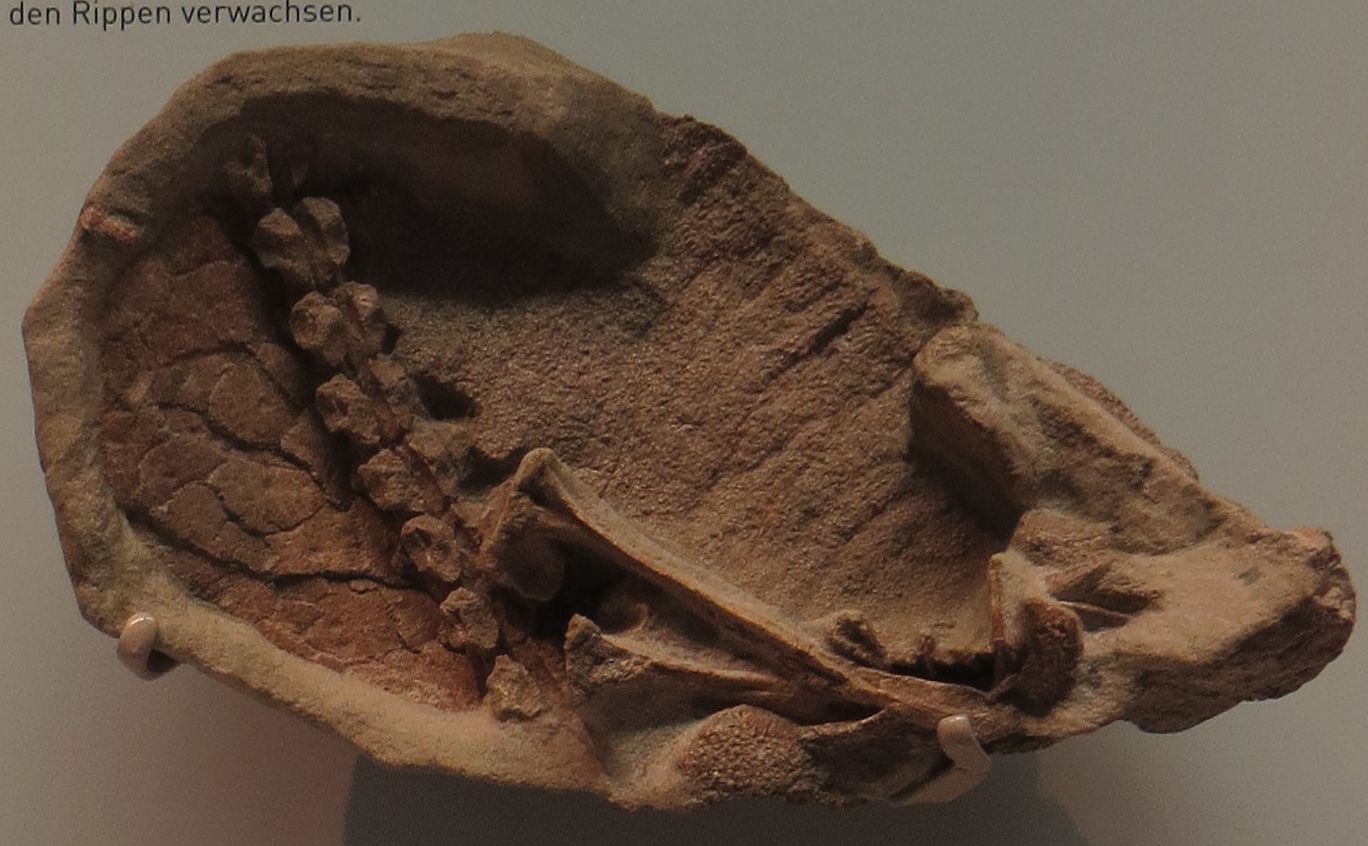
The museum photograph offers a useful starting point: an actual fossil display, with its own preserved surfaces and gaps. Ghedoghedo photographed this specimen at Stuttgart’s Museum am Löwentor in 2015. It gives the animal a physical presence; the movement must still be reconstructed from anatomy.[5]
That reconstruction has changed. In their 2013 study, Florian Witzmann and Rainer Schoch examined muscle attachment sites and the space available for muscles, using living animals to interpret missing tissues. The attachment scars on the lower jaw indicated a muscle capable of pulling that jaw downward. This made jaw depression part of the feeding mechanism, alongside skull lifting.[2]
Their proposed sequence begins with the jaws closed as the head rises. The skull then lifts farther, the lower jaw drops, and the supporting apparatus in the throat moves down and backward. The expanding mouth cavity draws water inward, potentially carrying prey with it. This is a model of suction feeding supported by bone and comparative anatomy. The fossils establish constraints on the movement; they do not preserve a filmed strike or its measured suction pressure.[2]
A living comparison helps make the mechanism tangible. In a 2022 study, Samantha Gartner and colleagues used moving X-ray reconstructions to examine suction feeding in West African lungfish. They compared their observations with the proposed mechanism in Gerrothorax: a largely rigid skull could still generate suction through jaw and throat movements. The lungfish supplies observable mechanics, while the fossil supplies its own anatomical constraints. Similarity strengthens the plausibility of a reconstruction without making the two animals mechanically identical.[6]
The rest of the skeleton helps explain how the animal could create room for that motion. Witzmann and Schoch’s January 2026 study describes flattened ribs and shoulder and pelvic structures, together with small but differentiated limb bones. They propose that the forelimbs helped push the front of the body away from the ground during feeding. A lift of the chest would make the mouth’s opening movement easier to accommodate.[4]
Armor did not turn the body into one immovable plate. The same study finds that the arrangement of the small bones in the skin permitted some flexibility. The authors interpret the overall proportions as those of an ambush predator with limited swimming ability, and the tail vertebrae offer little support for a deep tail fin. They place the animal in oxygen-rich, low-salinity waters near the shore. These are ecological interpretations assembled from the skeleton and its setting, with a consistent emphasis on life close to the bottom.[4]
The striking shape also persisted. Schoch and Witzmann’s 2012 assessment traced fossils assigned to G. pulcherrimus across more than 35 million years and found remarkably conservative anatomy. They nevertheless cautioned that similar-looking populations could have belonged to separate biological species. A name that remains useful across successive rock layers cannot tell us whether widely separated animals could have interbred.[1]
Inside the bones, there is evidence of substantial variation. Sophie Sanchez and Schoch’s 2013 study cut thin sections through 25 limb bones from Kupferzell and Vellberg in Germany. The sections exposed differences in tissue structure, vascular canals, remodeling and growth interruptions. The researchers inferred varied growth rates and developmental schedules within this externally conservative animal.[3]
Their explanation links that variation to environmental flexibility. Individuals may have adjusted growth and maturation to differences in their water bodies, including food supply and salinity. The deposits provide the environmental context; the bone tissues record how growth proceeded. Connecting the two produces a plausible account of resilience, although it does not recover the animal’s physiology directly or establish the cause of every growth pause.[3]
That distinction gives Gerrothorax a richer identity. Its broad skull invites attention to a momentary action: making space, opening the mouth, drawing prey inward. Its growth record invites attention to an entire lifetime. Read together, the studies suggest that a recognizable body shape could accommodate considerable variation in how an animal lived and grew. The apparent stillness of the fossil is an invitation to examine those different scales of movement.[3][6]
Sources
- Rainer R. Schoch and Florian Witzmann, “Cranial morphology of the plagiosaurid Gerrothorax pulcherrimus as an extreme example of evolutionary stasis.” Lethaia 45 (2012), 371–385; anatomy, distribution and species recognition; publisher-deposited bibliographic record.
- Florian Witzmann and Rainer R. Schoch, study of Gerrothorax’s cranial and throat muscles and suction feeding. Journal of Morphology 274 (2013), 525–542; publisher-deposited abstract and publication record.
- Sophie Sanchez and Rainer R. Schoch, study of bone histology and environmental and developmental plasticity in Gerrothorax. Evolutionary Biology 40 (2013), 627–647; open-access study of growth and environmental flexibility.
- Florian Witzmann and Rainer R. Schoch, study of Gerrothorax’s postcranial anatomy, development and body flattening. Zoological Journal of the Linnean Society 206 (2026), zlaf195; abstract on limbs, armor and habitat.
- Ghedoghedo, “Gerrothorax pulcherrimus 4458.jpg.” Wikimedia Commons; photograph taken at the Museum am Löwentor, Stuttgart, 19 August 2015; CC BY-SA 4.0.
- Samantha M. Gartner and colleagues, X-ray study of suction feeding in West African lungfish (Protopterus annectens). Biology Open 11 (2022), bio059447; experiments and comparison with Gerrothorax.