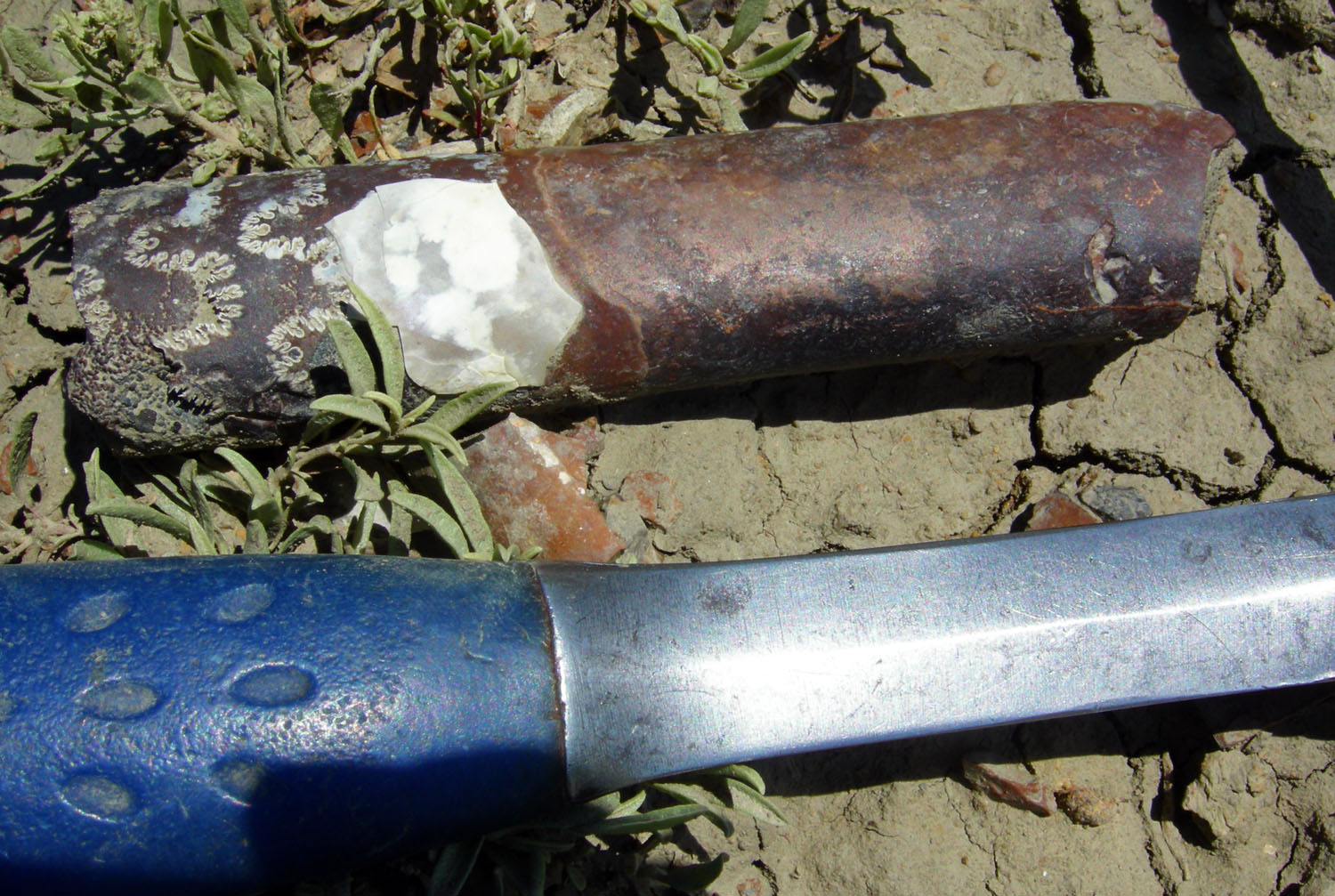
A straight shell lies exposed in the South Dakota sediment, pale, branching seams visible through its broken surface. Mark Wilson’s field photograph makes Baculites tangible: an animal has left something you could pick up, turn over and examine. Yet the shell offers little immediate guidance to the question that would have occupied its owner every day: what was there to eat?[7]
For that, the most revealing evidence came from structures almost lost inside the rock. In a 2011 Science study, Isabelle Kruta and colleagues reconstructed the mouth apparatus of Baculites using synchrotron X-rays. Delicate teeth and associated animal remains supported a diet of small planktonic prey. The finding opened a way to reconstruct feeding in an extinct ammonite without assuming that a familiar-looking shell contained a familiar kind of diner.[1]
Finding the machinery
The South Dakota fossils examined at the European Synchrotron Radiation Facility already showed traces of jaws. Scanning at its ID19 beamline revealed additional structures still enclosed in the surrounding material. The researchers used phase-contrast microtomography, which made it possible to reconstruct internal anatomy in three dimensions. Between the jaws appeared the radula: a ribbon bearing teeth, used by mollusks to handle food and move it toward the oesophagus.[2]
The scale was intimate. The reconstructed radula measured about seven millimetres long and six wide, with the tallest tooth cusp reaching roughly two millimetres. Some teeth remained connected, preserving their arrangement. Their slender shapes included comb-like and sabre-like forms. Around them sat an unequal pair of jaws: a large lower jaw with two calcified halves, and a smaller upper jaw.[2]
That arrangement is more informative than an isolated sharp point. A tooth can suggest a possible action; a tooth located between jaws helps constrain how the whole apparatus worked. The 2011 study joined that anatomical evidence to a second observation: small organisms preserved in the mouth region. Together, they made plankton feeding a stronger interpretation than either clue would have supplied alone.[1]
Why location makes a meal
One specimen contained a tiny snail and crustacean remains beside the feeding structures. According to the American Museum of Natural History’s account, these small fossils were absent elsewhere on the specimen. That distribution mattered. The team interpreted the association as food caught in the mouth around the time of death, rather than organisms that had simply entered the shell afterward.[3]
A fossil shell can contain things that never belonged to its living occupant. The inference therefore depends on position as well as identity. A small animal somewhere in a body chamber and a small animal lodged among mouthparts are different observations. Here, the mouth’s delicate construction and the local concentration of likely prey pointed in the same direction.[3]
“Last meal” is a compelling description of that evidence, but it remains an interpretation of a preserved association. It does not recover a lifetime’s menu, the frequency of different foods, or the motions used to capture them. The scene becomes more useful when its missing actions remain visible to the reader.
A jaw has to fit its proposed job
Other specimens let researchers test the mouth’s mechanics at a larger scale. In 2017, Neal Larson and Neil Landman described lower jaws of Baculites grandis preserved inside body chambers from the Pierre Shale of Wyoming. One retained a folded, U-shaped form that they considered an approximation of its position in life.[4]
Their measurements addressed whether these plates could also have served as an operculum—a lid closing the shell opening. Even spread out, the studied jaws would not reach the shell’s sides. That mismatch argued against an effective lid in these specimens and supported their role within the apparatus that gathered and conveyed food.[4]
This is an unusually concrete test of an extinct animal’s behavior. A proposed function must work with the available dimensions. Recognizing something as a plate is only the beginning; putting it back into the animal can rule out a job that its detached shape might suggest.
The menu does not fix the address
Comparisons also complicate any attempt to give all ammonites one diet. Kruta and colleagues’ 2013 study of Rhaeboceras halli revealed a broadly comparable radula with more robust lateral teeth. The authors allowed two explanations for the variation: differences in feeding specialization, or differences inherited through evolutionary history. Similar mouth architecture permits comparison, but does not establish identical meals.[5]
Even plankton feeding leaves the animal’s position in the sea unresolved. Jocelyn Sessa and colleagues approached that separate question in a 2015 study of the younger, upper Maastrichtian Owl Creek Formation in Mississippi. They compared shell oxygen-isotope evidence from ammonites with that of organisms associated with the seafloor and the water column. Their results placed Baculites and related baculitids close to the bottom.[6]
Those Mississippi shells are not the South Dakota mouth specimens. Nevertheless, the study explains why the two interpretations can coexist: the small prey inferred from baculite mouth remains could have occurred near the seafloor as well as higher in the water. Feeding on plankton does not, by itself, establish a life near the surface.[6]
The field photograph remains a good place to finish looking. The chambers give the fossil a recognizable shape; the concealed teeth give it a plausible activity. Each additional method restores a different part of the animal’s life. Keeping those parts connected, without making any one of them answer every question, is how a shell begins to acquire an ecology.
Sources
- Isabelle Kruta and colleagues, “The role of ammonites in the Mesozoic marine food web revealed by jaw preservation.” Science 331 (2011), 70–72; original study abstract and bibliographic record.
- European Synchrotron Radiation Facility, “The almost unattainable radula of ammonites.” Research Highlights 2011; scanning method, dimensions and mouth anatomy.
- American Museum of Natural History, “Ammonites Dined on Plankton” (2011); research-team account of the prey remains and their location.
- Neal L. Larson and Neil H. Landman, “Description of the lower jaws of Baculites from the Upper Cretaceous U.S. Western Interior.” Acta Geologica Polonica 67 (2017), 109–120; jaw preservation and the operculum hypothesis.
- Isabelle Kruta and colleagues, “The radula of the Late Cretaceous scaphitid ammonite Rhaeboceras halli (Meek and Hayden, 1856).” Palaeontology 56 (2013), 9–14; official abstract describing radular variation.
- Jocelyn Anne Sessa and colleagues, “Ammonite habitat revealed via isotopic composition and comparisons with co-occurring benthic and planktonic organisms.” PNAS 112 (2015), 15562–15567; Mississippi habitat study, including supplementary discussion of prey distribution.
- Mark A. Wilson, “Baculites.jpg.” Wikimedia Commons; field photograph from western South Dakota, June 2008, released into the public domain.