The pale rock at Foulden Maar is built largely from the silica shells of microscopic algae. Near Middlemarch, in New Zealand’s Otago region, a small diatomite pit opens into the remains of a lake roughly 23 million years old. Leaves, flowers, fish and insects occur within its fine layers. The organisms that made the sediment helped create an unusually intimate record of the organisms around them.[2]
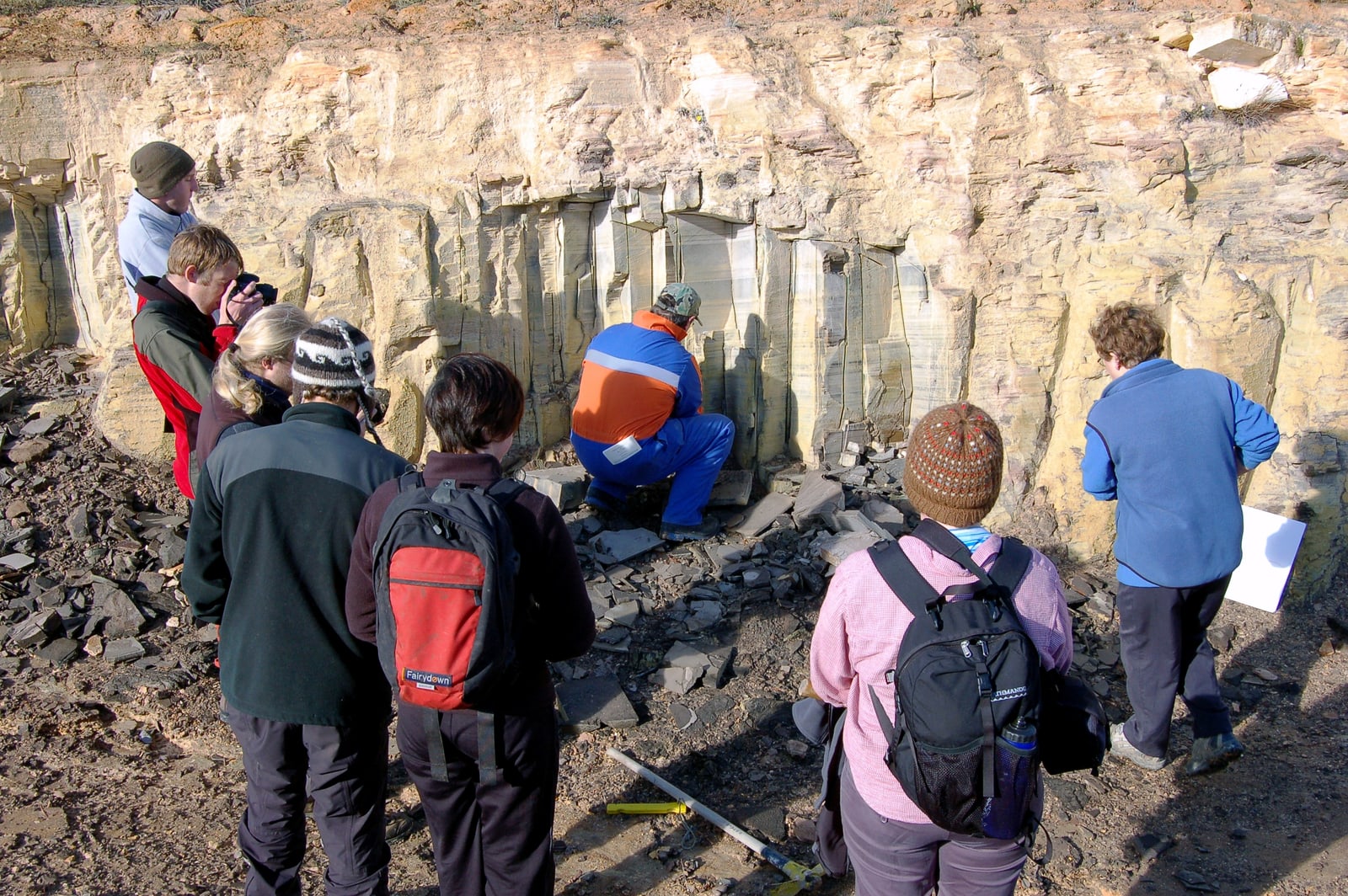
The field photograph captures students at the locality in 2006.[1] To understand what they were standing above, picture a deep crater holding water, with forest around its rim. That reconstruction rests on sediment and fossils. The crucial feature lies below the imagined surface: a lake floor where delicate remains could settle with little disturbance.[2][5]
A lake that kept its layers
Foulden began with an explosive encounter between rising magma and groundwater. Water later occupied the crater. Seasonal deposition produced alternating pale, diatom-rich layers and darker layers containing organic matter and other material. The researchers’ account identifies Encyonema jordaniforme as the dominant diatom.[2]
The separation between surface and bottom mattered. Sedimentary evidence supports an upper water body containing oxygen above deep water that lacked it. Intact laminations and the absence of traces of animals churning the bottom support that interpretation.[5] A lake can sustain life overhead while preserving its remains below.
Diatom secretions may also have helped protect organic material. That is a proposed contribution to preservation, not a complete explanation established for every fossil.[2][5] The sediment was an active part of the burial environment, as well as the material that eventually enclosed the specimens.
Giving the stripes a timescale
Repeated bands invite counting. But a pair of stripes becomes a year only when there is evidence for that interpretation.
In a 2016 study, Bethany Fox, Gary Wilson and Daphne Lee examined cycles in the deposit’s physical properties. Patterns corresponding to orbital and solar cycles supported an annual interpretation of the laminations. Combined with magnetic stratigraphy and argon dating, their analysis placed the studied diatomite sequence at approximately 23.033–22.931 million years ago: about 100,000 years, near the beginning of the Miocene.[3]
Those figures describe an age model for a sedimentary record. They should not become an exact lifespan stamped on the entire lake. Other accounts estimate about 130,000 years for the lake or its deposits.[2][5] The useful agreement is the scale: this was an accumulating record spanning many human lifetimes, rather than the debris of one fatal afternoon.
The 2016 chronology also aligned the sequence with Antarctic deglaciation during the latter part of the Mi-1 climate event.[3] That connection gives the little basin a wider significance. A fossil collected with its position recorded can belong to a changing environment, rather than float in the broad label “Miocene.”
A forest arrives in fragments
Plant remains indicate rainforest around the lake, with the laurel family prominent. The animals add another layer of detail, although preservation varies even within this exceptional deposit.[4]
Paul Selden and Uwe Kaulfuss’s 2018 study examined four arachnid compression fossils held at the University of Otago. Two had pyrite overgrowths that obscured anatomy. One could not confidently be distinguished as a spider or a harvestman. In another specimen, details of the mouthparts supported placement among mygalomorph spiders, probably in the trapdoor-spider family Idiopidae.[4]
This is the patient work concealed by the phrase “exquisitely preserved.” An outline may survive while the features needed to name its owner disappear. The specimens offer evidence of the forest’s inhabitants, but they do not license a fully populated scene in which every spider has a known identity and behavior.
The difference matters when imagining the lakeshore. Fossil evidence supplies a framework; the unpreserved web, burrow or hunting encounter remains reconstruction. A convincing illustration can make those levels look equally certain. The specimen descriptions keep them apart.
The absent insect that once lived here
A 2024 study by Viktor Baranov, Joachim Haug and Kaulfuss described 30 immature flies, mostly pupae. Among them were phantom midges closely comparable to Chaoborus, a group absent from New Zealand today. Their presence at Foulden establishes a former part of the freshwater fauna that the modern landscape no longer supplies.[5]
The authors also considered why these small bodies were preserved and found: diatomaceous mats may have aided burial, while pale sediment made tiny fossils easier to spot.[5] The collection therefore reflects both ancient conditions and the practical act of seeing a specimen on a split surface. A group’s abundance in a drawer cannot automatically become its abundance in the living lake.
Foulden’s strength lies in putting such partial records together. The layers constrain time; the plants reconstruct habitat; anatomical details establish which animals were present. Each answers a different question. Together they bring a vanished lakeshore into view while leaving room for the organisms, events and intervals that the sediment did not keep.
Sources
- Larusnz, “Foulden Maar 1.jpg,” Wikimedia Commons — field photograph dated 28 April 2006; location, authorship and license.
- Uwe Kaulfuss and Daphne Lee, “The Foulden Maar Diatomite, a terrestrial Konservat-Lagerstätte in southern New Zealand,” International Society for Diatom Research (2025) — site formation, diatoms, seasonal sediment and preservation.
- Bethany R. Storrs Fox, Gary S. Wilson and Daphne E. Lee, “A unique annually laminated maar lake sediment record shows orbital control of Southern Hemisphere midlatitude climate across the Oligocene-Miocene boundary,” Geological Society of America Bulletin 128 (2016), 609–626 — institutional abstract and chronology.
- Paul A. Selden and Uwe Kaulfuss, “Fossil arachnids from the earliest Miocene Foulden Maar Fossil-Lagerstätte, New Zealand,” Alcheringa (2018) — author-hosted paper on four specimens and identification limits.
- Viktor Baranov, Joachim T. Haug and Uwe Kaulfuss, “New records of immature aquatic Diptera from the Foulden Maar Fossil-Lagerstätte, New Zealand, and their biogeographic implications,” PeerJ 12 (2024), e17014 — fossil flies, lake conditions and preservation bias; full text.