An ammonite in amber seems to put a sea animal in the wrong world. The shell belonged to a relative of squid and octopuses; the material surrounding it began as resin from a tree. When researchers described this specimen from northern Myanmar in 2019, its surprise lay in bringing those environments into contact. Its explanation begins with something less spectacular: the shell was empty.[2]
That absence changes the scene. A living animal caught in sticky resin and a discarded shell picked up from a beach tell different stories. To read this fossil closely is to work backward from the finished amber, asking which parts of its contents arrived alive, which arrived dead, and what could have carried them together.
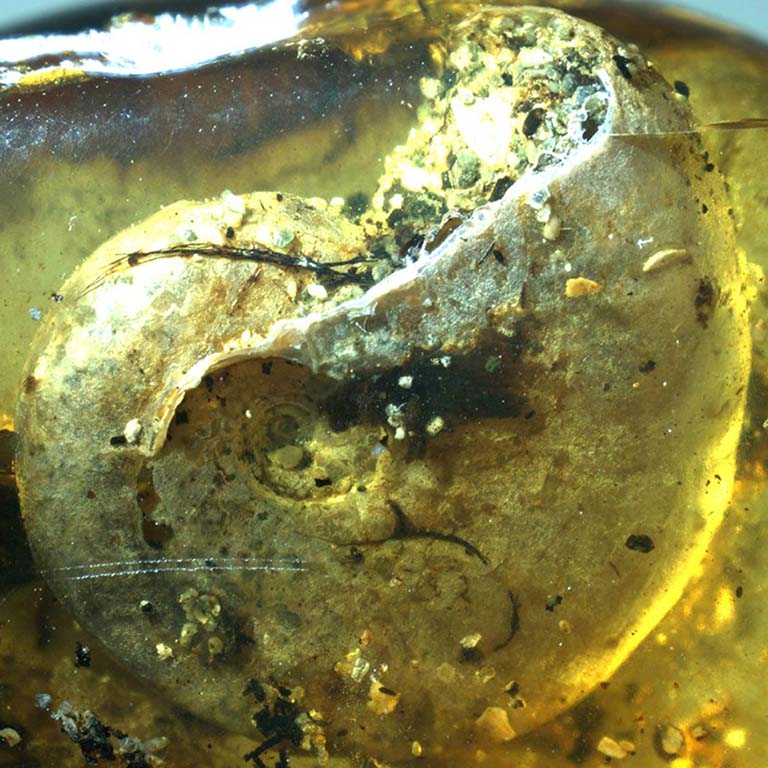
A small shell with a readable interior
The specimen, catalogued as BA18100, came from a mine near Noije Bum in the Hukawng Valley. Tingting Yu and colleagues reported it in PNAS and recorded its deposition in Shanghai's Lingpoge Amber Museum. The ammonite measures just 12 millimeters across its preserved diameter. It is a juvenile, with an incomplete outer body chamber, rather than a miniature adult preserved whole.[1]
X-ray microtomography let the team inspect internal features through the amber. The partly readable sutures, where chamber partitions met the shell wall, helped narrow the identification. The authors favored Puzosia (Bhimaites), while explaining the comparisons with other possible groups. That identification supported a late Albian to early Cenomanian age, around the transition between Early and Late Cretaceous time, roughly 100 million years ago.[1]
The restraint matters. The coil gives the eye an immediate object to recognize; the internal anatomy supplies a classification that can be argued over. Neither step reconstructs the shell's final journey. For that, its damage becomes more useful than its name.
Sand where the animal should have been
The ammonite's broken outer shell and sand-filled opening are central clues. The accompanying sea-snail shells also lack preserved soft bodies. In the research institute's account, these remains had already lost their occupants before resin engulfed them. Sand occurs elsewhere in the amber too, linking the contents of the shell with the material around it.[3]
Taken together, those observations support a sequence: death and loss of soft tissue, damage and contact with beach sediment, then incorporation into resin. The exact interval between those stages remains unknown. An empty shell alone would be a weaker argument, because missing tissue can reflect failed preservation; the associated breakage and sediment give the interpretation more support.
The institute's proposed reconstruction follows resin from a coastal tree toward a shell-strewn beach. Flying insects could enter it on the tree; creatures near the trunk's base could join as it descended; beach material could be incorporated farther along. This is a suggested route assembled from the inclusions, rather than a succession of movements directly observed in the fossil.[3]
One piece, several habitats
Alongside the shell are mites, a spider, insects and a millipede; the original study also describes isopods whose obscured anatomy leaves some habitat assignments uncertain.[1] Their proximity invites a picture of one crowded little community. But proximity inside a preservative need not mean proximity during life.
Modern resin research makes that distinction tangible. In Madagascar, Mónica Solórzano Kraemer and colleagues compared animals caught naturally in Hymenaea verrucosa resin with catches from traps around the same trees. Resin most closely resembled sticky traps attached to trunks. It represented animals living on or near the resin-producing trees better than the wider forest fauna sampled by nearby flight-interception traps.[5]
That experiment did not recreate the Cretaceous coast. It tested a more basic assumption: whether resin collects a neutral sample of its surroundings. Habitat and behavior affected what entered the sample. Applied cautiously here, the lesson is that the amber's occupants reflect both a living landscape and the collecting action of resin. The shell extends that collection beyond the tree; it does not turn every other inclusion into a marine organism.[5]
A coast is easier to establish than a catastrophe
Living coastal forests offer another useful comparison. Alexander Schmidt and colleagues studied Araucaria resin in New Caledonia, exposing fresh surfaces toward the sea and examining older resin still on trees. They found that marine microorganisms could become trapped alongside terrestrial remains and salt crystals. Airborne transport provided a plausible route for small numbers of marine inclusions.[4]
A microorganism carried inland and a centimeter-wide ammonite shell pose different transport problems. The modern study establishes a possible connection between sea and resin; it does not demonstrate that wind delivered this shell. Size, preservation and the associated sediment still have to constrain the explanation. An analogy becomes useful when its limits remain visible.[4]
The ammonite researchers considered a tsunami and tropical storms as alternatives to resin reaching beach debris. Indiana University's account emphasizes why they preferred the beach interpretation: the marine shells were already dead, while marine inclusions remained rare among the amber specimens then studied. Those observations made some dramatic scenarios less persuasive without eliminating every possible storm or flood.[2]
The result is a landscape with an unresolved event inside it. A forest grew close enough to the sea for materials from both environments to meet. The fossil does not supply a date for the ammonite's death or the weather on the day resin enclosed it. Its most revealing feature is the gap between those moments. Before the shell became an inclusion, it had already become debris.
Sources
- Tingting Yu et al., “An ammonite trapped in Burmese amber,” PNAS 116, 11345–11350 (2019)—specimen BA18100, locality, anatomy, identification and preservation; institutional full-text PDF.
- Andrea Zeek, “First-of-its-kind ammonite in amber offers rare glimpse of ancient sea life,” Indiana University (June 5, 2019)—discovery context, alternative transport scenarios and the specimen photograph.
- Nanjing Institute of Geology and Palaeontology, “Coastal Organisms Trapped in 99-Million-Year-Old Amber” (May 13, 2019)—empty shells, sand and the proposed tree-to-beach sequence.
- Alexander R. Schmidt et al., “Marine microorganisms as amber inclusions: insights from coastal forests of New Caledonia,” Fossil Record 21, 213–221 (2018)—modern observations of marine material entering coastal resin.
- Mónica M. Solórzano Kraemer et al., “Arthropods in modern resins reveal if amber accurately recorded forest arthropod communities,” PNAS 115, 6739–6744 (2018)—comparisons of natural resin and insect traps in Madagascar.