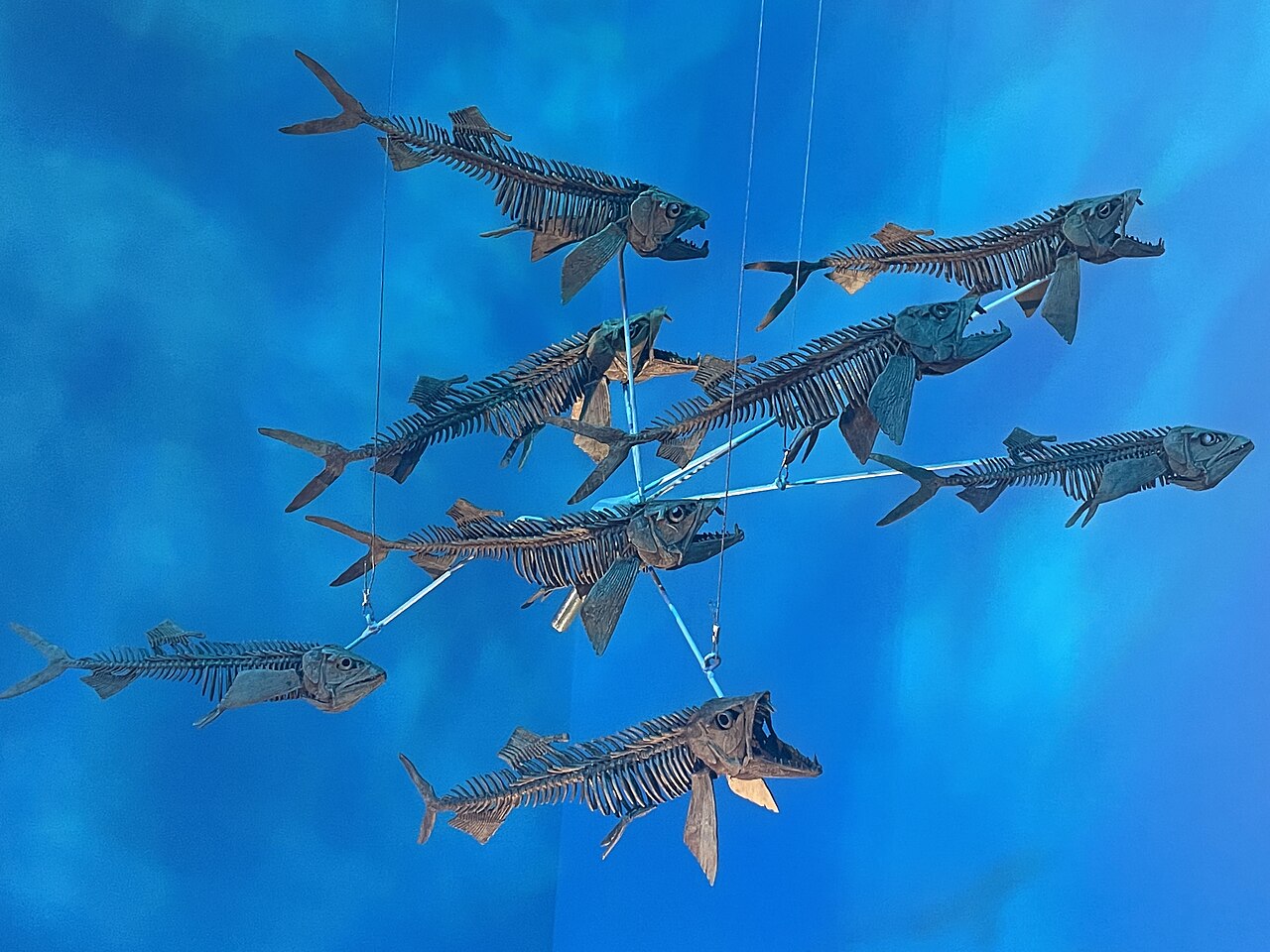
A large tooth can dominate an animal's reputation. In Enchodus, the impressive pair grew from bones called palatines, inside the roof of the mouth, with another enlarged tooth near the front of each lower jaw. These Cretaceous fishes carried their most conspicuous equipment well inside the bite.[2]
The arrangement invites an immediate question: where did all those points go when the mouth shut? A fossil fang displayed alone cannot answer it. A skull can preserve the spaces between teeth as well as the teeth themselves, and those spaces help restore the animal behind the trophy.
Room for the lower teeth
In June 2026, Luke Nelson, Alison Murray and Donald Brinkman described four Enchodus petrosus skulls from southern Alberta's Bearpaw Formation. They came from ammolite mines near Lethbridge and are about 74 million years old, from the Campanian stage of the Late Cretaceous.[3]
One skull retained enough depth to examine with CT scanning. The researchers found a recess in the premaxilla, an upper-jaw bone, that accommodated the lower fang. The tooth fitted into a hollow without passing through the bone. Earlier accounts had described a perforation in some related material; fragile bone can also acquire holes after death.[3]
These were substantial fish. Scaling the largest specimen's lower jaw against a more complete skeleton gave an estimated total length of roughly 1.5 metres. That estimate depends on comparable jaw-to-body proportions. The fossil preserves a large skull, not a complete fish laid out beside a tape measure.[3]
A different arrangement in Egypt
The genus contains more variety than its signature fangs suggest. In 2017, Waymon Holloway and colleagues described Enchodus tineidae from the Duwi Formation near Tineida, in Egypt's Western Desert. Its Late Cretaceous remains include both lower jaw bones and other parts of the head. The characteristic palatal tooth is missing.[4]
The lower jaws nevertheless preserve an unusually informative arrangement. A row of small teeth runs along the outside, while larger, flattened teeth occupy an inner row. Toward the back, the robust inner teeth form distinctive clusters. The jaw surface and the enclosed channel for a sensory system contribute further identifying features.[4]
Here, the rest of the mouth does the identifying. A fish can belong to a genus famous for one tooth even when that tooth has not survived. Looking along the jaw, rather than stopping at its tallest point, reveals differences between species that a generic reconstruction could easily smooth away.
The teeth that travelled furthest
For many finds, however, isolated teeth are all that remain. They reward close inspection.
Patrick Jambura and colleagues' 2024 study of Akkermanovka in Russia's Southern Urals distinguished several Enchodus forms in one Late Cretaceous assemblage. Teeth assigned to E. petrosus lacked a barb just below the tip and carried characteristic cutting edges. Shorter, more curved teeth with a small barb were tentatively compared with E. gladiolus. A fragment bearing a broken tooth represented E. ferox.[5]
The details matter because a pointed crown alone is a poor identity card. The researchers also separated other aulopiform fish teeth from Enchodus: enlarged bases and relatively hollow interiors contrasted with the dense construction and narrow internal cavities of enchodontid teeth.[5]
The exhibition mounts make the animal look immediately recognizable. A loose fang makes recognition a comparative exercise, working through curvature, edges, base and internal structure. Each additional feature offers another opportunity to test the first impression.
A hunter among larger hunters
What entered that mouth? A 2021 study led by Soledad Gouiric-Cavalli, describing teeth from Peru's Vivian Formation, summarized the ecological interpretation: skull shape and gape support a predator feeding probably on small fishes and cephalopods. The same synthesis places Enchodus between its prey and larger consumers, including other fishes, sharks and plesiosaurs.[2]
The teeth establish equipment; a particular menu requires further evidence. Even a formidable set of fangs offers no immunity from becoming someone else's meal. In the Cretaceous sea, the fish's role depended on the animals around it as much as on its own jaws.
Return to the skull and the long teeth look different. Their size still commands attention, but so do the recess that receives a fang, the smaller teeth beside it and the changing arrangement farther back. Together they give Enchodus a more specific presence: an animal whose mouth had to close, hold food and work as a whole.
Sources
- Eight heads serpent, “Enchodus petrosus 2.jpg” (2023) — exhibition photograph and provenance, CC BY-SA 4.0.
- Soledad Gouiric-Cavalli and colleagues, “The first Peruvian record of Enchodus in the Upper Cretaceous Vivian Formation,” Andean Geology 48 (2021), 303–315 — palatal teeth and ecological synthesis.
- Luke E. Nelson, Alison M. Murray and Donald B. Brinkman, “Description of large, well-preserved Enchodus specimens from the Bearpaw Formation of Alberta, Canada,” The Anatomical Record (2026) — PubMed record with full-text link.
- Waymon L. Holloway and colleagues, “A new species of the neopterygian fish Enchodus from the Duwi Formation,” Acta Palaeontologica Polonica 62 (2017), 603–611 — Egyptian jaw anatomy.
- Patrick L. Jambura and colleagues, “Fossil marine vertebrates from the Upper Cretaceous of Akkermanovka,” Cretaceous Research 155 (2024), 105779 — tooth anatomy and species assignments.