A shell's impression can outlast the sea floor that first buried it. In Suffolk, rounded sandstone nodules called boxstones preserve moulds of marine molluscs from deposits that have largely disappeared. Some of those nodules ended up inside the younger Red Crag. The animal died, sediment gathered and hardened around its remains, and erosion eventually released the resulting stone for another burial.[1]
That second journey changes the question a fossil can answer. Finding it in the Red Crag tells us where it came to rest. Establishing when it lived requires following the evidence farther back.
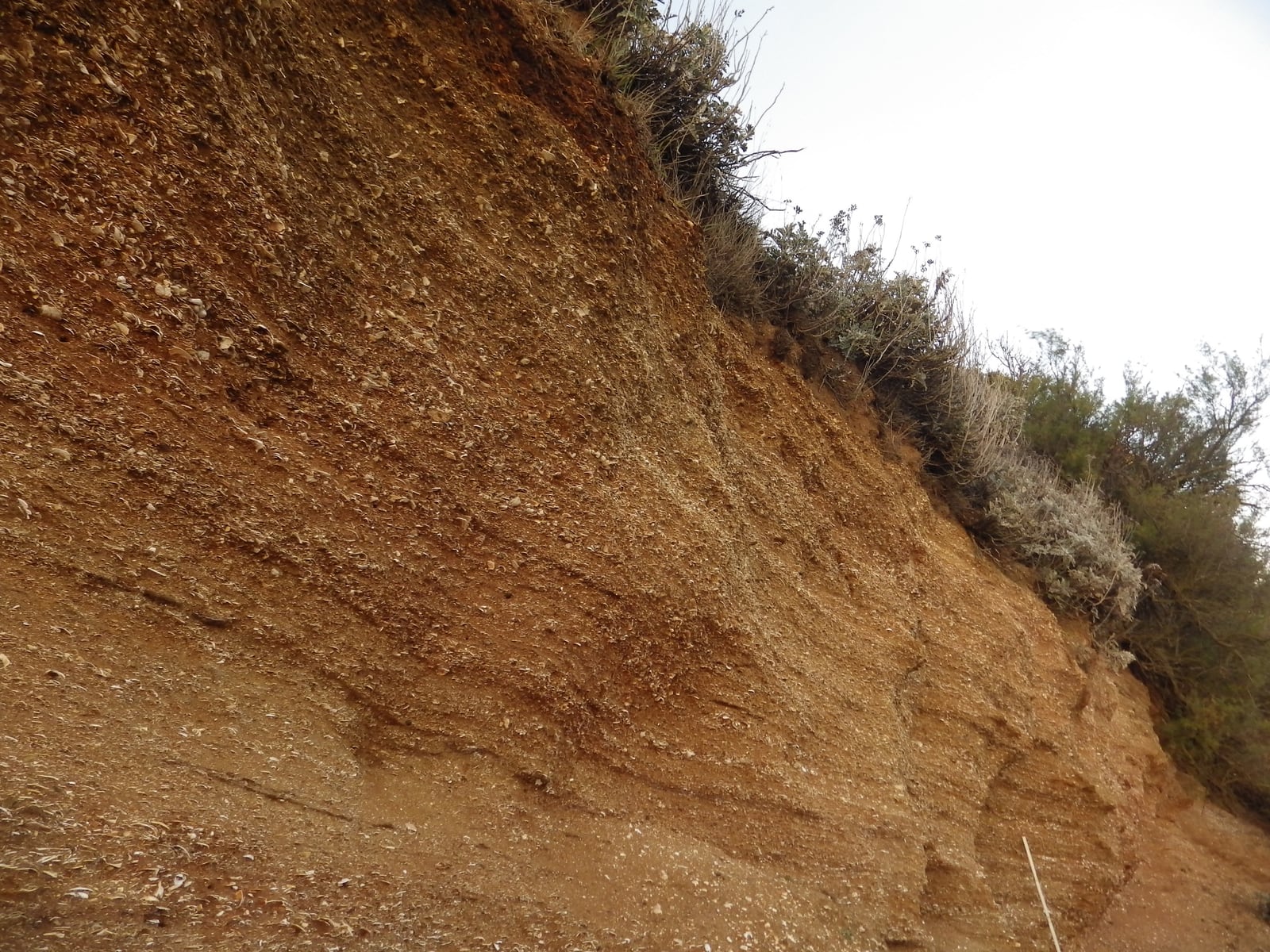
A younger sea gathers older remains
The Red Crag is a formation of shell-rich sands in eastern England and the southern North Sea basin. Its exposed deposits often have a rusty colour; below the reach of oxidation, the sands can remain dark green. The British Geological Survey describes a shallow marine deposit resting across an uneven geological inheritance: in different places, its base meets the older Coralline Crag, Palaeogene rocks or Cretaceous Chalk.[2]
Across the formation, deposition spans the Late Pliocene and earliest Pleistocene. Its inclined layers record sand moved into banks by tidal currents. At Bawdsey, the Geological Conservation Review describes a patchy layer of pebbles along the eroded contact with London Clay. Above it lie shelly sands whose internal layering records the movement of the younger sea.[3][5]
A fossil entering that setting could already have a long history. The International Stratigraphic Guide defines reworking as the erosion, transport and redeposition of fossils from older rocks into younger sediment. It treats these fossils separately from remains belonging to the receiving deposit's own fauna.[4]
Imagine loosening a fossil-bearing pebble from an old rock bed and dropping it into fresh sand. Neither the fossil nor its original enclosing stone becomes younger. A new relationship has formed around them. The sand records the latest deposition; the pebble retains evidence from before it.
The crowded layer at the bottom
The Red Crag's basal deposit brings several such histories together. Balson's chapter in the 1999 Geological Conservation Review traces many phosphatic mudstone pebbles, shark and ray teeth, and mineralized crabs and lobsters to the London Clay. Other components include Mesozoic belemnites and sandstone boxstones from a former Neogene deposit. One familiar name, the Suffolk Bone-Bed, covers an assemblage assembled from multiple sources.[3]
Reading that inventory as a single living community would put the animals into relationships the deposit cannot establish. A tooth beside a shell does not, by proximity alone, document a predator and its prey. Nor does their shared resting place establish that they occupied the same water temperature or even the same interval of geological time. These are consequences of the mixture, rather than reconstructions of a particular encounter.[4]
The physical association remains real. What changes is its meaning: the objects met during the history of sediment movement, potentially long after the organisms' lives had ended.
A small remnant of a missing bed
Boxstones make that distinction tangible. Mathers and Smith's 2002 BGS account describes them as sand cemented by phosphate and calcite, sometimes reaching about 20 centimetres across. They probably formed around decaying organic material, with large shell moulds at their centres. The authors considered a latest Miocene age probable for most, based on their fauna, while recognizing older material among the associated phosphatic remains.[1]
The lost source deposit has the informal name Trimley Sands. Its surviving nodules preserve both fossils and some enclosing sediment: small pieces of an earlier environment carried into later deposits. The age assigned to most boxstones should therefore not be applied automatically to every tooth or bone found beside them.[1]
This is the productive side of reworking. Erosion has damaged the original arrangement, yet the resistant pieces retain information. A nodule's sand and cement become part of the evidence alongside the impression of its shell. The reconstruction must work outward from those surviving pieces, accepting that their original positions may be unrecoverable.
When an old fossil points upstream
The same principle works at a much smaller scale. In the younger Chillesford Clay Member of the Norwich Crag Formation, the BGS regional synthesis records reworked Silurian acritarchs—microscopic organic-walled fossils. It interprets them as material probably carried from the Welsh Borders by the ancestral Thames, known in this context as the Kesgrave Thames.[5]
Those microfossils do not give the clay a Silurian age. They help identify rocks being eroded somewhere in the river's catchment. The inference depends on connecting the fossils with their likely source and a plausible transport route. Their very mismatch with the younger deposit makes them useful.[5]
At Suffolk's coast, a fossil can thus preserve two kinds of history: an organism's place in an earlier world and the later movement of material out of that world. A second burial may blur the first setting while carrying a fragment of it forward. The boxstone's shell mould survives inside that fragment, after the surrounding sea floor has gone.
Sources
- S. J. Mathers and N. J. P. Smith, Geology of the Woodbridge and Felixstowe district (British Geological Survey, 2002) — the Miocene section describes boxstone composition, inferred formation, age and the former Trimley Sands.
- British Geological Survey, “Red Crag Formation,” Lexicon of Named Rock Units — lithology, geographical extent and bounding formations.
- P. Balson, “The Red Crag,” in B. Daley and P. Balson, British Tertiary Stratigraphy, Geological Conservation Review 15 (JNCC, 1999) — chapter introduction, including the origins of the basal assemblage, and the Bawdsey Cliff site account, including the erosional contact and tidal deposits.
- International Subcommission on Stratigraphic Classification, “Biostratigraphic Units,” International Stratigraphic Guide, chapter 7 — definition of reworked fossils and their separate significance for age and environment.
- British Geological Survey, British Regional Geology: East Anglia (2015), “Late Neogene and Quaternary” — Red Crag depositional history and reworked Silurian acritarchs in the Chillesford Clay Member.
- Tall-timothy, “Red crag cliff at bawdsey cliff suffolk 30-10-2013,” Wikimedia Commons — original field photograph, taken 30 October 2013, CC BY-SA 4.0.