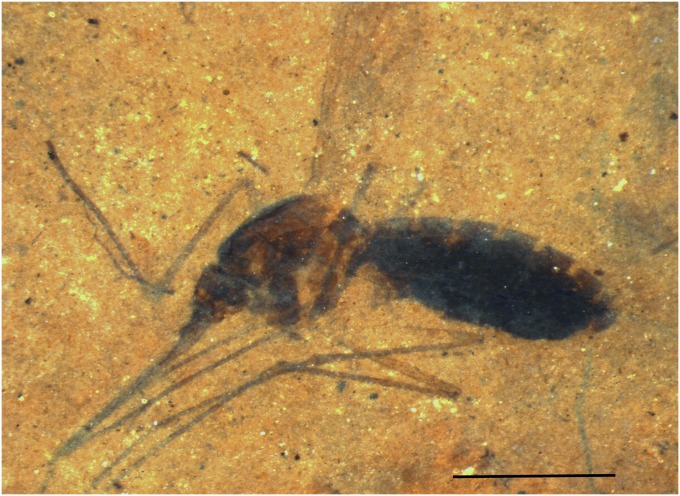
The abdomen draws the eye first: a dark, swollen oval, much heavier on the stone than the threadlike legs around it. The wings are pale and delicate. In this microscope photograph, one part of the insect seems almost overprinted. It is an invitation to wonder what the darkness contains.
This is USNM 559050, a female mosquito preserved in the roughly 46-million-year-old Coal Creek Member of Montana’s Kishenehn Formation. In 2013, Dale Greenwalt and colleagues reported chemical evidence of a blood meal inside it.[1] Reading the fossil means following that initial visual suspicion through a series of comparisons, then asking how such fragile evidence survived.
A mosquito with an incomplete name
The setting was an Eocene landscape of warm, wet conditions and extensive shallow water. In 2012, Ralph Harbach and Greenwalt described two mosquito species from its shale: Culiseta kishenehn and Culiseta lemniscata. Both were compression fossils, their bodies flattened in sediment. Their anatomy showed similarities to living groups within Culiseta.[2]
A name from the same deposit cannot simply be transferred to the blood-bearing specimen. A 2019 survey lists USNM 559050 separately as Culiseta? sp., retaining a question mark over its generic assignment. The two named species appear alongside it under different specimen numbers.[3]
That small punctuation mark deserves to survive the journey from scientific table to popular account. Identifying an insect precisely and identifying the contents of its abdomen are different tasks. One can remain provisional while the other gains strong experimental support. A spectacular result does not make every feature of a specimen equally legible.
The places where the signal disappears
Elemental analysis found roughly eight times as much iron in the female abdomen as in her thorax or a fossil male’s abdomen. Because fossilization can introduce iron, the researchers also tested for heme-derived porphyrins using mass spectrometry.[1]
The abdomen’s chemical signature resembled a hemoglobin reference sample; the other body regions and surrounding rock lacked it. The intact heme ion was absent, suggesting partial degradation.[1]
Each comparison asks the attractive explanation to survive a different objection. If the rock itself supplied the same signal, the insect’s meal would become harder to distinguish from its surroundings. If the male and female thorax matched the abdomen, the dark patch would lose its special status. The negative results help establish why this particular part of this particular body matters.
Heme is the iron-bearing component associated with hemoglobin’s oxygen-carrying function. In his accompanying commentary, paleontologist Derek Briggs explained that the protein portion of the meal’s hemoglobin was likely lost through decay. More durable chemical components could persist after that larger structure had broken down.[4]
The resulting claim concerns a chemical remnant. It does not require the blood to have remained fresh, liquid or microscopically unchanged. That distinction makes the finding more interesting: the past can remain recognizable even after much of its original material has disappeared.
The lake had to keep the abdomen together
Chemistry still needs a route into the rock. A distended mosquito would offer little resistance to rough handling; a plausible burial account must explain how it escaped being torn apart.
Greenwalt and colleagues’ 2015 study examined the broader insect assemblage and its sediment. Small aquatic insects, juveniles and water-flea resting egg cases pointed toward a shallow freshwater lake margin. More than 90 percent of the insects were intact. The fossils occurred in microbial mat layers within the laminated shale; the authors considered the mats possibly cyanobacterial and distinguished them from diatom-based deposits elsewhere.[5]
These mats offered a mechanism for enveloping delicate bodies. The study considered interactions at both the water surface and the sediment surface, leaving room for more than one preservation pathway.[5] That is a reconstruction of processes supported by the deposit, rather than an eyewitness sequence for this individual mosquito. We cannot follow its fall, descent and burial frame by frame.
The same study documented a pronounced bias toward very small insects.[5] Exquisite preservation therefore comes with a selective view of the ancient lake. The mosquito may be extraordinarily informative about one feeding event while remaining a poor guide to how frequently such events entered the fossil record. The conditions that kept it readable also helped decide which neighbors disappeared.
An old collection, a new question
The collection’s history began with fossil collecting along the Flathead River in the early 1980s. As Briggs recounts, Kurt Constenius and his family assembled fossils that were later largely donated to the Smithsonian. Their investigation continued long after they left the outcrop.[4]
There is something quietly consequential about that interval. A collection can preserve an opportunity before anyone knows which experiment will make use of it. The dark abdomen could be noticed, revisited and compared because the physical object remained available.
The blood evidence supplies no species name for the animal that was bitten. Nor does the study report recovered DNA.[1] Those missing answers leave plenty to look at. Return to the photograph: the wing, the legs, the concentrated darkness. What first appears to be a familiar insect in an unusually full state becomes evidence of a vanished encounter, carried forward by a few surviving chemical traces.
Sources
- Dale E. Greenwalt and colleagues, “Hemoglobin-derived porphyrins preserved in a Middle Eocene blood-engorged mosquito.” PNAS 110 (2013), 18496–18500 — specimen USNM 559050, analytical controls, degradation limits and photograph in figure 1.
- Ralph E. Harbach and Dale Greenwalt, “Two Eocene species of Culiseta (Diptera: Culicidae) from the Kishenehn Formation in Montana.” Zootaxa 3530 (2012), 25–34 — publisher’s abstract and opening page, describing the named species and geological setting.
- “Kishenehn Formation Diptera: Tables.” Palaeontologia Electronica (2019), table 2 — separate entries for the named Culiseta species and tentatively assigned specimen USNM 559050.
- Derek E. G. Briggs, “A mosquito’s last supper reminds us not to underestimate the fossil record.” PNAS 110 (2013), 18353–18354 — chemical preservation and the Constenius collection’s history.
- Dale E. Greenwalt and colleagues, “Taphonomy of the fossil insects of the middle Eocene Kishenehn Formation.” Acta Palaeontologica Polonica 60 (2015), 931–947 — lake setting, microbial mats, preservation pathways and size bias.