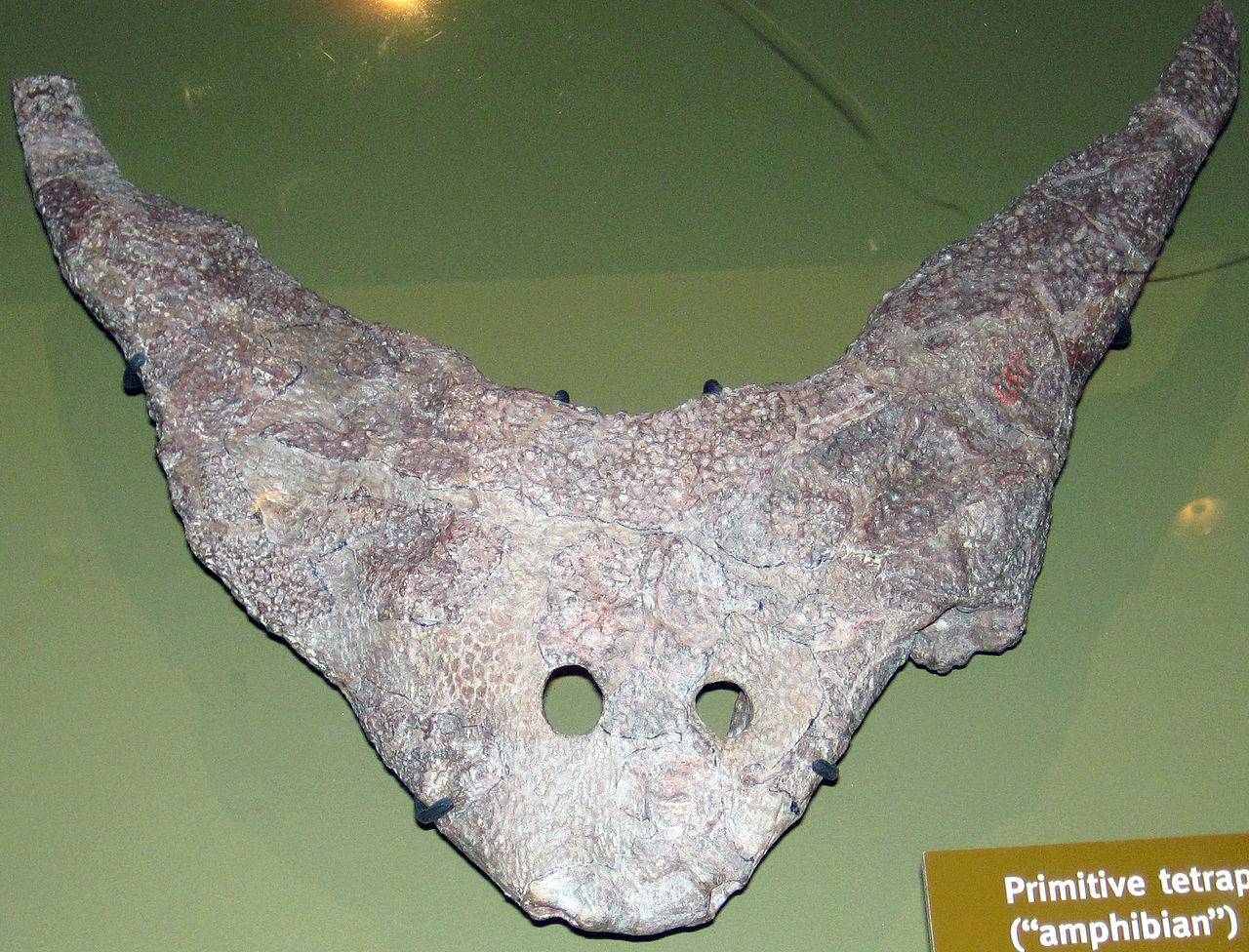
Diplocaulus magnicornis is one of those fossils that arrives in the mind too quickly. The head looks like a boomerang. The body, when reconstructed, looks low, long, and aquatic. The popular version almost writes itself: a strange Permian amphibian with a head so odd that the shape becomes the whole animal.
That shortcut is exactly what makes Diplocaulus worth slowing down. The skull is not a joke attached to a salamander-like body. It is a large, bony, growth-shaped structure in a Paleozoic tetrapod whose relationships, habitat, swimming mechanics, and predator risks all have to be kept separate before they can be put back together. The strongest reading is not "we know exactly what the head was for." It is narrower and better: the skull shape gives paleontologists a test case in how anatomy, development, fluid mechanics, and fossil context can constrain an explanation without turning it into certainty.
Image context: the cover uses a photographed fossil skull from the Lower Permian of Baylor County, Texas, originally identified as UC 637 and now housed at the Field Museum of Natural History.[6] It belongs here because the article is about the material skull itself. Reconstructions can decide too much in advance; the fossil keeps the argument attached to bone.
The specimen record starts with a skull, not a silhouette
The iDigBio mirror of the Smithsonian NMNH record for a Diplocaulus magnicornis skull is a useful modern anchor because it states the fossil in plain collection terms: a fossil specimen, USNM PAL617002, from Baylor County, Texas, in the Clear Fork Group's Arroyo Formation, Early Permian Leonardian age, classified under Amphibia, Nectridea, Keraterpetontidae.[1] Those labels do not solve the animal, but they keep the first layer honest. The famous shape is not free-floating iconography. It belongs to a specific Permian skull record from the red-bed world of north Texas.
That matters because Diplocaulus is often over-familiar in the wrong way. Calling it an "amphibian" is convenient, but it should not make readers imagine a modern frog or salamander enlarged and given novelty headgear. The animal sits among extinct Paleozoic lepospondyl-grade tetrapods, a set of small-to-medium early limbed vertebrates whose exact relationships to living amphibians and other tetrapod lines have long been debated. Ruta, Coates, and Quicke's early-tetrapod supertree paper is useful less as a final answer than as a reminder that lepospondyl branching and early tetrapod relationships remained areas of disagreement inside a much larger phylogenetic problem.[5]
So the first anatomical discipline is negative: do not let the living-animal comparison do the work. Diplocaulus had a flat, broad skull with long posterolateral extensions, short limbs relative to the body, and a body plan interpreted as strongly aquatic, but the fossil should be read as an extinct solution in its own setting, not as a familiar animal with a single exaggerated trait.
The horns are not a fixed adult logo
The second discipline is growth. E. C. Olson's 1951 study, Diplocaulus: A Study in Growth and Variation, treated the genus through a growth series rather than only through spectacular adult skulls.[2] That changes the whole interpretive mood. The tabular horns, which dominate the adult outline, are not simply present as a finished emblem from the start. They become important through skull growth.
Olson's discussion of skull-shape change emphasized that small skulls could look much less extreme, with the horn region developing as the animal grew.[2] In practical terms, this means the boomerang is partly an ontogenetic story. Adult Diplocaulus looks most alien because the back corners of the skull became proportionally important during growth. The structure was not just a taxonomic badge; it was a developmental trajectory written into the skull roof.
That point limits several easy explanations. If a feature changes strongly through growth, then its function may also have changed with size. A tiny juvenile and a full adult did not necessarily experience current, predators, feeding, or display in the same way. The adult horns may have affected swimming or predator handling, but the growth series warns against pretending that every life stage used the same structure in the same way.
It also turns the skull into evidence for method. Paleontology is often strongest when it replaces the question "What was this for?" with the slower question "When did it become this shape, and what else changed with it?" For Diplocaulus, that order matters. Shape first, growth second, function third.
Hydrodynamics is plausible, but not a permission slip for fantasy
The best-known functional idea is hydrodynamic. B. W. Skews's 2016 paper in the Journal of Applied Fluid Mechanics revisited the head as a fluid-mechanics problem, noting that Diplocaulus had long tabular horns similar in planform to aircraft wings and that earlier work had used wind-tunnel tests on a model head.[3] Skews then examined what happens when both head and body incidence vary, rather than treating the body as fixed at zero incidence.[3]
The result is more interesting than a simple "the head was a wing" slogan. Skews found conditions implying unstable motion and a high level of maneuverability, along with possible static equilibrium under particular orientations if tail thrust countered drag; the paper also had to make assumptions about body and head densities to consider buoyancy effects.[3] That last phrase is important. Fluid-mechanics models can sharpen an idea, but they are still models built from reconstructed geometry, assumed tissues, and simplified behavior.
The right conclusion is therefore bounded. The boomerang skull could have mattered in water. Its planform makes hydrodynamic testing reasonable. A broad head could have interacted with current, lift, pitch, and maneuvering in ways a narrow skull would not. But the model does not let us watch Diplocaulus hunt, surface, or steer. It tells us that the skull can be treated as a working surface, not that every behavior has been recovered.
That distinction keeps the animal alive scientifically. A gimmick skull asks for one cute answer. A hydrodynamic skull asks for constraints: angle, body posture, tail thrust, density, flow speed, and developmental stage. The fossil becomes less like a cartoon and more like a problem in extinct biomechanics.
A wide head may also be a predator problem
The simplest additional idea is mechanical rather than hydrodynamic: a very broad skull is hard to swallow whole. The fossil-image record used for this article notes that the skull shape has been interpreted both as a swimming aid and as a structure that could prevent predators from consuming Diplocaulus whole.[6] That second possibility should be handled carefully. It is not proof of one predator-prey scene. It is a plausible consequence of geometry.
Broad defensive shapes recur in living and extinct animals for a reason. A predator that relies on engulfing prey faces a gape problem. If the prey's widest rigid dimension is too broad, the attack becomes harder even when the prey is not armored in the usual sense. In Diplocaulus, the tabular horns made the skull dramatically wider than the body. That would have changed how the animal presented itself to any large Permian predator attempting a head-first swallow.
But predator defense cannot be isolated from hydrodynamics or growth. If the horns grew larger through life, then predator deterrence may have intensified with size. If the animal was aquatic, then the same broad surface that complicated swallowing may also have affected motion through water. A single structure can carry more than one selective consequence. The mistake is not proposing multiple functions; the mistake is pretending the fossil can rank them cleanly from one skull photograph.
Diplocaulids make the shape comparative, not unique magic
Diplocaulus also becomes clearer when it is not treated as the only animal in the room. Beerbower's 1963 monograph on Diploceraspis, a related Permo-Pennsylvanian diplocaulid, placed morphology, paleoecology, and phylogeny together across a broader horned-skull problem.[4] That comparison matters because it moves the discussion from "Why did this one animal have a boomerang head?" toward "How did related skull plans vary, and what do those variations imply?"
Comparative context is a guardrail. If related animals had different horn proportions, flange details, or skull outlines, then the function of the shape cannot be reduced to one universal answer. Differences among diplocaulids could reflect different habitats, flow regimes, predator pressures, growth trajectories, or phylogenetic inheritance. They could also preserve noise from sampling and preservation. The point is not to multiply speculation. It is to make speculation answer to anatomy.
That is why Diplocaulus works so well as an anatomy-and-method fossil. The skull is spectacular enough to demand explanation, but not transparent enough to reward overconfidence. Its meaning has to be assembled from specimen metadata, growth series, comparative diplocaulid anatomy, and model-based hydrodynamics.[1][2][3][4]
The best reading is useful because it stays incomplete
The most defensible Diplocaulus is not the one with the most dramatic reconstruction. It is the one that keeps four claims in order.
First, the animal was an extinct Permian nectridean with a materially preserved, very broad skull, known from real collection records rather than only from a famous outline.[1][6] Second, the adult boomerang shape was tied to growth, so function should be discussed with life stage in view.[2] Third, hydrodynamics is a serious hypothesis because the skull was a broad surface moving through water, but model results depend on assumptions and should not be inflated into behavioral certainty.[3] Fourth, related diplocaulids keep the discussion comparative, preventing Diplocaulus from becoming a one-animal myth.[4]
Once those boundaries are set, the skull becomes stranger in a better way. It may have helped the animal maneuver or manage lift. It may have made swallowing harder for predators. It certainly made growth, skull-roof anatomy, and aquatic biomechanics intersect in one unforgettable fossil. The boomerang is real, but it is not the explanation by itself.
That is the lasting value of Diplocaulus. It teaches a reader how to look at an extreme fossil without letting extremity become the whole argument. The head is not a gimmick. It is a preserved anatomical experiment whose best answers are partial, testable, and still attached to the rock.
Sources
- iDigBio portal record for Smithsonian NMNH specimen USNM PAL617002, "Diplocaulus magnicornis," Baylor County, Texas.
- E. C. Olson, "Diplocaulus: A Study in Growth and Variation," Fieldiana: Geology 11, no. 2 (1951), University of Illinois digitized PDF.
- B. W. Skews, "Hydrodynamics of an Extinct Amphibian," Journal of Applied Fluid Mechanics 9, no. 6 (2016).
- James R. Beerbower, "Morphology, paleoecology, and phylogeny of the Permo-Pennsylvanian amphibian Diploceraspis," Bulletin of the Museum of Comparative Zoology 130 (1963), BioStor record.
- Marcello Ruta, Michael I. Coates, and Donald L. J. Quicke, "Early tetrapod relationships revisited," Biological Reviews 78 (2003), PDF hosted by AmphibiaTree.
- Wikimedia Commons file page for the photographed Diplocaulus magnicornis skull used as the article image.