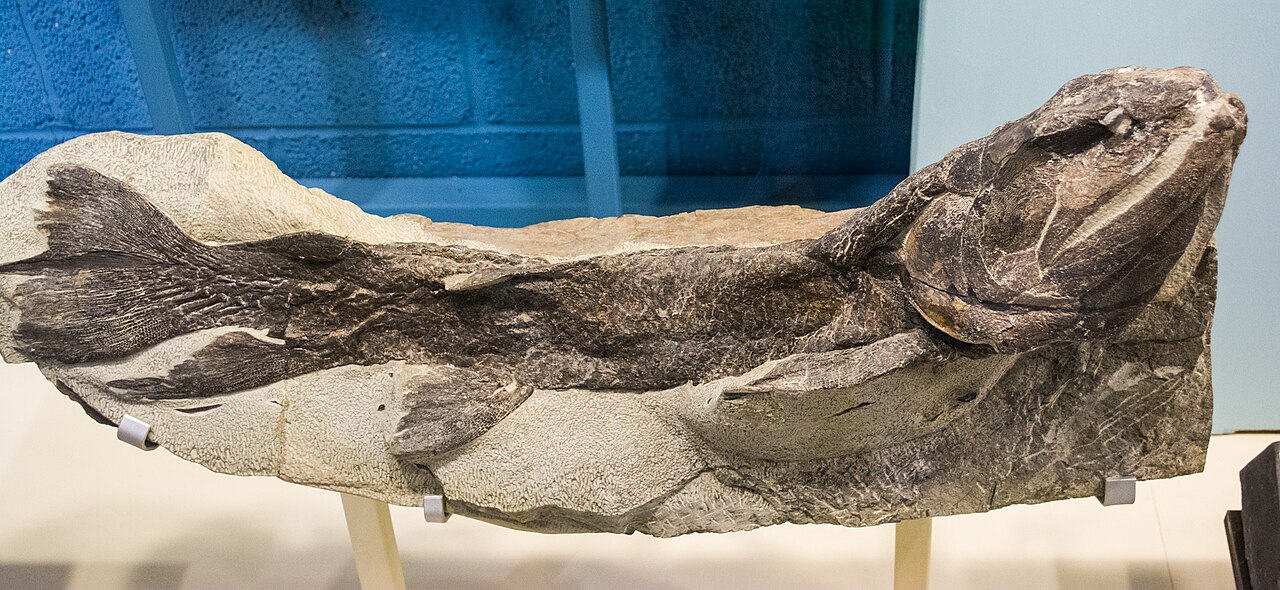
Eusthenopteron foordi has spent more than a century standing in for a scene it probably did not perform: a lobe-finned fish hauling itself out of the water on the way to becoming an amphibian. The body makes the story tempting. Its paired fins contain substantial internal bones. Its skull, jaws, teeth, and nostril pattern sit close to the ancestry of tetrapods. It comes from a Devonian fossil site famous precisely because the fish-to-tetrapod transition is unusually visible there.[2][3]
The better reading is more interesting. Eusthenopteron matters because it was not yet a land animal. It was a fully aquatic animal from the Late Devonian whose anatomy preserves several ingredients that later tetrapods would reuse, modify, and discard. Its value is not that it walked out of the sea like an evolutionary cartoon. Its value is that it shows how much of the limb story was already present inside a fish that still needed fins, scales, gills, and a swimming body.
Image context: the cover uses a real fossil photograph from Wikimedia Commons, showing an Eusthenopteron display specimen rather than a reconstruction.[1] That restraint matters. A reconstruction can smuggle in a posture, habitat, or behavior. A fossil photograph keeps the argument anchored in the material animal.
Miguasha made one fish unusually legible
The genus was named in the nineteenth century from the fossil fish deposits at Miguasha, on Quebec's Gaspe Peninsula. Canada's science-history account of the site notes that Geological Survey of Canada expeditions between 1879 and 1881 helped build the collection, and that Joseph Whiteaves named Eusthenopteron foordi in 1881 after Arthur Foord.[2] Miguasha later became a UNESCO World Heritage Site because the Escuminac Formation preserves an exceptional Late Devonian fish assemblage, including lobe-finned fishes central to the origin of tetrapods.[3]
That setting changes how the animal should be read. Eusthenopteron is not famous because one dramatic skeleton solved a transition. It is famous because Miguasha produced enough well-preserved material for repeated anatomical study. Abundance let researchers compare growth stages, skull details, fin bones, scales, and microscopic tissues rather than treating one specimen as a heroic missing link.
This is why the old linear diagram is misleading. A line from fish to amphibian makes Eusthenopteron look like a rung. Miguasha makes it look like a reference population inside a broader Devonian ecosystem. The animal belongs near the tetrapod stem, but "near" is not the same as "direct ancestor." Its anatomy helps locate a region of evolutionary possibility, not a single file path from water to land.
The fin already had limb-like bones, but it was still a fin
The most seductive feature is the pectoral fin. In broad terms, Eusthenopteron has a humerus-like proximal element followed by radius-and-ulna-like bones deeper in the fin skeleton, which is why the animal became central to twentieth-century stories about the origin of limbs. Clack's review of the fish-to-tetrapod transition describes Eusthenopteron as a long-known baseline for thinking about how a limb could evolve from a lobe-finned fish appendage, while placing it below more tetrapod-like forms such as Panderichthys and Tiktaalik.[4]
That hierarchy matters. A limb is not just an internal bone pattern. It is also a loss of fin rays, a change in joints, a change in muscles, a shoulder that no longer locks the head to the body, and a body plan that can handle substrate loading in new ways. Eusthenopteron had important endoskeletal pieces, but it still carried a webbed fin supported by dermal rays. It was not a hand waiting to be revealed.
The point is subtler than "fish had arm bones." The proximal skeleton shows that the raw architecture for a forelimb was older than terrestrial walking. But the distal fin still records aquatic function. Evolution did not simply add fingers to a generic paddle. It rebalanced two systems: the internal endoskeleton and the external dermal-ray fin web.
Fin rays keep the animal honest
Recent work on fin rays helps pull Eusthenopteron out of the mascot role. Stewart and colleagues compared pectoral fin rays in Sauripterus, Eusthenopteron, and Tiktaalik using CT data. Their study emphasizes that the fin-to-limb transition involved not only the origin of digits but also changes in dermal rays, which had often received less attention than the internal skeleton.[6] In Eusthenopteron, dorsal rays are only slightly larger than ventral rays; in Tiktaalik, asymmetry becomes much stronger and is tied to a fin that could better resist substrate-based loading.[6]
That contrast is a useful boundary. Eusthenopteron shows a fin with tetrapod-relevant internal bones, but its ray pattern does not yet look like the more specialized support system seen closer to digited forms. It belongs to the story before the story becomes a wrist.
The dermal skeleton also has its own history. Zylberberg, Meunier, and Laurin redescribed Eusthenopteron fin rays and scales under light, scanning, and transmission electron microscopy, showing jointed, branched lepidotrichia and scale tissues that differ from older thick rhomboid armor.[7] That detail matters because it keeps the animal from becoming only a skeleton-inside-the-fin diagram. The outside of the fish was evolving too. Fins, scales, swimming efficiency, and body covering were part of the same animal, not decoration around the future limb.
Bone marrow is a clue, not a prophecy
Microanatomy adds another layer. Sanchez, Tafforeau, and Ahlberg studied the humerus of Eusthenopteron and argued that its internal organization foreshadows aspects of tetrapod limb bone marrow.[5] It is a powerful result because it pushes the limb story below visible shape. The transition was not only about external form. It also involved growth, remodeling, vascular spaces, and the way a long bone handled its own tissue economy.
But even here, restraint is important. A humerus with tetrapod-relevant internal features does not make the whole animal a proto-salamander. It shows that some tissue-level properties of later limbs were emerging inside aquatic sarcopterygians. The fossil record is often strongest when it refuses to let one character carry the whole animal.
That is the recurring lesson of Eusthenopteron. The pectoral fin has limb-like internal bones, but it remains a fin. The humerus has important microanatomy, but the animal remains aquatic. The Miguasha site is central to tetrapod origins, but not every important fish there is a direct ancestor. Each statement is stronger when bounded.
The lineage is a branching map, not a ladder
The fish-to-tetrapod transition is easy to flatten because it has a direction readers recognize. We live on land, so land can start to look like the goal. Eusthenopteron corrects that bias. It was a successful Devonian predator or large fish in its own right, part of a fish-dominated world before terrestrial vertebrates became ecologically large. Its anatomy later became useful for explaining limbs, but it did not exist to prepare for us.
Clack's synthesis places Eusthenopteron, Panderichthys, Tiktaalik, and early tetrapods in a sequence of increasing tetrapod-like features, but the sequence is not a parade of ancestors.[4] It is a comparative scaffold. Eusthenopteron marks one combination: aquatic fish body, robust lobe-finned appendage, tetrapod-relevant skull and fin characters, and retained fin rays. Tiktaalik marks another combination. Early tetrapods mark still others. The transition becomes intelligible because the fossils overlap and differ, not because one turns into the next on command.
That is why Eusthenopteron is clearest when it stays in the water. Put it on land and it becomes a poor amphibian. Leave it in the Devonian water column and it becomes a better fossil: an animal with a fish's commitments and a tetrapod story inside some of its bones.
What the fossil teaches
The strongest lesson is about timing. The body plan that eventually produced wrists, digits, weight-bearing limbs, and terrestrial vertebrates did not appear all at once at the shoreline. Some of its parts were older, aquatic, and useful before walking. Internal fin bones could elaborate before fingers. Bone tissue could change before land locomotion. Dermal rays could remain functionally important while the endoskeleton became more complex.
That does not make Eusthenopteron less transitional. It makes transition less theatrical. Evolution often works by shifting the job of structures already present. A fin that once moved a fish through water can become the anatomical neighborhood from which a limb emerges, but only after many linked systems change together. Eusthenopteron is one of the fossils that lets those systems be separated.
The old image of a fish crawling toward destiny is too neat. The photographed fossil is better: a long-bodied Devonian animal, still fish-shaped, still finned, still scaled, but carrying evidence that the tetrapod limb did not begin at the water's edge. It began earlier, inside aquatic bodies that had no reason to know what their bones would later make possible.
Sources
- Tim Evanson, "Eusthenopteron - Cleveland Museum of Natural History," Wikimedia Commons file page and source photograph.
- Government of Canada, "36. Miguasha (1881)," History of the Geological Survey of Canada in 175 Objects.
- UNESCO World Heritage Centre, "Miguasha National Park" site description and Outstanding Universal Value.
- Jennifer A. Clack, "The Fish-Tetrapod Transition: New Fossils and Interpretations," Evolution: Education and Outreach 2 (2009).
- Sophie Sanchez, Paul Tafforeau, and Per E. Ahlberg, "The humerus of Eusthenopteron: a puzzling organization presaging the establishment of tetrapod limb bone marrow," Proceedings of the Royal Society B 281 (2014), SwePub record.
- Thomas A. Stewart, Justin B. Lemberg, Natalia K. Taft, Ihna Yoo, Edward B. Daeschler, and Neil H. Shubin, "Fin ray patterns at the fin-to-limb transition," PNAS 117, no. 3 (2020), Penn State research record.
- Louise Zylberberg, François J. Meunier, and Michel Laurin, "A microanatomical and histological study of the postcranial dermal skeleton in the Devonian sarcopterygian Eusthenopteron foordi," Acta Palaeontologica Polonica 55, no. 3 (2010).