Nectocaris pteryx is stronger as a fossil after it loses the cleanest label. For a while, the best public sentence called it a Cambrian squid-like animal: a small Burgess Shale predator with camera-type eyes, two forward tentacles, lateral fins, gills, and a funnel that seemed to push cephalopod history deep into the Middle Cambrian.[1][2] That sentence was exciting because it made the animal familiar. It was also fragile because every familiar word carried a modern body plan behind it.
The sharper profile in 2026 is less tidy. Nectocaris still matters because it preserves a coherent swimming animal from about 505 million years ago, not because it can be turned into a primitive squid without remainder.[1] The 2025 description of Nektognathus evasmithae, a related nectocaridid from Sirius Passet, pushes the whole group toward a stem-chaetognath reading by adding neural and jaw evidence that the Burgess specimens themselves did not make obvious.[5] That does not make Nectocaris less interesting. It makes the fossil more honest: a body plan that looked cephalopod-like may instead record an extinct branch near arrow worms, where predatory anatomy was broader and stranger than living chaetognaths suggest.[5]
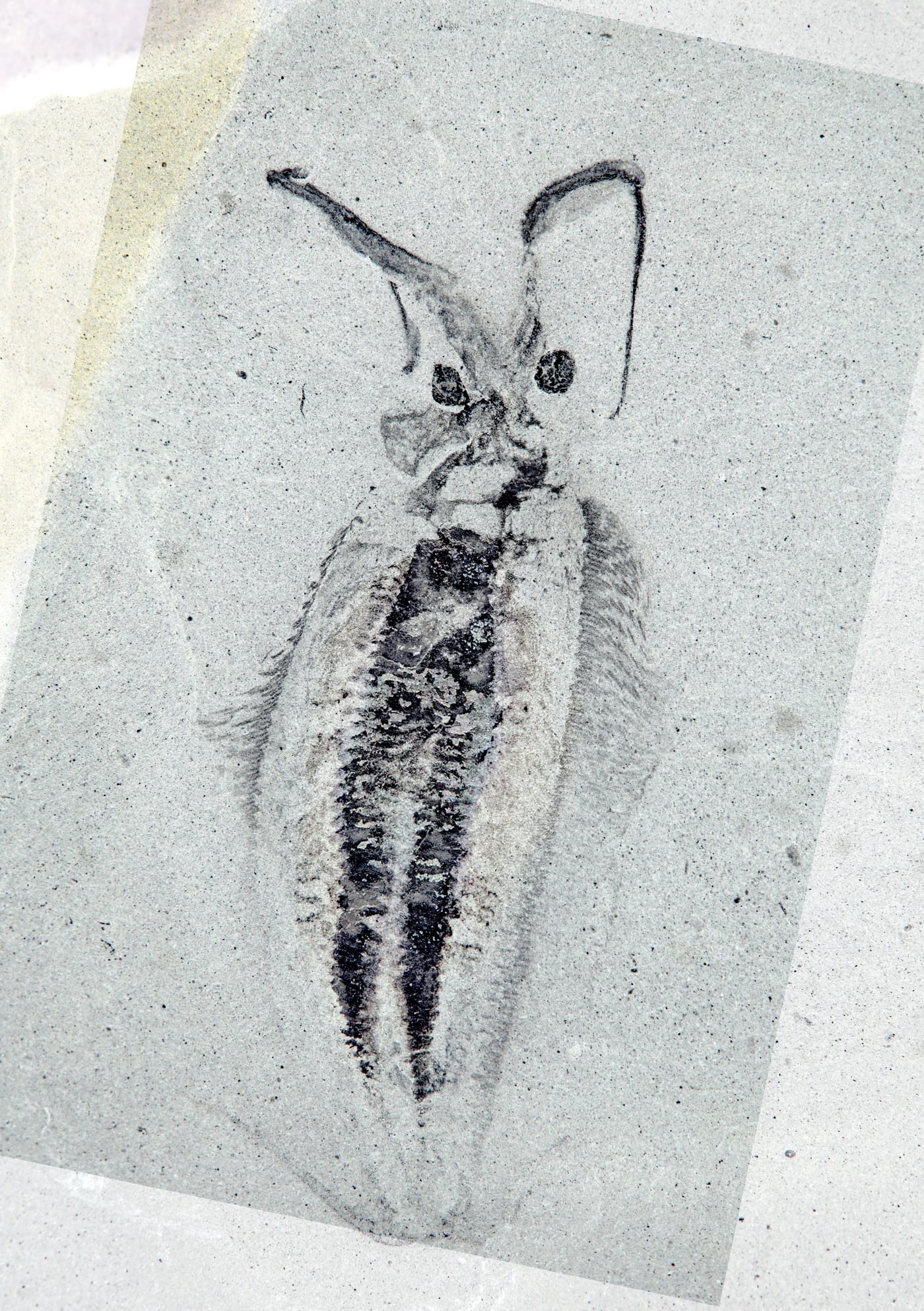
Image context: the cover uses the real ROM 60079 fossil photograph from Wikimedia Commons, sourced from Martin R. Smith's Dryad data release.[6] It belongs here because this profile is about evidence under revision. The specimen is not a reconstruction of a squid, a diagram, or a generated animal. It is a flattened fossil whose details have carried several competing interpretations.
The old squid reading had real evidence
The 2010 Nature paper by Martin Smith and Jean-Bernard Caron was not a casual overreach. It replaced a nearly solitary, confusing fossil with a much larger sample from the Royal Ontario Museum collections, and it tried to make sense of an animal whose preserved structures did not fit easily inside older categories.[2] Nature's editorial summary captured why the claim landed so strongly: the available material showed paired eyes, flexible tentacles, a nozzle-like funnel, and a swimming body, with two tentacles rather than the eight or ten arms expected in living coleoids.[2]
The ROM's Burgess Shale page still preserves that interpretation in public form. It describes Nectocaris as a squid-like predator with a kite-shaped body, paired camera-type eyes on short stalks, two flexible tentacles, lateral fins, a funnel under the head, and paired gills inside a large axial cavity.[1] It also gives the useful specimen scale: known Burgess material reaches up to 72 mm including tentacles, with about 90 specimens from Fossil Ridge and only two from Walcott Quarry, including the holotype.[1]
That anatomy explains why the cephalopod hypothesis was attractive. A funnel looks like jet-propulsion plumbing. Tentacles look like prey-grabbing equipment. Eyes and fins make sense on a mobile predator. If one starts from living squid and works backward, Nectocaris offers a tempting early, shell-less version of the package.[1][2]
But that backward path was exactly the risk. A Cambrian fossil can resemble a modern animal in function without belonging to that modern animal's lineage. Similar jobs can build similar-looking tools.
The first resistance was about sequence
The skepticism arrived quickly because the proposed evolutionary order was hard to swallow. Mazurek and Zatoń's 2011 Lethaia note put the question directly: is Nectocaris pteryx a cephalopod?[3] Their challenge mattered because cephalopods had generally been understood through shelly early forms, with the mineralized shell playing a central role in the group's early history. A soft, shell-less, squid-like animal in the Middle Cambrian seemed to invert that sequence.
That objection does not prove the 2010 paper wrong by itself, but it identifies the problem the fossil had to solve. If Nectocaris was a stem cephalopod, then shelllessness and a coleoid-like swimming body had to be placed very early, before the familiar shelly cephalopod record. If it was not a cephalopod, then the funnel, tentacles, eyes, and fins had to be explained as another lineage's solution to predation and swimming.[2][3]
Smith's 2013 Paleobiology paper widened the question from one species to a nectocaridid body plan across Canada, China, and Australia.[4] Its abstract is careful in a way that still helps: whether the construction reflected common ancestry or deep convergence, the body plan showed rapid occupation of nektobenthic niches after the Cambrian explosion.[4] That is a useful middle step. Even before the 2025 revision, the fossil could be important without the word "cephalopod" doing all the work.
Nektognathus changed the evidence layer
The 2025 Science Advances paper changes the profile because it adds a different kind of character. Vinther, Parry, Lee, Park, and colleagues described Nektognathus evasmithae from the early Cambrian Sirius Passet Lagerstatte of North Greenland, about 519 million years old.[5] Key specimens preserve paired phosphatized arcuate structures that the authors interpret as a ventral ganglion, a feature characteristic of living and fossil chaetognaths.[5]
That is not a small correction. A funnel-like structure can invite functional analogy. A preserved nervous-system feature pulls on deeper anatomical identity. The paper also reports a gnathostomulid-like jaw apparatus, lateral fins, a subterminal anus, and large antennae shared with Timorebestia and Amiskwia, placing nectocaridids on the chaetognath stem lineage.[5] In other words, the new evidence does not merely say "not squid." It offers a new neighborhood.
The result is a better profile of Nectocaris because it separates resemblance from relationship. The animal can remain a mobile Cambrian predator with striking eyes, tentacles, fins, gills, and a funnel-like structure.[1][2][4] It no longer has to carry the origin story of cephalopods if a stem-chaetognath placement explains the broader nectocaridid anatomy more coherently.[5]
The animal becomes stranger, not smaller
The most common mistake after a taxonomic revision is to treat the fossil as demoted. That is backward here. If Nectocaris is not the earliest squid, it stops being a misleading prologue to cephalopods and becomes evidence for another lost Cambrian predator experiment.
Living chaetognaths are mostly small, pelagic arrow worms, important in zooplankton food webs but visually easy to underrate. The 2025 paper argues that their early relatives included larger, more diverse pelagic predators with complex sensory anatomy, long sensory appendages, and well-developed lateral fins.[5] That frame makes Nectocaris more interesting than a failed squid. It suggests that the early chaetognath total group may have been ecologically bolder than its living remainder implies.
That is the right way to keep the fossil. Nectocaris is a warning against making extant animals the full template for extinct lineages. Modern cephalopods are not the only animals that can evolve eyes, forward appendages, fins, and active predation. Modern chaetognaths are not the full measure of what their stem relatives could look like. The Cambrian record repeatedly punishes both habits.
A good profile keeps the uncertainty visible
The strongest current reading is therefore layered. High confidence: Nectocaris pteryx is a rare but well-sampled Burgess Shale animal from Fossil Ridge, with a small swimming body, paired eyes, tentacles, fins, funnel-like anatomy, and gill traces described from multiple specimens.[1][2] Medium-to-live revision: the older stem-cephalopod interpretation was reasonable under the sample and comparisons available in 2010, but it was always vulnerable because it required an unusual early shell-less cephalopod sequence.[2][3][4] New pressure: related nectocaridids now carry neural and jaw evidence that strongly shifts the group toward stem chaetognaths.[5]
That sequence is why Nectocaris still earns attention. It is not a fossil whose story collapsed. It is a fossil whose story improved by losing a too-clean headline. The first-squid label made it famous. The chaetognath revision makes it more useful. It shows how a Cambrian problematicum becomes sharper when more specimens, more anatomical layers, and more willingness to revise the category arrive.
The best final sentence is not that Nectocaris was a squid, and not simply that it was an arrow worm. It was a nectocaridid: a small, active Cambrian predator whose body forced paleontologists to discover that resemblance, ecology, and ancestry can point in different directions before a better fossil pulls them back into order.[1][4][5]
Sources
- Royal Ontario Museum, "Nectocaris pteryx" on The Burgess Shale site - specimen photographs, morphology, locality, abundance, and the 2010 stem-cephalopod interpretation.
- Martin R. Smith and Jean-Bernard Caron, "Primitive soft-bodied cephalopods from the Cambrian," Nature 465 (2010).
- Dawid Mazurek and Michał Zatoń, "Is Nectocaris pteryx a cephalopod?" Lethaia 44, no. 1 (2011), CiNii Research record with DOI.
- Martin R. Smith, "Nectocaridid ecology, diversity, and affinity: early origin of a cephalopod-like body plan," Paleobiology 39, no. 2 (2013), Cambridge Core PDF.
- Jakob Vinther, Luke A. Parry, Mirinae Lee, et al., "A fossilized ventral ganglion reveals a chaetognath affinity for Cambrian nectocaridids," Science Advances 11, no. 30 (2025), University of Bristol research record.
- Wikimedia Commons file page for the photographed Nectocaris pteryx specimen ROM 60079 used as the article image.