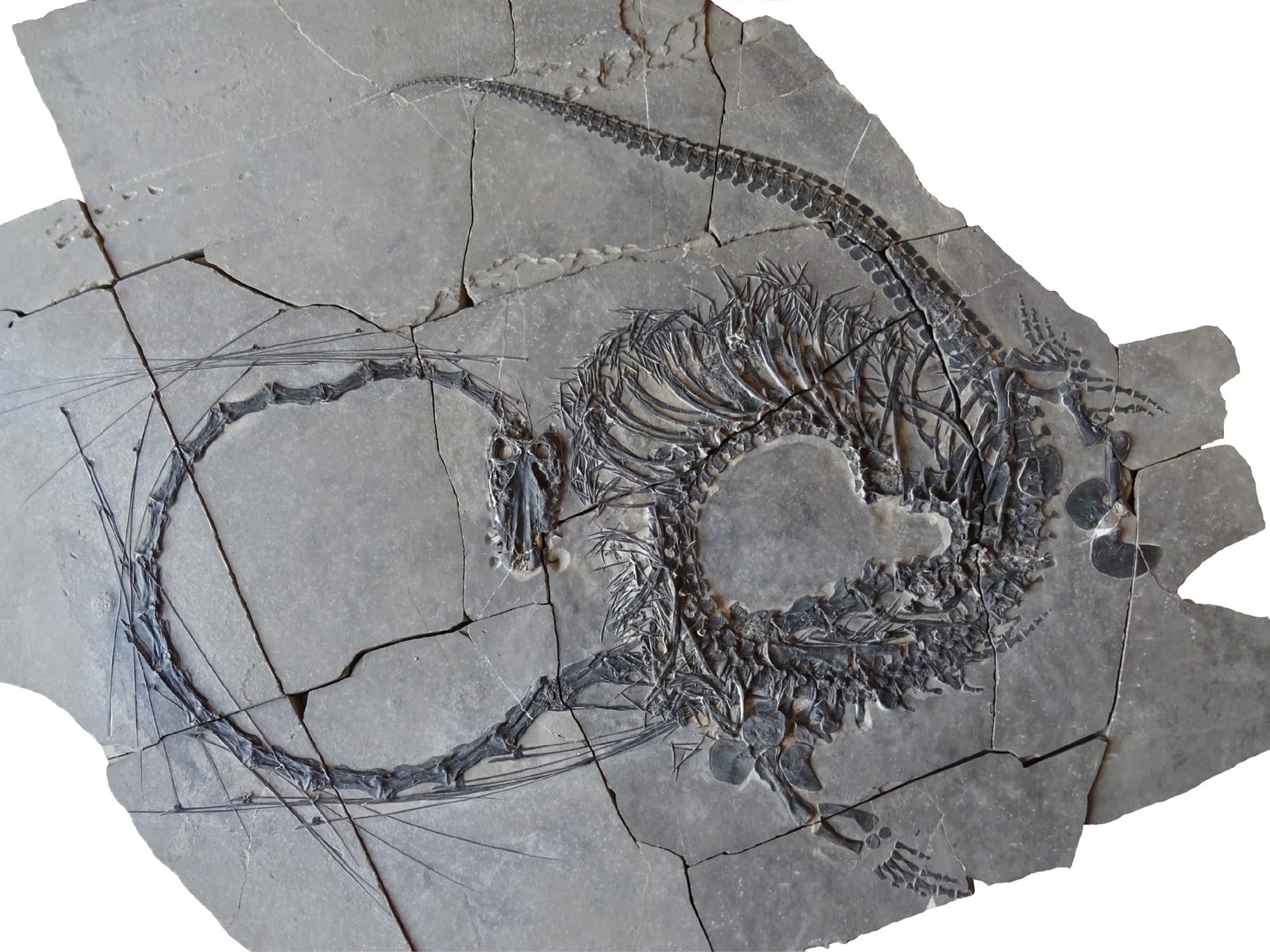
Start at the small head and follow the vertebrae. The neck travels so far around the slab that the rib cage seems to belong to another animal. Short limbs interrupt the outline; a tapering tail completes the sweep. In Nicholas Fraser's photograph of Dinocephalosaurus orientalis, the difficulty is keeping track of which part of the skeleton your eye has reached.[2]
The spectacular coiled specimen, IVPP V20295, preserves the entire tail along with its skull, neck and trunk.[1] That continuity invites us to imagine movement. But a body preserved in a loop does not supply a swimming stroke. Reading this fossil means following the skeleton while resisting the animation that comes so readily with it.
The outline took decades
Dinocephalosaurus lived in Middle Triassic seas in what is now southern China, roughly 240 million years ago. It was identified in 2003; the fuller account announced in February 2024 followed a decade of work involving researchers in China, Scotland, Germany and the United States. Additional specimens, including a fully articulated skeleton, made the whole animal available for comparison.[3]
The distinction between naming an animal and understanding its proportions matters here. A skull can establish a taxon while leaving much of its body unknown. A connected skeleton answers another kind of question: how do the head, trunk and appendages fit together? Further specimens then test whether that arrangement belongs to the animal or to the accidents of one burial.
The material examined for the 2024 work is held in Beijing and at the Zhejiang Museum of Natural History in Hangzhou.[2] The public image compresses a distributed collection and years of comparison into one apparently immediate encounter. Its clarity was earned across specimens.
The neck is longer than its explanation
The neck contains 32 vertebrae. National Museums Scotland compared the animal with Tanystropheus, another long-necked Triassic reptile with fish-catching teeth, while emphasizing the much greater number of vertebrae in Dinocephalosaurus.[3] Similar silhouettes can conceal different construction.
Look beneath the neck vertebrae and the apparent flexibility becomes less straightforward. Long cervical ribs run lengthwise, crossing several joints and stiffening the neck. Its length therefore cannot be read as permission to bend freely in every direction.[1]
The 2024 study challenges an earlier suction-feeding hypothesis: long, curved teeth obstruct the mouth, and no strongly ossified throat apparatus is known. The authors favour a snapping bite, possibly sideways, by comparison with Tanystropheus. That remains a functional hypothesis; the bones do not preserve the strike.[1]
That distinction gives the neck its scientific interest. Counting its components is comparatively secure. Reconstructing their range of motion requires joints and soft tissues. Explaining why such an extraordinary reach evolved requires an ecological argument as well. Each step asks more of the evidence than the previous one.
A meal and a pregnancy
Flipper-like limbs and fish preserved in the stomach region support an aquatic, fish-eating way of life.[3] A meal brings the animal closer: something passed from the surrounding sea into this body. Yet stomach contents establish consumption more directly than capture technique. They cannot choose between every plausible hunting motion.
A different specimen carries evidence about reproduction. LPV 30280, collected at Luoping in Yunnan and described by Jun Liu and colleagues in 2017, contains a small, incomplete Dinocephalosaurus skeleton within its abdomen. The team identified it as an embryo through several converging observations. It lies within the adult's body, curls in an embryonic posture and points neck-forward. A swallowed fish in the same adult points the other way, providing a particularly useful comparison with actual prey.[4]
The embryo has well-developed bones, but no calcified eggshell surrounds it. Together these findings support live birth. The authors acknowledge that failure to preserve a shell cannot be excluded; their conclusion rests on the combination, rather than that absence alone.[4]
The 2024 reassessment retains an important qualification: LPV 30280 belongs to Dinocephalosaurus, but cannot confidently be assigned to D. orientalis.[1] The pregnant animal also is not the coiled skeleton pictured here. Keeping the specimens separate lets their evidence accumulate without inventing one impossibly informative fossil.
Resemblance has a history of its own
The long neck and aquatic body may suggest a plesiosaur, but Dinocephalosaurus belongs among early archosauromorphs, on the broader reptile branch that includes crocodilians and birds. It is neither a plesiosaur nor a dinosaur. A separate March 2024 study linked it with the German fossil Trachelosaurus and revived the older family name Trachelosauridae in place of Dinocephalosauridae.[5]
That revision shows another use for a well-understood skeleton: it can make old, disarticulated material intelligible. Features once difficult to place become comparable when another fossil preserves how the parts connect. Classification changes through those anatomical comparisons, not through resemblance to a familiar sea monster.[5]
Return to the photograph and the outline becomes richer without becoming fully animated. We can distinguish a connected skeleton, a proposed feeding motion and reproductive evidence carried by another individual. The pleasure of following this neck is that the animal keeps becoming more specific, even where its movements remain out of reach.
Sources
- Stephan N. F. Spiekman et al., “Dinocephalosaurus orientalis Li, 2003: a remarkable marine archosauromorph from the Middle Triassic of southwestern China,” published online in 2024—specimens, cervical ribs, feeding hypotheses and the identity of LPV 30280.
- State Museum of Natural History Stuttgart, “Paleontologists present a 240 million year old ‘Chinese dragon’,” 23 February 2024—collection context and the fossil photograph credited to Nicholas C. Fraser.
- National Museums Scotland, “Palaeontologists reveal a 240-million-year-old ‘Chinese Dragon’,” 23 February 2024—research history, neck vertebrae, aquatic limbs and preserved fish.
- Jun Liu et al., “Live birth in an archosauromorph reptile,” Nature Communications, 2017—LPV 30280, embryo identification, comparison with ingested prey and the evidence for live birth.
- Stephan N. F. Spiekman et al., “A redescription of Trachelosaurus fischeri from the Buntsandstein (Middle Triassic) of Bernburg, Germany,” Swiss Journal of Palaeontology, 2024—European material, evolutionary relationships and the priority of Trachelosauridae.