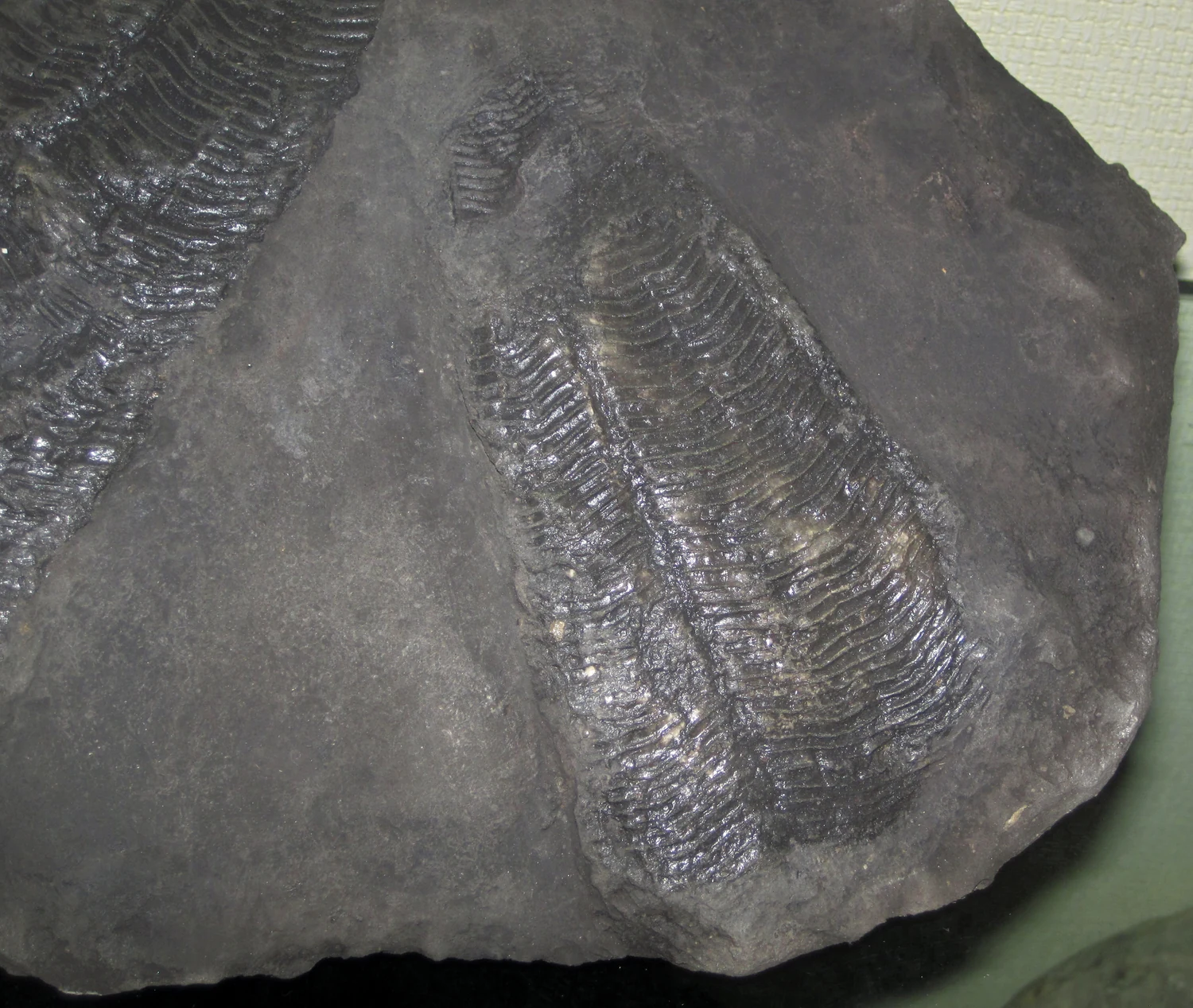
A conulariid looks built. Its tapering outline, grooved corners and repeated ribs suggest a miniature architectural model, all edges and surfaces. The animal inside belonged to the cnidarians, the group that includes jellyfish. Yet the familiar image of a drifting, transparent bell is a poor starting point for understanding this extinct inhabitant of the seabed.[1]
The surprise is in the covering. A conulariid's mineralized pyramid could be flexible. Some fossils preserve its broad opening folded shut; others record a change of direction as the animal grew. Getting to know the group means letting a seemingly rigid object acquire a little movement.[3][5]
A pyramid with a soft occupant
The photograph shows Conularia gratiosa from Indiana's Salem Limestone, of Middle Mississippian age. These specimens were photographed in the geology department's display at Wittenberg University in Ohio. Their repeated ridges make the external construction easy to appreciate, while leaving the soft occupant out of sight.[2]
Paleontologists call this outer covering the periderm. In a 2016 study, Robert Ford, Heyo Van Iten and George Clark examined sections of Conularia and Paraconularia using light and electron microscopy. The wall contained extraordinarily thin layers, approximately 0.5–3 micrometres thick, alternating between relatively organic-rich and organic-poor material. Calcium phosphate supplied the mineral component.[3]
That layered construction changes the meaning of a fossil's hardness. The rock specimen in a collection has undergone burial and alteration; its feel today cannot simply be projected back onto the living animal. Ford and colleagues also examined thin-walled conulariids with folded openings. In Archaeoconularia slateri, internal ridges bent smoothly through more than a right angle. The combination of microscopic structure and large folds supported an originally flexible covering.[3]
There is more to the cone than its outline. Its material properties belong in any reconstruction of the animal.
Broad end up
How did this improbable body occupy the seafloor? Some of the strongest evidence comes from fossils that retain their relationship to the sediment around them.
In a 2013 study of the Middle Devonian Mount Marion Formation in eastern New York, Van Iten and colleagues described unusually abundant Conularia preserved in successive burial deposits. Their broad openings faced obliquely upward. Some individuals stood almost perpendicular to the sedimentary layers, with their narrow ends resting on fine bottom sediment.[4]
The authors interpreted them as upright or partly upright inhabitants of the bottom, sometimes partly embedded in it. Storm-derived sediment occasionally smothered this community. These are conclusions tied to a particular population and its burial setting, rather than a single compulsory pose for every conulariid.[4]
A few specimens occurred in pairs or small radial clusters. The arrangement invites a story about reproduction or shared attachment, but their narrow ends showed no direct connection between the coverings. The investigators left the origin of the clusters unresolved. Proximity is an observation; a colony is an additional claim.[4]
Growing around a bend
In 2024, Jana Bruthansová and colleagues studied 89 specimens of Conularia fragilis from the Lower Devonian Prague Formation in the Czech Republic. Many were bent, with altered rib patterns accompanying their changes in direction.[5]
A crooked fossil alone cannot establish a crooked living animal: sediment can deform a carcass. Here, the microscopic layers continued through the bends without a break in their growth. The authors concluded that the changes occurred during life. They proposed that adding more material along one side of the growing opening could redirect the expanding cone.[5]
Changing currents or movement of the sandy substrate were possible triggers. The stronger finding is that growth continued through the bend; the fossils do not record the exact disturbance that prompted it.[5]
The missing animal comes into view
Rare internal preservation is beginning to put anatomy inside the outline. In 2023, Consuelo Sendino and colleagues used X-ray micro-CT to investigate Pennsylvanian conulariids from Texas and Oklahoma. They identified structures as longitudinal muscle bundles, and in some specimens a possible gastric cavity. The bundles ran along the covering toward its opening, sometimes joining in V-shaped pairs.[6]
Another 2023 study examined two specimens of Metaconularia manni from Iowa's Silurian Scotch Grove Formation, now held at the University of Wisconsin Geology Museum. Silica preserved small internal structures. The researchers interpreted paired pouches and associated tubes in one specimen as reproductive organs and retractor muscles, comparing their arrangement with living cnidarians.[1]
That interpretation carries a striking possibility: at least this species may have reproduced sexually in its bottom-dwelling form, without a separate free-swimming jellyfish stage. It remains a hypothesis derived from exceptional specimens, not a complete life cycle observed in stone.[1]
The ribbed pyramid therefore holds several kinds of information. Its folds reveal material behavior, its position in sediment constrains posture, and its rare internal traces offer a route toward the animal itself. Look again at the photograph and the ridges become more than surface ornament: they belonged to a covering that grew around a living body.
Sources
- Heyo Van Iten and colleagues, “Conulariid soft parts replicated in silica from the Scotch Grove Formation (lower Middle Silurian) of east-central Iowa,” Journal of Paleontology 97 (2023), 961–970 — cnidarian affinities, specimens UWGM 6834 and 6835, internal structures and the life-cycle interpretation.
- James St. John, “Conularia gratiosa … 1.jpg,” Wikimedia Commons (photographed 2018) — specimen photograph, Salem Limestone provenance and Wittenberg University display; CC BY-SA 4.0.
- Robert C. Ford, Heyo Van Iten and George R. Clark II, “Microstructure and composition of the periderm of conulariids,” Journal of Paleontology 90 (2016), 389–399 — microscopic layering, mineral composition and folded apertures.
- Heyo Van Iten and colleagues, “Life mode of in situ Conularia in a Middle Devonian epibole,” Palaeontology 56 (2013), 29–48 — New York specimens, life orientation, clusters and storm burial.
- Jana Bruthansová and colleagues, “Underwater drunken forest: Changes in growth direction and ornamentation in Conularia fragilis Barrande, 1867 (Lower Devonian, Czech Republic),” Palaeontologia Electronica 27 (2024), a54 — growth through bends and proposed environmental responses.
- Consuelo Sendino and colleagues, “Internal conulariid structures unveiled using µCT,” PalZ 97 (2023), 451–467 — muscle bundles and a possible gastric cavity in Pennsylvanian specimens.