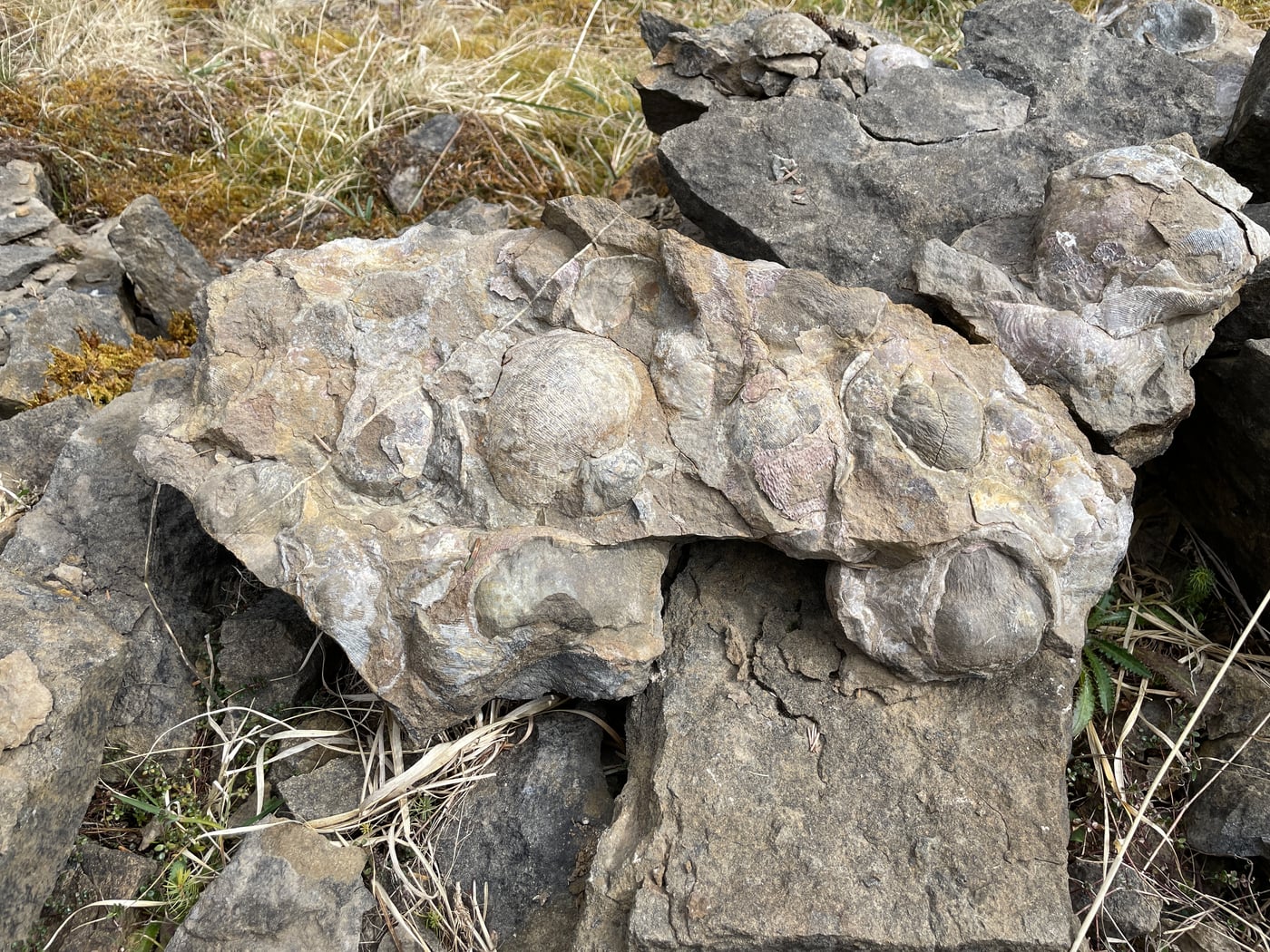
A fossil shell from an ancient seabed can return a temperature that would make a poor home for its original inhabitant. In a 2015 study of Nevada’s Carboniferous Bird Spring Formation, brachiopod shells yielded an average clumped-isotope temperature of 153°C. The researchers interpreted that heat through the rocks’ long burial and cooling history.[1]
The measurement was answering a real geological question. It just belonged to a different chapter of the shell’s existence.
That is the fascination of clumped-isotope thermometry: a fossil contains a record finer than its ribs, growth lines or crystal texture. The arrangement of rare atoms can preserve the warmth of the water in which a shell grew. Recovering that information means establishing when the arrangement was set—and what may have changed it afterward.[2][5]
Counting partners inside a crystal
The familiar oxygen-isotope approach to ancient temperature has a complication. A shell’s oxygen-isotope composition depends on both its growth temperature and the isotopic composition of the surrounding water. If the water is gone, one measurement leaves two quantities to disentangle.[3]
Clumped isotopes offer another way in. Carbon and oxygen each occur in lighter and heavier forms. Within carbonate minerals, the heavy isotopes carbon-13 and oxygen-18 have a temperature-dependent tendency to bond together. At equilibrium, cooler formation temperatures produce a greater excess of these pairings above a random distribution.[2]
The laboratory does not photograph individual atomic partners. Researchers react carbonate with phosphoric acid and analyse the resulting carbon dioxide using mass spectrometry. A measurement called Δ47 records the excess of particular heavy carbon-dioxide molecules relative to the random expectation. Calibration translates that signal into temperature.[2]
Prosenjit Ghosh and colleagues demonstrated the approach in 2006. Its great advantage is that the temperature estimate does not require an assumed oxygen-isotope composition for the vanished water. The shell supplies information about the arrangement of isotopes as well as their overall abundance.[2]
For paleontology, that opens a route from a small piece of mineral to the conditions an animal experienced. But a thermometer built by a living organism needs to be tested against living organisms.
The animal helps set the reading
Brachiopods are attractive archives because their shells are abundant through much of the fossil record, and many contain low-magnesium calcite, long regarded as relatively resistant to alteration. Thomas Letulle and colleagues tested modern shells from environments spanning −1.9 to 25.5°C in a 2023 study.[3]
Their results supported clumped isotopes as a useful temperature indicator while confirming departures from the general calibration used for other carbonates. Shell formation can proceed without the isotopes reaching the equilibrium arrangement expected from temperature alone. Growth processes leave a chemical contribution of their own, often called a vital effect.[3]
This distinction matters before a fossil ever enters the ground. Excellent preservation could faithfully retain a signal that already differed from the standard thermometer’s expectations.
A second 2023 study, led by Amelia Davies, tackled that problem by measuring two clumped-isotope signals together: Δ47 and Δ48. Their relationship helped the researchers estimate the disequilibrium affecting individual brachiopod samples, rather than correcting every shell by the same average offset.[4]
The team applied the approach to Eocene brachiopods from the La Meseta Formation on Antarctica’s Seymour Island. Corrected temperatures agreed, within uncertainty, with published measurements from contemporaneous bivalves. Using the uncorrected brachiopod Δ47 readings would have made the reconstructed water 6–11°C colder.[4]
That comparison gives the correction something concrete to answer to. Separate kinds of shells from the same interval can test whether an apparent cold spell belongs to the environment or to the way one group built its skeleton.
Heat can rearrange a shell that still looks intact
After burial, another process can intervene. Sustained heating can reorganize carbon–oxygen isotope bonds within a solid mineral. A fossil may retain recognizable shell structure while its clumped-isotope thermometer changes. The visible survival of the object and the survival of its original atomic arrangement are different tests.[1][5]
The Bird Spring rocks studied by Brock Shenton and colleagues had been buried more than five kilometres deep. Their modelling indicated that the brachiopods’ clumped-isotope signals had equilibrated at maximum burial temperatures, then recorded a later stage as the rocks cooled. The final reading reflected the point at which further rearrangement became too slow to keep pace with cooling.[1]
A 2025 study by Barbora Křížová and colleagues brought this problem to Late Cretaceous rudist bivalves from Italy and Croatia. Shells from southern Istria returned temperatures of 34–41°C; those from Friuli-Venezia Giulia returned 73–101°C. Screening of shell texture and chemistry pointed away from substantial recrystallization as the explanation for the hotter group. The authors instead identified resetting of the clumped-isotope signal during burial.[5]
They also emphasized that different fossil carbonates can rearrange at different rates. Their rudist results did not establish a definitive universal rate. A heating history that preserves one kind of shell’s thermometer may alter another’s.[5]
This is why a convincing temperature reconstruction needs geological context beyond the specimen drawer. How deeply was the bed buried? How hot did it become, and for how long? Those questions determine which part of the shell’s history the instrument is reading.
Returning the shell to its sea
None of this makes ancient seawater temperatures unrecoverable. In 2018, Gregory Henkes and colleagues evaluated evidence for bond reordering across a record of fossil shells and added new Carboniferous and Permian measurements. They rejected the proposal that burial heating had destroyed most of the primary temperature information in that record.[6]
Their screened reconstruction placed low-latitude Carboniferous waters broadly around 25–30°C, while some earlier Paleozoic intervals reached 35–40°C. These are conclusions from that study’s samples and screening framework, rather than temperatures that can be assigned to any shell of the same age.[6]
The methodological lesson is constructive. Comparisons with modern animals test the original recording process. Geological histories test its survival. Other fossils can provide independent checks. Each comparison helps connect a laboratory number to a particular setting in deep time.[3][4][6]
A shell has a life in the sea and a much longer residence in rock. Its hidden thermometer may retain evidence of either. The achievement is learning enough about both histories to recognize which one has survived.
Sources
- Brock J. Shenton and colleagues, “Clumped isotope thermometry in deeply buried sedimentary carbonates: The effects of bond reordering and recrystallization,” GSA Bulletin (2015). Stony Brook University research record.
- Prosenjit Ghosh and colleagues, “13C–18O bonds in carbonate minerals: A new kind of paleothermometer,” Geochimica et Cosmochimica Acta (2006). Foundational method and calibration.
- Thomas Letulle and colleagues, “Multi-proxy assessment of brachiopod shell calcite as a potential archive of seawater temperature and oxygen isotope composition,” Biogeosciences (2023). Modern-shell calibration and biological effects.
- Amelia J. Davies and colleagues, “Isotopic disequilibrium in brachiopods disentangled with dual clumped isotope thermometry,” Geochimica et Cosmochimica Acta (2023). Individual-sample corrections and Seymour Island fossils.
- Barbora Křížová and colleagues, “Clumped isotope reordering kinetics in rudist fossils: Impact of burial history and paleoclimatic implications,” Geochimica et Cosmochimica Acta (2025). Vrije Universiteit Amsterdam research record.
- Gregory A. Henkes and colleagues, “Temperature evolution and the oxygen isotope composition of Phanerozoic oceans from carbonate clumped isotope thermometry,” Earth and Planetary Science Letters (2018). Stony Brook University research record.
- Northumberland Wildlife Trust, “Fossil of the month — Gigantoproductus.” Source of the accompanying fossil photograph.