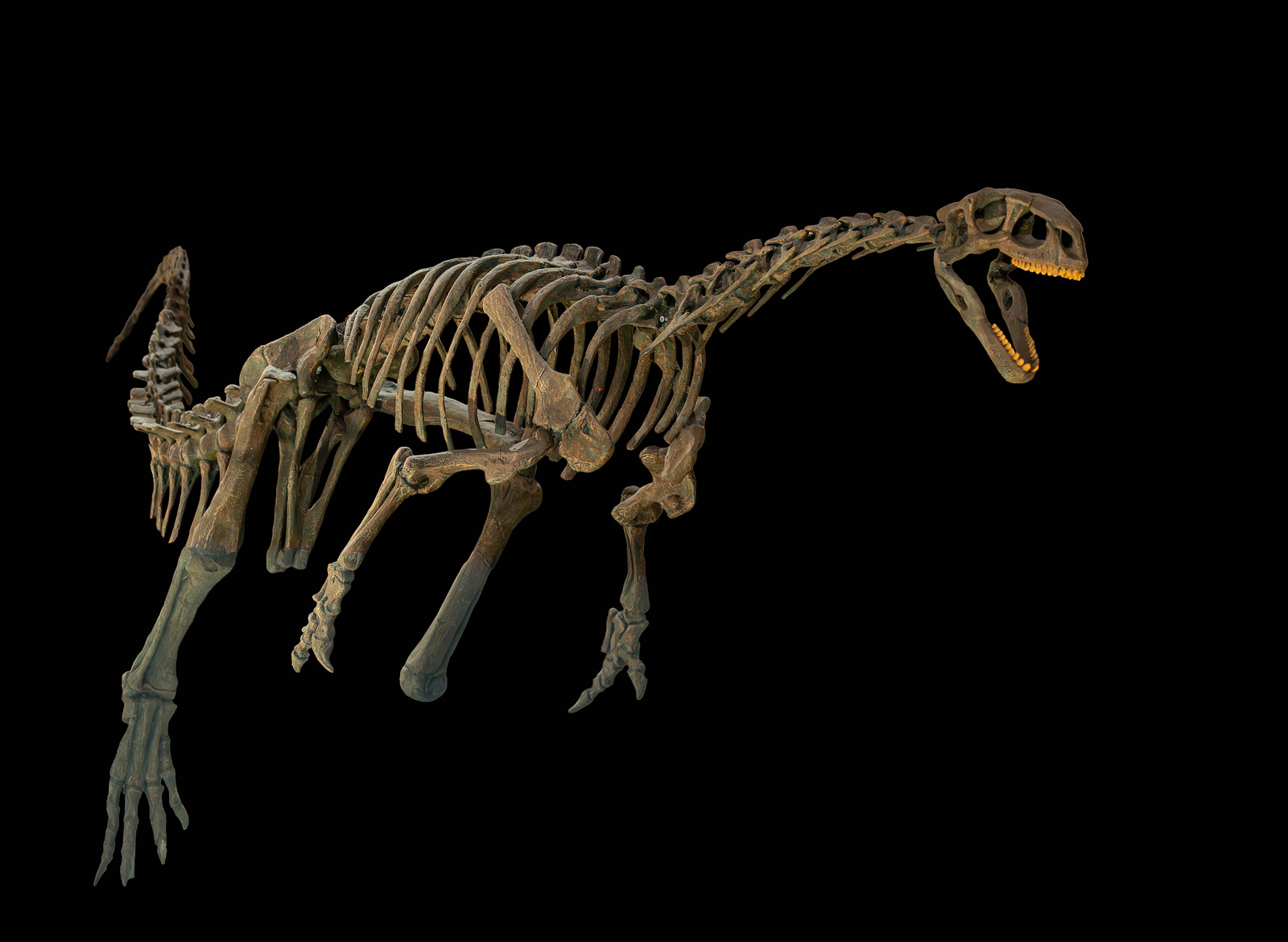
The bones of Chilesaurus diegosuarezi are not waiting for someone to discover what shape the animal had. A nearly complete articulated holotype and several partial articulated specimens collectively preserve a small head, long neck, sturdy hindquarters, short arms and an unusually broad foot. The holotype is about 1.6 metres long, while material from a larger individual implies an adult around twice that length. Its teeth, hands and pelvis can all be described in detail.[1]
What remains unstable is the address attached to that body.
The original description placed Chilesaurus among theropods, the dinosaur branch that includes Allosaurus, tyrannosaurs and birds. A later analysis moved it to the base of Ornithischia, alongside the lineage that would produce stegosaurs, ankylosaurs and duck-billed dinosaurs. Subsequent studies have recovered both alternatives. This is sometimes presented as if paleontologists cannot decide what they are looking at. The better explanation is more interesting: the same skeleton carries real anatomical signals that different evolutionary datasets weight in different ways.[1][3][4]
A good species profile therefore should not turn Chilesaurus into a stitched-together caricature, as though its parts came from unrelated animals. The articulated material represents one coherent, plant-eating biped from Late Jurassic Patagonia. The puzzle lies in how familiar features were combined—and in whether that combination records convergence, deep ancestry, or both.
One locality preserved more than one growth stage
The first bones were noticed in 2004 by seven-year-old Diego Suárez while he accompanied his geologist parents, Manuel Suárez and Rita de la Cruz, in Chile's Aysén Region. The species name later honoured him. Excavation in the Toqui Formation, south of General Carrera Lake, produced the holotype SNGM-1935 and a series of referred specimens representing different sizes and growth stages.[1]
This is unusually generous material for a dinosaur known from one locality. The holotype is a nearly complete, naturally articulated juvenile. Other individuals preserve overlapping portions of the skeleton: limbs, feet, vertebrae and pelvic bones. The authors of the original study emphasized that several skeletons were found in natural articulation and in the same greenish matrix, evidence against the tempting suspicion that the strange anatomy was a chimera assembled from multiple species.[1]
The rocks supply a tight deep-time anchor. Three zircon samples from tuffs within the succession produced uranium-lead ages between 148.7 ± 1.4 and 147.0 ± 1.0 million years, placing Chilesaurus in the Tithonian, near the end of the Jurassic. The naming paper compared the clastic beds to braided-river deposits; a dedicated geological study instead interpreted them as a synvolcanic fan delta entering a shallow marine basin.[1][8] Whatever the precise position within that system, articulation shows that the bodies were not left to scatter completely before burial.
Articulation matters twice here. It establishes which elements belong together, and it preserves relationships between them. Four specimens keep the forelimbs strongly flexed beneath and beside the body, with the hands directed backward. A 2017 study interpreted that repeated arrangement as a resting posture retained when relatively inactive animals were buried quickly.[2] That is a plausible behavioural reading, not a freeze-frame with a known cause of death. What the fossils establish directly is that the posture repeats across individuals.
Start at the mouth, where the ecological signal is strongest
The mounted skeleton looks vaguely like a small, long-necked theropod until the mouth interrupts the comparison. Chilesaurus did not carry the laterally compressed, backward-curving blades typical of a flesh-cutting theropod. Its crowns were tiny—less than a centimetre in the recent dental synthesis—straight, elongated and leaf-shaped, with minute serrations restricted toward the crown tips. Many point slightly forward rather than sitting vertically in the jaw.[1][5]
That dentition is the strongest evidence that Chilesaurus ate plants. The short skull, narrow tooth crowns and inferred toothless front of the upper jaw reinforce the interpretation. Similar packages evolved in other dinosaur herbivores, including some sauropodomorphs and therizinosaurs, even though those animals occupy different branches and times.[1][3][5]
The inference still has a boundary. No gut contents preserve a last meal, and the teeth do not identify a particular fern, seed or branch. “Herbivorous” describes the food-processing system far more securely than any exact menu or browsing height. It also should not be inflated into a claim that one dietary change explains every oddity in the skeleton. Plant eating can drive convergence in jaws, teeth and gut-supporting body proportions; it does not automatically rotate a pubis or build a particular ankle.
This distinction is essential because the diet is much less controversial than the family placement. Regardless of whether Chilesaurus sits just inside Theropoda or near the base of Ornithischia, its teeth document a departure from the ancestral predatory equipment associated with early theropods. The ecological event survives either tree.[1][3][5]
The hand is reduced, but not along a familiar script
The forelimb makes the mosaic harder to narrate as a simple diet switch. Chilesaurus had robust arms ending in a functionally two-fingered hand: digits I and II carried the main structure, while digit III was reduced. The first finger included a stout, twisted first phalanx. That combination recalls basal sauropodomorph hands in some respects, while a semilunate wrist bone and reduction of the third digit helped the original authors recover theropod affinities.[1]
Nothing in the preserved hand proves a specific task. It was not the long grasping apparatus of a predatory theropod, but neither does reduction alone demonstrate that the hand was useless. The flexed forelimb fossils offer evidence for how the arms could rest; they do not show a branch being hooked, food being gathered or a rival being struck.[2]
The foot adds another mixed signal. It was short and broad, with four toes rather than the narrow, three-toed pattern familiar from many derived theropods. The ankle retained a low ascending process on the astragalus, a condition regarded as unexpectedly primitive in the original description. At the same time, features elsewhere in the hind limb and vertebral column resemble theropods. The result is not a random parts bin. It is a locomotor system in which ancestral-looking and more specialized traits persisted together.[1]
One backward-pointing bone changed the scale of the argument
The pubis of Chilesaurus points backward. That opisthopubic condition is famous in ornithischians—the name means “bird-hipped”—but it also evolved independently within several theropod groups, including the lineage leading to birds. A backward pubis is therefore a powerful clue and a poor verdict when used alone.[1][3]
In 2015, four phylogenetic analyses in the naming study all recovered Chilesaurus as a theropod, usually near the base of Tetanurae. The authors highlighted theropod-like openings and projections in the vertebrae, the form of the ilium and tibia, the wrist, and the reduced third finger. On that tree, the plant-eating teeth, broad foot and backward pubis represented a remarkable bundle of convergences with herbivorous dinosaurs elsewhere.[1]
In 2017, Matthew Baron and Paul Barrett tested the animal in a broad early-dinosaur dataset and recovered it instead as the earliest-diverging ornithischian. Their interpretation turned apparent convergence into an evolutionary sequence: a backward pubis and dietary changes could have appeared before hallmark ornithischian structures such as the predentary bone. In that arrangement, Chilesaurus helped bridge part of the anatomical gap between theropods and ornithischians and supported the proposed grouping Ornithoscelida.[3]
Neither result follows from the pubis by itself. A phylogenetic analysis compares many scored characters across many taxa and seeks the tree that best explains their distribution. If the comparison includes a dense sample of theropods but few early ornithischians, a mosaic animal may be pulled toward the better-sampled branch. If the set emphasizes early dinosaurs and characters informative outside Theropoda, the balance can change.
Baron's 2024 reanalysis made that dependency explicit. Adding ornithischian outgroups to datasets previously focused on saurischians materially changed the recovered position of Chilesaurus, again making an early ornithischian placement possible. The study did not declare the case closed; it showed that outgroup and character choices are part of the result, not neutral scaffolding around it.[4]
The current answer is competing hypotheses, not a settled label
More recent work has kept the theropod hypothesis very much alive. Andrea Cau's large 2024 analysis recovered Chilesaurus close to the base of Tetanurae, and a 2026 review of non-coelurosaur theropod teeth treats it as a possible early-branching tetanuran while plainly acknowledging the ornithischian results. That review identifies a dozen unusual dental features and emphasizes how sharply the animal's herbivorous teeth depart from those of other early tetanurans.[5]
The responsible short label today is therefore “an enigmatic dinosaur, often recovered as an early theropod.” Calling it a theropod reflects several large or focused analyses; calling the placement settled would conceal genuine dataset sensitivity. Calling it a basal ornithischian is a published, testable alternative; presenting it as an established missing link would overstate the case.[3][4][5]
A promising new fossil assemblage could change the balance. At a 2025 vertebrate-palaeontology meeting, researchers reported an as-yet unnamed dinosaur from the slightly older Cañadón Calcáreo Formation of Argentina. At least three individuals together preserve most of the skeleton. The conference abstract describes a functionally two-fingered hand and backward pubis resembling Chilesaurus, alongside features that may support a theropod position. Because the taxon remains unnamed and the comprehensive analysis was described as future work, this is a field signal rather than a peer-reviewed resolution.[6]
That prospective relative matters because phylogeny improves when a strange anatomy stops being a sample of one. Shared details could identify a real southern South American lineage; differences could reveal which features were inherited and which evolved independently. Multiple growth stages may also help separate juvenile anatomy from stable adult characters—a persistent problem when the Chilesaurus holotype itself is immature.[1][6]
Keep the animal when the tree moves
The safest profile of Chilesaurus is also the most vivid. Near the close of the Jurassic, a modest-sized biped moved through a volcanically active delta system in what is now southern Chile. It had a small head and plant-processing teeth, a long neck, strong hind limbs, a broad four-toed foot, short flexing arms, a reduced hand and a backward-pointing pubis. More than one individual was buried articulated, leaving anatomy across several growth stages.[1][2][8]
Those claims do not flicker when a computer returns a different tree. The unstable part is the explanation of how the traits were inherited. If Chilesaurus is a theropod, it records an early South American experiment in herbivory and extraordinary convergence with other plant-eating dinosaurs. If it is an ornithischian, it preserves an unexpected combination near that branch's poorly known beginnings. Either way, the fossil warns against treating familiar-looking features as exclusive badges of membership.[1][3][4][5]
The body is not confused. Chilesaurus is the most abundant dinosaur in the described Aysén fossil assemblage, although that count is inevitably filtered by where collectors searched, how bodies were buried and which remains survived.[1] Our categories are being asked to accommodate a combination evolution genuinely produced. That is why Chilesaurus remains useful after the novelty of its anatomy wears off: it turns disagreement over a label into a test of how evolutionary trees are built.
Sources
- Fernando E. Novas et al., “An enigmatic plant-eating theropod from the Late Jurassic period of Chile,” Nature 522 (2015)—original description, specimen inventory, anatomy, locality, age, diet and initial phylogenetic analyses.
- Nicolás R. Chimento et al., “Forelimb posture in Chilesaurus diegosuarezi (Dinosauria, Theropoda) and its behavioral and phylogenetic implications,” Ameghiniana 54 (2017)—study of the repeated flexed-arm posture in four articulated specimens.
- Matthew G. Baron and Paul M. Barrett, “A dinosaur missing-link? Chilesaurus and the early evolution of ornithischian dinosaurs,” Biology Letters 13 (2017)—open paper presenting the early-ornithischian hypothesis and its anatomical sequence.
- Matthew G. Baron, “The effect of character and outgroup choice on the phylogenetic position of the Jurassic dinosaur Chilesaurus diegosaurezi,” Palaeoworld 33 (2024)—reanalysis of how taxon and character sampling change the recovered tree.
- Christophe Hendrickx, “Dental evolution in non-coelurosaur theropods,” Italian Journal of Geosciences (2026)—current synthesis of Chilesaurus dentition, herbivory and competing phylogenetic placements.
- Maximilian Kellermann, Diego Pol and Oliver W. M. Rauhut, “A new Argentinian cousin of the enigmatic dinosaur Chilesaurus (Dinosauria) could help clarify its phylogenetic position,” EAVP 2025 conference abstract—provisional report of an unnamed, closely related taxon and the analysis still required.
- Rjcastillo, “Esquelueto articulado Chilesaurus diegosuarezi,” Wikimedia Commons (photographed 2 May 2026)—source record for the replica skeletal-mount photograph used as the article image.
- Manuel Suárez et al., “Tithonian age of dinosaur fossils in central Patagonian, Chile: U–Pb SHRIMP geochronology,” International Journal of Earth Sciences 105 (2016)—radiometric ages and the synvolcanic fan-delta interpretation of the fossil-bearing succession.