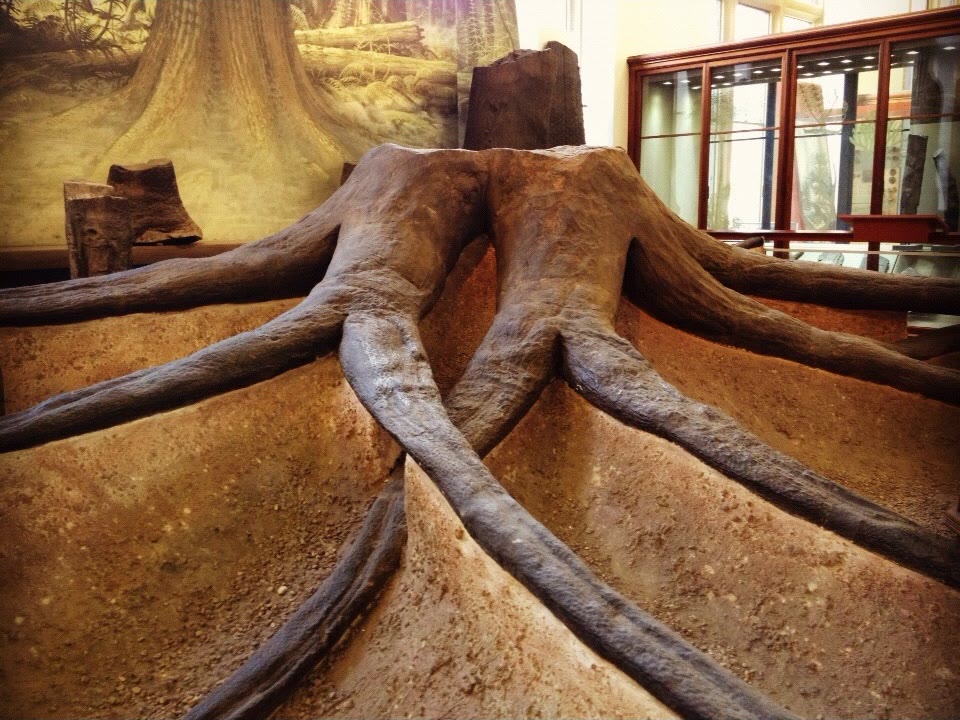
The cover photograph does not show a botanical whole. Across a Manchester Museum case, broad fossil axes radiate from a central stump-like base. The collection display identifies the object as Stigmaria ficoides, specimen LL.11627, an Upper Carboniferous rooting system from Bradford, Yorkshire. Its name is Stigmaria.[6]
That name sounds as though it identifies a plant. It does something more careful. Stigmaria names a recognizable kind of underground organ made by the giant lycophytes of Carboniferous wetlands. Several parent plants, including those whose stems are called Lepidodendron and Sigillaria, produced stigmarian systems. A root found alone may therefore deserve a precise name without revealing which whole tree stood above it.[4]
This is not a loophole in taxonomy or an old mistake waiting to be erased. It is a disciplined response to the way plants become fossils. Paleobotany often has to name the pieces first and reconstruct the organism later—and those are related but different acts.
A plant enters the rock record already in pieces
A vertebrate skeleton can certainly be scattered, scavenged and transported. A plant begins with an additional problem: separation is part of its normal life. Leaves fall. Pollen travels. Seeds and fruits disperse. Flowers open and break apart. Bark sloughs while roots remain in place and wood persists after softer tissues have vanished. One organism can deliver its organs to different sediments, in different seasons, through different transport routes.
Steven Manchester and colleagues make the contrast explicit in their review of whole-plant reconstruction. Fossil leaves, fruits, flowers, seeds and wood are commonly collected in isolation, and the size of one plant organ does not supply a dependable shortcut to the dimensions or identity of the entire plant. The same review reduces the reconstruction problem to two main routes: find organs physically attached, or build a case from their repeated association, strengthened by anatomical similarity.[2]
Preservation creates another split. A flattened leaf compression records different characters from a three-dimensional permineralized stem. A cast of a hollow trunk may keep its exterior geometry while losing the cellular anatomy that would connect it to another specimen. The International Code of Nomenclature therefore allows fossil-taxa whose boundaries may correspond to one organ, several organs or a particular preservational expression—not necessarily to a complete biological organism.[1][3]
The fragment is not an inferior whole. It is the actual unit the rock supplied.
The separate name is a guardrail
Coal-swamp lycophytes make the logic visible because their detached organs are common and distinctive. The Sam Noble Museum’s fossil guide uses Lepidodendron for characteristic outer stem surfaces and for a reconstructed whole-plant concept; Knorria for a different exposed stem surface; Stigmaria for the rooting systems of several arborescent lycophytes; Lepidophylloides for dispersed leaves of uncertain parentage; and Lepidostrobus for intact cones of a particular construction.[4]
It is tempting to treat that vocabulary as clutter. In fact, it prevents a more serious error. If a Stigmaria axis occurs below a Lepidodendron-type stem, immediate unification would turn proximity into proof. The root might belong to that tree. It might also belong to another lycophyte growing on the same wetland surface. If the connection is later demonstrated, the biological reconstruction becomes stronger; the old organ name can still remain useful for roots whose parent cannot be narrowed.
Separate names also stop a fossil census from becoming falsely literal. Five named organ fossils from one bed do not automatically represent five plant species. The reverse is equally important: one broadly defined leaf or root taxon may have been produced by more than one whole-plant species. Cleal and Thomas warn that fossil-taxa based on different organs can correspond to different biological ranks in their parent plants, which complicates diversity counts and phylogenetic datasets.[1]
The name is thus best understood as a claim boundary. It says: these specimens share enough observable structure to classify together. It does not quietly add a trunk, crown, reproductive system and exact evolutionary address that the specimens do not preserve.
How fragments earn a whole plant
Whole-plant reconstruction works through an evidence ladder, not a flash of resemblance.
The strongest rung is organic connection: a seed attached to its fruiting structure, a fruit attached to a twig bearing leaves, or roots continuous with a stem. Connection shows that the organs belonged to one individual at burial. Even then, a single specimen may not reveal the full range of variation within a species.[2]
The Green River Formation shows how attachment can overturn a familiar-looking answer. Isolated Paleogene leaves with myrtle-family features had been compared with Eucalyptus and Syzygium. A branch bearing both those leaves and fruits confirmed the broad myrtle affinity, yet the reproductive structures fit neither living genus. The connection did not simply complete a known plant; it exposed an extinct combination that leaf shape alone had hidden.[2]
The next rung is repeated association. If two detached organs occur together across several localities, especially where each lacks plausible alternative partners, the relationship becomes more credible. One crowded slab is weaker: water, wind or decay can mix material from an entire community. Repetition changes coincidence into a testable pattern, but it remains an inference.[2]
Manchester and colleagues give a deliberately less direct example: the fruits called Polyptera manningii and leaves called Juglandiphyllites glabra occur together at at least ten Paleocene Fort Union localities, where no alternative walnut-family organs offer an obvious partner. Consistent anatomy and affinity make the pairing useful, but no attached twig promotes it to the certainty of the Green River specimen.[2]
Then comes anatomical correspondence. Matching epidermal or cuticular features can connect a leaf to a reproductive organ even when no twig joins them. Internal tissues can be still more discriminating. This is why similarly shaped leaves can be misleading: convergence may produce the same outline in unrelated lineages, while stomata, veins, glands or cellular organization preserve a different set of relationships.[2]
Finally, the proposed whole must remain compatible with age, locality and preservation. Parts separated by an impossible stratigraphic interval cannot belong to the same biological species. Parts that repeatedly occupy the same narrow horizon carry more weight than look-alikes collected from distant periods. Each link should retain its own confidence rather than disappearing inside a polished life reconstruction.[1][2]
The evidence ladder does not end when an organ has been assigned to a larger plant. Stigmaria remains scientifically productive at its own scale. Hetherington, Berry and Dolan combined compression fossils with permineralized material to show that stigmarian rootlets branched repeatedly—up to five divisions in their studied material—and carried root hairs. Their case depended on anatomical features that distinguish these rootlets inside coal balls as well as on the size distribution of a large sample.[5] Naming the rooting organ separately did not trap it in artificial taxonomy; it made a comparable body of evidence possible.
A name stays fixed while a reconstruction can move
Scientific names need anchors. Under the current Madrid Code, botanical names are governed by an international set of rules, and fossil-taxa receive provisions suited to incomplete, mixed material. Article 40.8 now asks for a particularly fine-grained anchor: for a new fossil-species or infraspecific fossil-taxon published from 1 January 2026 onward, the protologue must state where the holotype lies within its rock, sediment or preparation.[3][7] A collection number may lead to the correct microscope slide or slab; a grid reference, mark or overview image may still be needed to find the one grain or impression that fixes the name. The rule is about making the actual type relocatable inside its carrier, not merely naming the institution that conserves it.[7]
The type specimen does not have to embody everything eventually inferred about the organism. It fixes how the name is applied. The taxonomic circumscription can then be reconsidered as attachments are discovered, anatomies are matched or supposed associations fail. Cleal and Thomas argue that keeping fossil-taxa for different parts separate may remain useful even after some connections are known, because collapsing the names can destabilize a practical literature built around identifiable fossils.[1]
That division of labor is elegant. Nomenclature preserves continuity at the specimen level. Reconstruction remains free to improve at the organism level.
Read the root twice
Return to the museum case. The photograph shows the broad, radiating architecture of a real fossil rooting system, but the display is not an untouched growth surface in rock.[6] Comparison with studied specimens supports calling the organ Stigmaria. Museum and research sources place stigmarian systems beneath multiple kinds of arborescent lycophyte, so the image does not by itself name the tree that rose above this particular root.[4][5]
Those are not disappointing limits. They are the structure of the knowledge. At the organ level, the fossil records how a rooting system was built. At the whole-plant level, it becomes one component in a larger reconstruction. At the ecosystem level, stigmarian systems preserved elsewhere in coal-bearing strata help recover the wetland substrate in which giant lycophytes anchored themselves.[4][5]
A good reconstruction does not make the separate names vanish. It explains the links among them and shows which links are physical, which are repeated, which are anatomical and which remain provisional. In that sense, fossil-plant names are more than labels. They are error bars written into language: a way to let a leaf be exactly a leaf until the evidence earns a tree.
Sources
- Christopher J. Cleal and Barry A. Thomas, “Naming of parts: the use of fossil-taxa in palaeobotany,” Fossil Imprint 77 (2021)—peer-reviewed treatment of part-based fossil taxa, nomenclature and whole-plant concepts.
- Steven R. Manchester, Laura Calvillo-Canadell and Sergio R. S. Cevallos-Ferriz, “Assembling extinct plants from their isolated parts,” Boletín de la Sociedad Geológica Mexicana 66 (2014)—organic connection, repeated association and epidermal anatomy in whole-plant reconstruction.
- International Association for Plant Taxonomy, International Code of Nomenclature for algae, fungi, and plants (Madrid Code) (2025)—current nomenclatural code and fossil-taxon provisions.
- Sam Noble Museum, University of Oklahoma, “Fossil Lycophytes”—collection-based guide to Lepidodendron, Knorria, Stigmaria, dispersed leaves and cones.
- Alexander J. Hetherington, Christopher M. Berry and Liam Dolan, “Networks of highly branched stigmarian rootlets developed on the first giant trees,” Proceedings of the National Academy of Sciences 113 (2016)—compression and permineralized evidence for rootlet architecture.
- akhenatenator, “Day 9 - Fossilized Root System,” Wikimedia Commons—source page for the Manchester Museum photograph of specimen LL.11627 used as the article image.
- Julia Gravendyck et al., “Describing a new fossil species: How to satisfy Art. 40.8 of the Madrid Code,” International Organisation of Palaeobotany (2026)—guidance on relocating a holotype within rock, sediment or a preparation.