In February 2002, an expedition looking for deep-sea clams in Monterey Canyon encountered a dead whale. Its bones carried a dense covering of worms. Those animals, eventually named Osedax, helped make the whale fall familiar as a place where death supports an extraordinary concentration of life.[1]
The association suggested an evolutionary story almost too tidy to resist: whales entered the ocean, their carcasses sank, and specialists evolved to consume them. Fossils have since pushed the bone-eaters much further back. Marine reptiles were supplying their meals around 100 million years ago, long before whales appeared.[4]
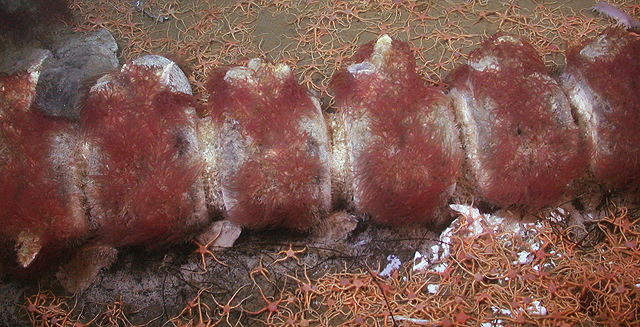
A skeleton still contains a meal
To a scavenger, a carcass offers several resources in succession. Flesh attracts animals capable of removing it quickly. Exposed bone still contains organic compounds, including collagen and fats, available to organisms with a different means of feeding. MBARI's experiments and observations have followed that transition from visiting scavengers to animals exploiting the skeleton itself.[2]
Osedax has no mouth or gut. Root-like tissues penetrate bone and contain symbiotic bacteria involved in nutrition. The apparent solidity of the skeleton conceals a food supply, and the worm's body reaches into it. Living species can colonize bones from several vertebrate groups, including fishes, birds and turtles.[2]
That breadth matters when reading the fossil record. A whale is a conspicuous delivery of bone to the seabed, but the feeding opportunity depends on the material arriving there. Once researchers recognized that distinction, extinct marine reptiles became promising places to look.
The evidence moves beyond whales
In 2010, Steffen Kiel and colleagues reported traces resembling modern Osedax borings in whale bones from Washington State. The fossils came from early Oligocene deep-water deposits and were about 30 million years old. Their age fitted an association between the worms and an early diversification of whales, while leaving open the possibility of a much older history.[3]
A fossil occurrence provides a minimum age: the activity existed by then. Establishing when it began requires earlier evidence. The Washington bones therefore supplied both a discovery and a reason to search further back.
Silvia Danise and Nicholas Higgs made that search productive in a 2015 study of English marine-reptile remains. Their material included a plesiosaur upper-arm bone from the Cambridge Greensand, whose fossils were largely reworked from older Albian deposits, and fragmentary sea-turtle bones from the Cenomanian Grey Chalk. These specimens placed comparable bone consumption around 100 million years ago.[4]
Computed tomography revealed tiny entrances leading into expanded, irregular chambers. The geometry matched the spaces occupied by the buried parts of modern Osedax. The worms themselves had disappeared; cavities in another animal's skeleton preserved their activity.[4]
The turtle remains also suggested a route through the end-Cretaceous extinction, when plesiosaurs vanished. Surviving vertebrates could have continued supplying bones before whales evolved. That is a plausible ecological bridge, supported by the worms' varied diet today, rather than a continuous fossil record of every meal across the interval.[2][4]
Small openings, a wider ocean
A 2024 study led by Sarah Jamison-Todd extended the Cretaceous evidence to plesiosaurs from Britain and the southeastern United States, and to mosasaurs from Belgium. The sample included a tooth as well as skeletal bones. Multiple chamber shapes suggested that bone consumption already involved more diversity than the earliest discoveries had revealed.[5]
Identification depends on looking inside. Weathering, disease and other organisms can leave pits on a bone's surface; CT scans reveal the internal structures that make an Osedax interpretation convincing. The trace-fossil name Osspecus describes these borings. It records a characteristic excavation without preserving the worm's body or automatically identifying a living species.[5]
The examined fossils came from relatively shallow, oxygenated marine settings. They establish that this feeding relationship operated there. Reconstructing its full Cretaceous depth range would require additional evidence.[5]
A carcass can become several kinds of habitat
Going further back also changes the cast. A study published in 2014 examined a Late Jurassic Ophthalmosaurus skeleton from the Ringstead Clay Member in southern England. Its bones preserved evidence of scavenging, microbial growth, grazing sea urchins and attached suspension feeders. The researchers reconstructed a carcass that remained available on the seabed long enough to support successive occupants.[6]
They found no traces attributable to Osedax. Nor did this specimen document the specialized chemosynthetic molluscan community associated with some deep-water whale falls. Its encrusting animals instead emphasized the skeleton's value as a firm surface: a place to attach above a muddy bottom.[6]
This comparison gives the ancient scene texture without filling it with modern species. A carcass supplies food, alters its immediate surroundings and provides physical shelter or attachment space. Which animals exploit those opportunities depends on the setting and on which lineages exist at the time. Similar ecological roles can recur with different occupants.[6]
There is a final complication for anyone collecting such bones. The consumers can destroy the very material that would preserve them. Surviving borings catch that destruction partway through; complete consumption leaves no comparable specimen. Researchers call this potential loss the Osedax effect, while acknowledging that its total impact on the fossil record cannot yet be measured.[3][5]
A pitted reptile bone therefore holds two intertwined histories. One belongs to the animal that grew it. The other began when that animal died and its skeleton became somebody else's habitat.
Sources
- Kim Fulton-Bennett, “An inordinate fondness for bone-eating worms,” MBARI (2018) — discovery history, experimental observations and the photograph credited to MBARI, 2006.
- MBARI, “Osedax Studies” — feeding anatomy, bacterial symbiosis, diverse bone substrates and carcass consumption.
- Steffen Kiel, James L. Goedert, Wolf-Achim Kahl and Greg W. Rouse, “Fossil traces of the bone-eating worm Osedax in early Oligocene whale bones,” PNAS 107 (2010), 8656–8659 — Washington fossils and the implications of bone destruction.
- Silvia Danise and Nicholas D. Higgs, “Bone-eating Osedax worms lived on Mesozoic marine reptile deadfalls,” Biology Letters 11 (2015), 20150072 — Cretaceous plesiosaur and turtle bones examined with CT.
- Sarah Jamison-Todd, Philip D. Mannion, Adrian G. Glover and Paul Upchurch, “New occurrences of the bone-eating worm Osedax from Late Cretaceous marine reptiles and implications for its biogeography and diversification,” Proceedings of the Royal Society B 291 (2024), 20232830 — additional reptile occurrences, diagnostic limits and preservation bias.
- Silvia Danise, Richard J. Twitchett and Kate Matts, “Ecological succession of a Jurassic shallow-water ichthyosaur fall,” Nature Communications 5 (2014), 4789 — grazing, encrustation and community succession around Ophthalmosaurus.