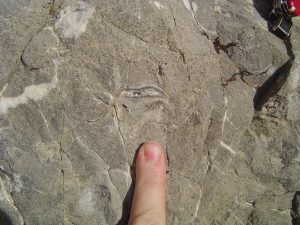
A finger points toward a small shell exposed in limestone. Inside its curved outline, brown sediment meets pale crystalline calcite along a remarkably level boundary. The animal has disappeared, but the space it once occupied has kept a physical reference: which way was down when sediment collected there.[1]
This is a geopetal fill. Its quiet usefulness comes from a sequence that can be read in the rock. Sediment accumulated in the lower part of a cavity; minerals subsequently occupied space above it. Together, the two materials preserve an ancient horizontal.[1][2]
The empty shell becomes a container
The crucial structure is the cavity. Once an animal's soft tissues have gone, its shell can shelter a space into which fine sediment enters. A partial filling leaves room above the sediment for later mineral growth. In limestones, that upper fill is commonly coarse crystalline calcite, known as spar. Comparable structures also form beneath shells that act as little roofs.[2]
The boundary between the fills supplies the level. Maurice Tucker's field guide illustrates one inside a Carboniferous gastropod from Wales, only four centimeters across. He also explains how these small structures can reveal the original inclination of limestone deposits: on a submarine slope, the sediment surface inside a cavity can preserve a horizontal even when the surrounding deposit formed at an angle.[2]
That distinction changes how a rock is read. The surface of a bed and the level recorded inside a fossil need not have started parallel. A tilted-looking layer does not, by itself, tell us how much movement happened after deposition. The internal fill offers a separate reference against which to examine it.[2]
Read the filling event, then the animal
There is an easily missed gap between the two questions a fossil invites. How did this animal live? How did its remains come to rest here? A geopetal fill speaks most directly to the second.
Consider a thought experiment. An empty shell rolls, then takes in sediment: the fill records its new position. If that fill becomes firm enough to survive another movement, the shell can carry its older level elsewhere. Interpreting a rotated fill therefore requires asking whether it became fixed before the fossil moved.[3]
For that reason, the useful unit of observation expands beyond a handsome specimen. Neighboring shells, the surrounding sediment and the orientation of the bed help establish what an individual boundary means. The question becomes whether the little levels agree, and what could have made them disagree.
When the old levels point different ways
Susanne Mayrhofer, Alexander Lukeneder and Leopold Krystyn applied that reasoning to ammonoid concentrations in Turkey's Taurus Mountains. Their study, published online in 2016 and in a 2017 issue of Lethaia, examined Kasimlarceltites beds in the Kasımlar Formation, from the Carnian stage of the Late Triassic.[3]
Some internal fills pointed in different directions; fragments of older sediment also contained ammonoids with inverted fills. The researchers interpreted these relationships as evidence that material had hardened before being reworked. Their reconstruction involved an initial accumulation followed by transport and redeposition through gravity flows. The shells retained traces of an earlier resting place inside a later deposit.[3]
This provides a useful test of an attractive fossil bed. A crowd of well-preserved shells may look like a community caught where it lived. Internal boundaries can instead reveal a history of assembly. The visual completeness of the animals and the stability of their burial positions are separate observations.
Intact shells still need a sedimentary history
An example from Poland makes the same discipline tangible. In a 2018 study, Stanisław Skompski and colleagues examined a dense brachiopod accumulation at Józefka Quarry in the Holy Cross Mountains. The deposit belongs near the Middle–Late Devonian boundary and contains a striking concentration of largely uncrushed shells.[4]
The team measured shell orientations and the boundaries between internal sediment and cement. They also considered the varied material inside shells, the deposit's geometry and its setting within deeper-water basin sediments. Together, these observations favored transport by gravity-driven debris flows. The authors did not entirely exclude an accumulation where the animals had lived, but regarded redeposition as more probable.[4]
That qualification is part of the method's strength. A boundary inside a shell contributes one observation to a reconstruction; it does not independently identify a whole environment or explain every movement. Its value grows when the surrounding rock supplies compatible evidence.
Return to the small shell in the photograph. Its exterior offers an animal's shape. Its interior adds an episode that took place after the animal was gone. Reading both allows the fossil to preserve something more particular than an ancient creature: a container, a settling surface, and a piece of the journey into rock.
Sources
- Chris Johnson, Matthew D. Affolter, Paul Inkenbrandt and Cam Mosher, “Sedimentary Structures,” OpenGeology textbook chapter hosted by Geosciences LibreTexts — geopetal indicators and Matt Affolter's shell photograph.
- Maurice E. Tucker, Sedimentary Rocks in the Field, third edition (Wiley, 2003), section 5.4.1.1, pp. 119–120 — cavity fills, the Welsh gastropod and original depositional slopes; PDF hosted by UNAM.
- Susanne Mayrhofer, Alexander Lukeneder and Leopold Krystyn, “Taphonomy and palaeoecology of Late Triassic (Carnian) ammonoid concentrations from the Taurus Mountains, Turkey,” Lethaia 50 (2017), 87–104 — internal fills and evidence for reworking.
- Stanisław Skompski, Andrzej Baliński, Michał Szulczewski and Inga Zawadzka, “Middle/Upper Devonian brachiopod shell concentrations from the intra-shelf basinal carbonates of the Holy Cross Mountains (central Poland),” Acta Geologica Polonica 68 (2018), 607–633 — University of Warsaw repository record and full paper.