
PBS Eons' Bear Gulch episode works because it starts with the surprise that Montana once held a tropical marine bay, then refuses to leave the viewer with a simple "weird sharks" montage.[1] The better way to watch the video is to treat the strange forms as ecological evidence. The Carboniferous fish in this story are not isolated curiosities. They are pieces of a preserved community whose cartilaginous fishes, bony fishes, invertebrates, algae, habitats, and burial conditions have to be kept in the same frame.[2][3]
That shift matters because extinct sharks are often introduced as a list of visual gimmicks: a tooth whorl here, a spine there, a flattened body, an improbable fin. Bear Gulch gives a stronger lesson. The American Elasmobranch Society's project overview describes work in the Bear Gulch Limestone beginning in 1968 and emphasizes the exceptional preservation of a highly diverse community, including early chondrichthyans whose body plans challenge familiar modern shark expectations.[3] In other words, the site is valuable because it shows a whole range of ways to be a cartilaginous fish before modern categories make the past look too tidy.
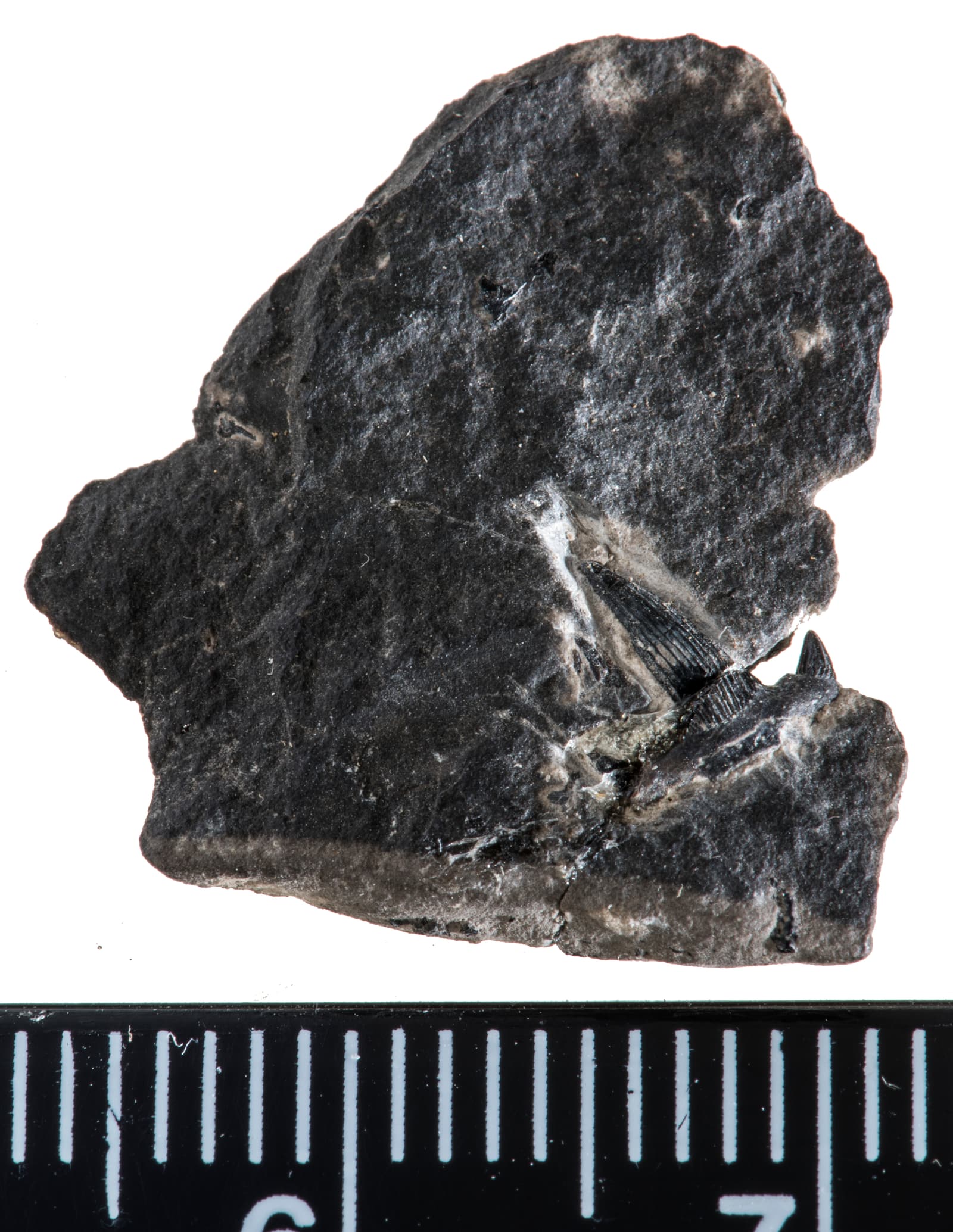
Image context: the cover uses a real Wikimedia Commons photograph of the Stethacanthus hibberti holotype held by the Natural History Museum of Neuchatel. The specimen is not from Bear Gulch, but it anchors the article's Stethacanthus discussion in a physical fossil rather than a life restoration or diagram.[6]
The video's title is deliberately startling: sharks on the Great Plains.[1] As a hook, it works. As an interpretation, it needs narrowing. The Bear Gulch Limestone was not preserving prairie sharks. It was preserving a Mississippian marine setting that later became part of Montana's rock record.[2][3] Grogan and Lund describe the deposit as a productive Paleozoic marine bay with a diverse biota of fishes, invertebrates, and algae, and they argue that its preservation cannot be explained by a single simple condition such as permanently anoxic bottom water.[2] That is a useful correction because it turns the episode from a geographic joke into a taphonomic problem.
The video is strongest when it lets viewers feel how different Carboniferous chondrichthyan diversity was from the modern mental template.[1] Today, "shark" often means a streamlined open-water predator. Bear Gulch disrupts that expectation. The AES overview says the chondrichthyans of this roughly 318-million-year-old interval were dominant marine fishes in species richness and adaptive variety, while also having little direct resemblance to living cartilaginous fishes.[3] That line is the interpretive key. Bear Gulch is not interesting because one extinct shark had a strange fin. It is interesting because the whole chondrichthyan field was experimenting with bodies.
Stethacanthus is the easiest animal to overread, so it makes a good test case. The famous spine-brush complex can be called an "ironing board" only if that nickname remains a doorway into anatomy rather than a replacement for it.[4][5] Lund's Bear Gulch work described stethacanthid elasmobranch remains from the Montana limestone, including forms referred to Stethacanthus and immature material not safely assignable to named spine species.[4] That uncertainty matters. The fossil record does not hand us one finished mascot. It gives specimens at different maturity states, different preservational qualities, and different levels of taxonomic confidence.
The spine-brush complex also shows why the video needs written annotation around it. Maisey's study of symmoriiform sharks treats the complex as a structurally rich anatomical feature with phylogenetic value, not merely as a bizarre dorsal decoration.[5] That point changes the viewer's posture. A flattened plate or spine on the back of a Paleozoic fish may have affected display, hydrodynamics, species recognition, maturity signaling, or some combination we cannot fully recover. The disciplined claim is not "this is what the fin was definitely for." It is that the structure was anatomically organized enough to become evidence for relationships and modularity in early chondrichthyans.[5]
Bear Gulch helps keep that discipline because it is not a one-specimen story. The deposit's force comes from community scale.[2][3] If a strange dorsal complex appears inside a fauna that also includes many other cartilaginous-fish solutions, then oddness stops being a punch line and becomes a distributional fact. The question changes from "Why did this one animal look so strange?" to "What ecological and evolutionary space allowed so many chondrichthyan experiments to coexist?"
That is why the episode's moving reconstructions should be watched with two layers of attention.[1] First, they are useful visual aids. They let a viewer imagine fish moving through a bay rather than lying as flattened shapes on a page. Second, they should remain accountable to fossil limits. Grogan and Lund's depositional model emphasizes multiple biofacies and a preservation regime more complex than one stable dead zone.[2] The animals were not floating in an abstract aquarium. They belonged to a bay with gradients, habitats, storms, sediments, and biological sorting.
The best final reading of the PBS Eons video is therefore ecological. Bear Gulch is not just the place where ancient sharks became visually funny. It is a place where chondrichthyans became unusually inspectable as a community.[1][2][3] Stethacanthus keeps the viewer's attention because the spine-brush complex is so memorable, but the site asks for a broader conclusion: Paleozoic cartilaginous fishes were not failed versions of modern sharks. They were a diverse, locally abundant set of animals whose bodies make more sense when the bay, the fossils, and the preservational machinery are allowed to speak together.
Sources
- PBS Eons, "When Sharks Swam the Great Plains," YouTube video.
- Eileen D. Grogan and Richard Lund, "The geological and biological environment of the Bear Gulch Limestone (Mississippian of Montana, USA) and a model for its deposition," Geodiversitas 24, no. 2 (2002).
- American Elasmobranch Society, "The Bear Gulch Project."
- Richard Lund, "Stethacanthid elasmobranch remains from the Bear Gulch Limestone (Namurian E2b) of Montana," Internet Archive scan of American Museum Novitates no. 2828.
- John G. Maisey, "The spine-brush complex in Symmoriiform sharks (Chondrichthyes: Symmoriiformes), with comments on dorsal fin modularity," Journal of Vertebrate Paleontology 29, no. 1 (2009), BioOne article page.
- Wikimedia Commons, "File:FOS172.jpg," source page for the photographed Stethacanthus hibberti holotype used as the article image.