Archaeocyaths are easy to lose inside the word "reef." The word makes modern coral appear too quickly: color, fish, branching skeletons, a whole postcard ecology. The early Cambrian version was stranger and more mechanical. Archaeocyaths were calcifying, sponge-grade animals with cup-like skeletons, porous walls, and bodies built to move water through carbonate architecture. Their importance is not that they were primitive corals. It is that they made animal reef-building possible before the familiar reef builders of later eras existed.[1][2]
The cleanest way into them is to imagine a reef as plumbing before imagining it as scenery. A single archaeocyath skeleton could be conical, cylindrical, or cup-shaped. Many forms had inner and outer walls separated by an interval, with pores and internal structures that mattered for filtering water and maintaining shape.[1][3] Put enough of those bodies into warm, shallow Cambrian seas, often in association with microbial mats and stromatolites, and the seafloor became a new kind of habitat: rigid, elevated, perforated, and full of small spaces where other organisms could live, feed, hide, or attach.[1][2][3]
That is why archaeocyaths deserve a theme essay rather than a novelty profile. Their story is not "ancient cups appeared, then vanished." It is a short, intense experiment in how animals could engineer marine space. The Digital Atlas of Ancient Life summarizes their global reef-building event as lasting roughly 10 to 15 million years in the Early to Middle Cambrian, around 530 to 520 million years ago, and notes their value as index fossils for Cambrian rocks.[1] Oxford's museum account puts the same group in a collection frame: abundant early Cambrian calcifying sponges, some of the first metazoan reef builders, then declining before disappearing by the end of the Cambrian.[2]
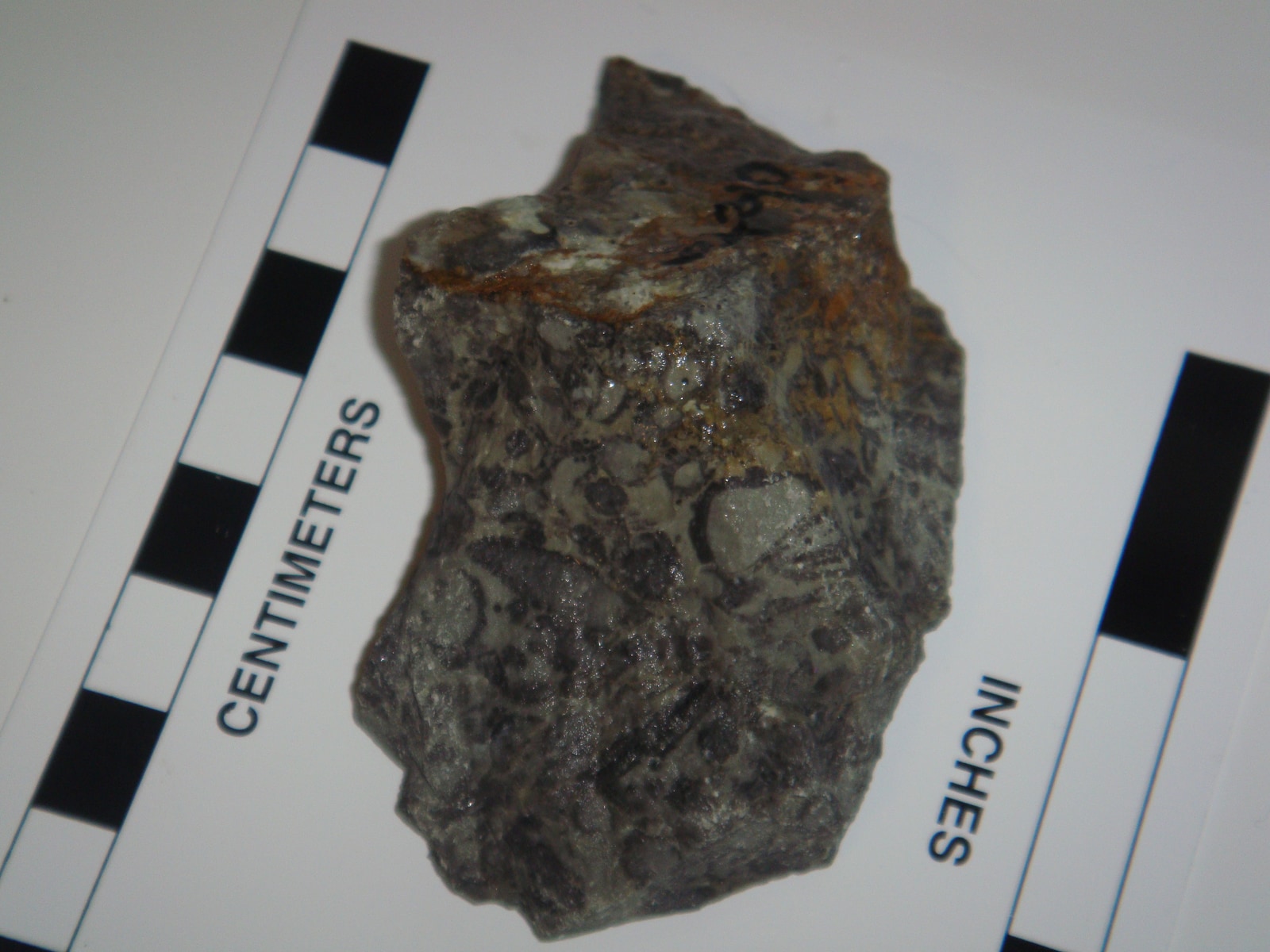
Image context: the article uses one real fossil photograph, a lower Cambrian archaeocyathid reef from the Poleta Formation of eastern California.[6] Its value is not glamour. The cross sections and rock texture show why these animals have to be read as preserved carbonate fabric, not as a smooth modern reconstruction.
The cup was a working surface
The public image of a fossil cup can make archaeocyaths look passive, as if the animal simply sat on the bottom and waited for sediment to bury it. The anatomy says otherwise. Their walls were not inert borders. They were perforated surfaces through which water, particles, and waste interacted with the animal. The question is not only what the cup looked like, but how water moved through it.[3][4]
Recent functional work makes that point sharper. Qureshi and colleagues describe Archaeocyatha as Early to Middle Cambrian reef-building filter-feeding sponges whose calcium carbonate skeletons supported a wide range of morphologies, from cylindrical to conical or domal forms.[3] Their 2026 study of Yukonensis yukonensis uses fluid and structural mechanical modeling to ask what a particularly complex archaeocyath body could do. The result is useful beyond one taxon: some strange skeletal features changed flow and stress in ways that cannot be reduced to decoration.[3]
That is the first correction. Archaeocyath skeletons were not just hard parts that happened to fossilize. They were interfaces. A pore size, wall thickness, chamber shape, spine, ridge, or cup angle could change feeding and flow. In a Cambrian sea where skeletonization itself was becoming ecologically important, that made the archaeocyath body a small piece of infrastructure.
The second correction is that "sponge-like" does not mean biologically vague. The Royal Society Open Science study by Gibson and colleagues tested whether archaeocyaths could have relied mainly on passive suspension feeding. Their computational work instead supported active suspension feeding for modeled forms, arguing that active pumping plus biomineralization may have helped create modern-style metazoan reef ecosystems.[4] In plain terms, the reef was not simply a pile of cups in current. It was built from animals whose bodies likely contributed to moving water.
Reef-building made biodiversity spatial
A reef is powerful because it changes space. A flat seafloor offers surface. A reef offers relief, cavities, current shadows, attachment points, exposure, and crowding. Digital Atlas describes archaeocyath reef construction as creating ancient hotspots of biodiversity, with other organisms flourishing on the structures the archaeocyaths built.[1] Oxford's Brasier Collection note adds a tactile version of the same point: the museum holds hand specimens, polished slices, and thin sections, including fossils where stromatolites grew between near-circular archaeocyathids.[2]
That intergrowth matters. The first animal reefs were not modern coral reefs in miniature. They were mixed systems in which archaeocyaths, calcareous microbes, stromatolites, sediment, and small skeletal animals interacted. The PLOS One paper notes that many Lower Cambrian reef frameworks incorporated calcareous microbes alongside archaeocyaths, producing variable reef composition across environments and localities.[3] The important word is "framework." These organisms were not merely neighbors. Together they built physical settings that changed what later neighbors could do.
This is also where the archaeocyath story becomes less lonely. If a reef creates crevices and gradients, then feeding, competition, and refuge all become more spatially complex. Antcliffe, Jessop, and Daley's work on prey fractionation treats archaeocyaths as suspension feeders whose pore sizes limited the plankton they could consume, with different assemblages showing different upper prey-size limits.[5] That pushes the discussion from "they filtered water" to "different cups may have partitioned the water column differently." A reef is not just one filter. It can be a set of filters.
The same paper is careful about scale: many archaeocyaths seem to have fed mainly on nano- and microplankton, while some forms could plausibly take larger planktonic prey.[5] That is exactly the kind of bounded claim this group needs. The fossils do not preserve a filmed meal. They preserve pore geometry, assemblages, and environmental context. From those, paleontologists can infer feeding envelopes without pretending every detail of Cambrian water traffic is settled.
The rise is brief because the system was fragile
The archaeocyath interval looks dramatic partly because it was short. A group can be historically important without being long-lived. Digital Atlas gives the useful compression: roughly 10 to 15 million years for the first global animal reef-building event.[1] Oxford's museum page describes archaeocyathids as abundant in the early Cambrian, declining later, and gone before the Ordovician.[2] PLOS One places their demise in Cambrian Series 2, Stage 4, around the Toyonian interval near 510 million years ago.[3]
That brevity changes the lesson. Archaeocyaths were not a failed draft of coral. They were a successful early experiment that belonged to a particular Cambrian configuration of seawater chemistry, microbial construction, skeletonizing animals, shallow platforms, and ecological opportunity. When that configuration shifted, the reef-building system changed with it.[2][3]
The fall also prevents a triumphalist reading of the Cambrian explosion. Skeletons, reefs, and animal engineering did not appear as a smooth escalator toward the present. Some innovations opened habitats and then collapsed or were replaced. Archaeocyath reefs helped make complex animal-built seafloor architecture real, but the later history of reefs would be carried by different organisms under different rules.
That makes archaeocyaths more interesting, not less. They show that early animal ecosystems were already capable of construction, feedback, and specialization. They also show how much of that capability was contingent. Pores and cups could make a reef, but they could not guarantee a dynasty.
What the fossil reef asks us to notice
The photographed Poleta Formation fossil is useful because it resists the polished icon. It shows cross sections in rock: arcs, ovals, textures, and broken carbonate surfaces.[6] That is how archaeocyaths often meet the eye. Not as a living sponge pumping water, not as a brightly restored reef, but as architecture cut through after half a billion years.
Reading that surface well means keeping three layers together. First, the organism: a calcifying sponge-grade animal with porous cup-like skeletons.[1][2] Second, the function: water flow, suspension feeding, pore-size filtering, and skeletal forms that shaped currents and stresses.[3][4][5] Third, the ecosystem: a reef framework shared with microbes and other Cambrian organisms, creating habitat before modern reef categories existed.[1][2][3]
The mistake is to choose only one layer. Treat archaeocyaths only as strange cups and they become fossil curios. Treat them only as first reef builders and they become a milestone label. Treat them only as sponges and the engineered seafloor recedes. The stronger reading is cumulative: an early Cambrian animal body became a filter, the filters became carbonate architecture, and the architecture became habitat.
That is the real force of archaeocyath reefs. They made the seafloor more three-dimensional by making water movement, skeletons, and microbial surfaces work together. For a geologically brief interval, Cambrian cups turned plumbing into place.
Sources
- Digital Atlas of Ancient Life, "Archaeocyatha" - overview of archaeocyath body plan, reef-building interval, index-fossil value, and Cambrian reef ecology.
- Oxford University Museum of Natural History, "Archaeocyathids" - Brasier Collection note on archaeocyathids as early Cambrian calcifying sponges, reef builders, and filter feeders.
- Zaid A. Qureshi, Brandt M. Gibson, Simon A. F. Darroch, and Marc Laflamme, "Functional morphology of the Cambrian archaeocyath sponge Yukonensis," PLOS One 21, no. 5 (2026).
- Brandt M. Gibson, Max Chipman, Paolo Attanasio, Zaid Qureshi, Simon A. F. Darroch, Imran A. Rahman, and Marc Laflamme, "Reconstructing the feeding ecology of Cambrian sponge reefs: the case for active suspension feeding in Archaeocyatha," NSF Public Access Repository record for Royal Society Open Science 10 (2023).
- Jonathan B. Antcliffe, William Jessop, and Allison C. Daley, "Prey fractionation in the Archaeocyatha and its implication for the ecology of the first animal reef systems," Paleobiology 45, no. 4 (2019), Cambridge Core record.
- Qfl247, "Archeocyathids.JPG," Wikimedia Commons file page for the real lower Cambrian Poleta Formation fossil-reef photograph used as the article image.