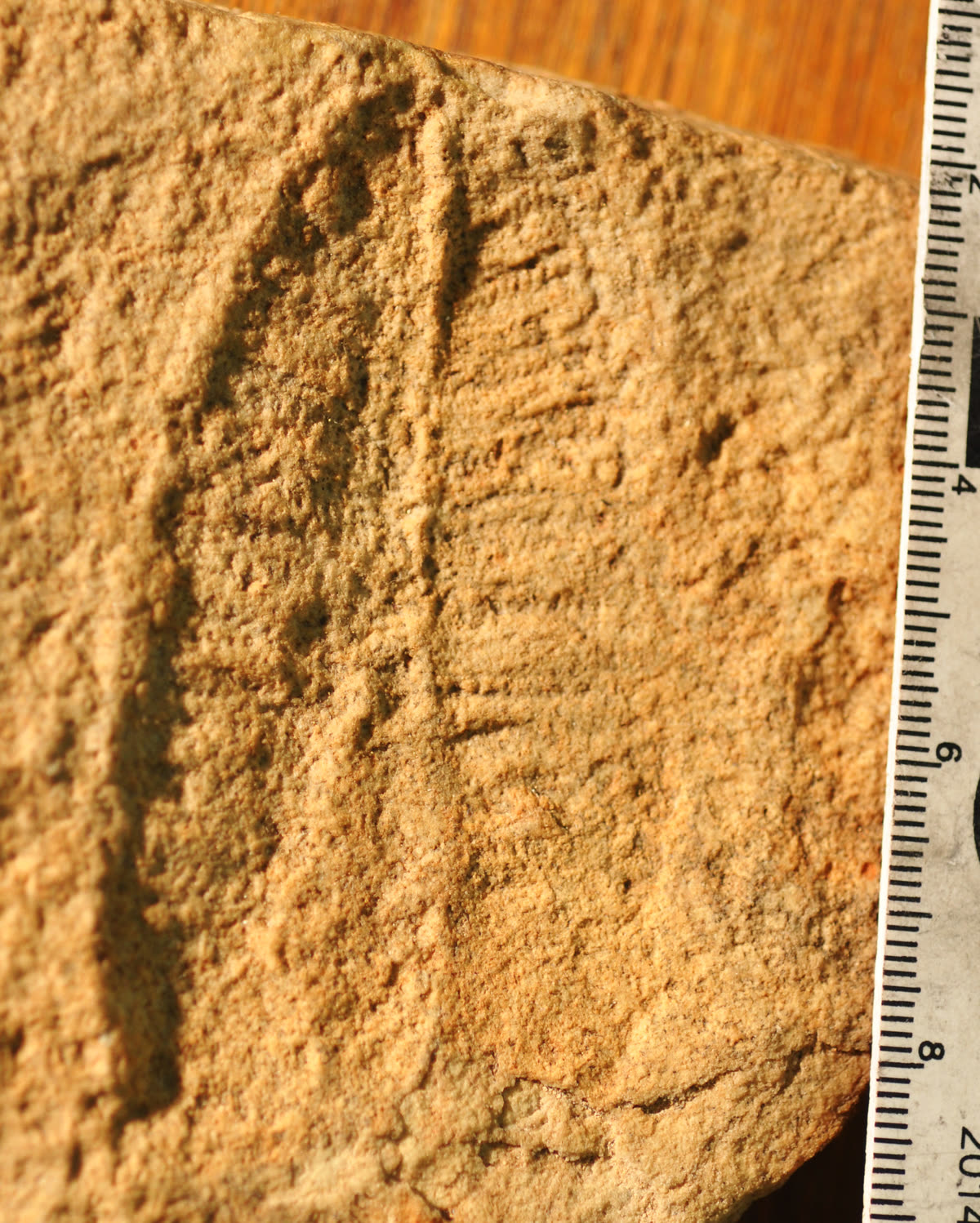
Rangea schneiderhoehni is easy to misread because the fossil looks almost botanical. The exposed surface has a leafy outline, a central line, and repeated ridges that spread outward like a pressed fern. That resemblance is the trap. Rangea matters because it was not a plant, not a modern sea pen, and not merely a pretty Ediacaran surface. It was a late Ediacaran rangeomorph whose scientific value starts when the "frond" is treated as a three-dimensional body with six vanes, repeated quilted branches, and an internal structure that had to resist collapse.[1][2]
The organism comes from the Nama Group of southern Namibia, one of the key late Ediacaran records for soft-bodied organisms close to the Cambrian boundary.[1][2] Vickers-Rich and colleagues describe Rangea as the type genus of the rangeomorphs and emphasize that new Namibian material expanded the evidence far beyond the handful of specimens that had carried earlier interpretations.[1] That matters because a fossil like this cannot be solved from one slab. Its body plan has to be assembled from many partial views, some preserving exterior ridges, others revealing internal geometry, sediment infill, or deformation.
The frond is a misleading word
Calling Rangea a frond is convenient, but it can make the organism too flat. The visible fossil surface preserves repeated quilt-like units, and those units are real anatomy in the broad sense: they mark the modular construction of the organism. But the best reconstructions do not stop at a single leaf-like panel. Vickers-Rich and colleagues argued that Rangea had a hexaradial axial bulb and an axial stalk, with radiating vanes arranged around that core.[1] In plainer terms, the organism was organized around a central three-dimensional axis, not around a decorative surface.
That is the first boundary for a good species profile. Rangea should not be treated as a failed version of a familiar plant or animal. It belongs to a vanished Ediacaran body-plan problem: large, modular organisms that were macroscopic before the fossil record fills with shells, burrows, legs, and more familiar Cambrian anatomical tools.[3] A modern analogy can help a reader enter the shape, but it cannot finish the interpretation.
The six-vaned reconstruction also changes the way size and support should be imagined. A flat impression could be dismissed as a passive sheet. A body with multiple vanes meeting around an internal axis has to solve mechanical problems. How did it hold shape? How did the vanes relate to one another? How did sediment enter or surround the body after death? Those questions pull Rangea out of the category of visual oddity and into the category of organismal engineering.[1][2]
The internal core matters
The most important newer evidence comes from seeing inside rare specimens without destroying them. Sharp, Evans, Wilson, and Vickers-Rich used high-resolution X-ray microCT on exceptionally preserved ironstone fossils from the Nama Group.[2] Their study found internal structures interpreted as boundaries between individual fronds or structural elements, branching into secondary and tertiary divisions around a central core with a distinct texture.[2]
That result is not just a better picture. It changes the claim. If a fossil preserves only an external surface, the argument has to lean heavily on outline, relief, and comparison. If it preserves internal organization, the body starts to constrain reconstruction from the inside out. The microCT work supported a rigid or semi-rigid skeleton-like construction that helped the organism maintain integrity during life rather than buckling into an arbitrary soft mass.[2]
This does not mean Rangea had a skeleton in the later animal sense of bone, shell, or mineralized armor. The safer phrase is the one the evidence supports: skeleton-like structural support.[2] The distinction matters because Ediacaran organisms are often damaged by overtranslation. A semi-rigid construction can be biologically important without being a modern skeleton. A central core can organize a body without being a backbone. The fossil becomes clearer when the language stays modest.
The central core also gives the fossil a different kind of beauty. The visible ridges are no longer merely pattern. They are the exterior trace of a branching system wrapped around internal support. Rangea becomes less like a stamped leaf and more like a body whose surface, vanes, and interior had to work together.
Feeding stays an inference, not a slogan
The hardest part of Rangea is the mode of life. Many rangeomorphs have been discussed as organisms that may have absorbed dissolved nutrients across high-surface-area bodies, while other authors have pushed back against simple osmotrophy for macroscopic organisms.[3] Butterfield's constructional and functional analysis is useful here because it places rangeomorphs inside a physical problem: large bodies cannot rely on tiny-organism assumptions without confronting fluid flow, exchange surfaces, internal space, and support.[3]
For Rangea, that means the ridged, modular body probably mattered to resource exchange, but the fossil does not preserve a mouth, gut, prey item, or feeding event that would settle the matter by itself. The shape suggests surface-area logic. The internal architecture suggests a body more organized than a flimsy sheet. The Namibian preservation suggests sediment and microbial-mat settings that affected how the body was buried and cast.[1][2] Those are strong constraints, but they are constraints, not a complete life movie.
This is why the species is more interesting when it is not forced into one modern box. It may sit near early animal-grade experiments, or near a broader extinct rangeomorph solution that does not map cleanly onto living phyla.[3] Either way, its body plan shows that late Ediacaran seas contained organisms large enough and organized enough to make engineering questions unavoidable before Cambrian animals made those questions easier to recognize.
Preservation is part of the animal story
The Namibian material is not just where Rangea happens to come from. It is part of how the organism can be known. Fossils are often preserved as molds and casts, and the unusual specimens used in CT work preserve three-dimensional information that ordinary flattened impressions cannot provide.[2] This creates a useful asymmetry. Some specimens show the visual signature that made Rangea iconic; others preserve the hidden structure that makes the icon scientifically productive.
That also means every confident reconstruction has to carry a taphonomic warning. Sediment can infill spaces. Compression can alter relief. Partial specimens can make vanes look isolated or merged. A ridge can represent a real structural boundary, a compressed surface feature, or a composite signal produced during burial. The good news is that Rangea has enough material now to make those warnings productive rather than paralyzing.[1][2]
The species therefore teaches a reading method that applies far beyond one Ediacaran fossil. Start with the surface, because the surface is what the rock gives first. Then ask what the surface hides: internal compartments, axes, support, sediment pathways, and deformation. The fossil is not less real because it needs reconstruction. It is real in exactly the way deep-time soft-bodied fossils often are: as a controlled argument between preserved shape and lost tissue.
Why Rangea still matters
The strongest profile of Rangea schneiderhoehni is neither "ancient fern" nor "first animal" headline. It is a more disciplined picture: a late Ediacaran rangeomorph from Namibia, built from repeated quilted elements arranged around a three-dimensional axis, preserved well enough in rare cases for CT imaging to reveal internal architecture, and still difficult enough that its exact biological affinity remains open.[1][2][3]
That combination is the point. Rangea makes the Ediacaran less empty without making it modern. It shows large body size before familiar animal organs become easy to read. It shows repeated modular construction before skeletons dominate the archive. It shows that the history of animal-like complexity did not begin as a simple ladder toward the Cambrian, but as a field of body plans, some of which disappeared without leaving living descendants that can explain them for us.
Read this way, the photographed slab is not just a frond-like mark. It is the exposed edge of a vanished construction system. The ridges invite the eye; the six-vaned body, internal core, and semi-rigid support make the fossil worth staying with.
Sources
- Patricia Vickers-Rich et al., "Reconstructing Rangea: New Discoveries from the Ediacaran of Southern Namibia," Journal of Paleontology 87, no. 1 (2013), Cambridge Core record.
- Alana C. Sharp, Alistair R. Evans, Siobhan A. Wilson, and Patricia Vickers-Rich, "First non-destructive internal imaging of Rangea, an icon of complex Ediacaran life," Precambrian Research 299 (2017), DOI resolver.
- Nicholas J. Butterfield, "Constructional and functional anatomy of Ediacaran rangeomorphs," Geological Magazine 159, no. 7 (2022), Cambridge Core open-access article.
- Wikimedia Commons, "File:Rangea scheiderhoehni 2.jpg," source page for the real photographed fossil used as the article image.