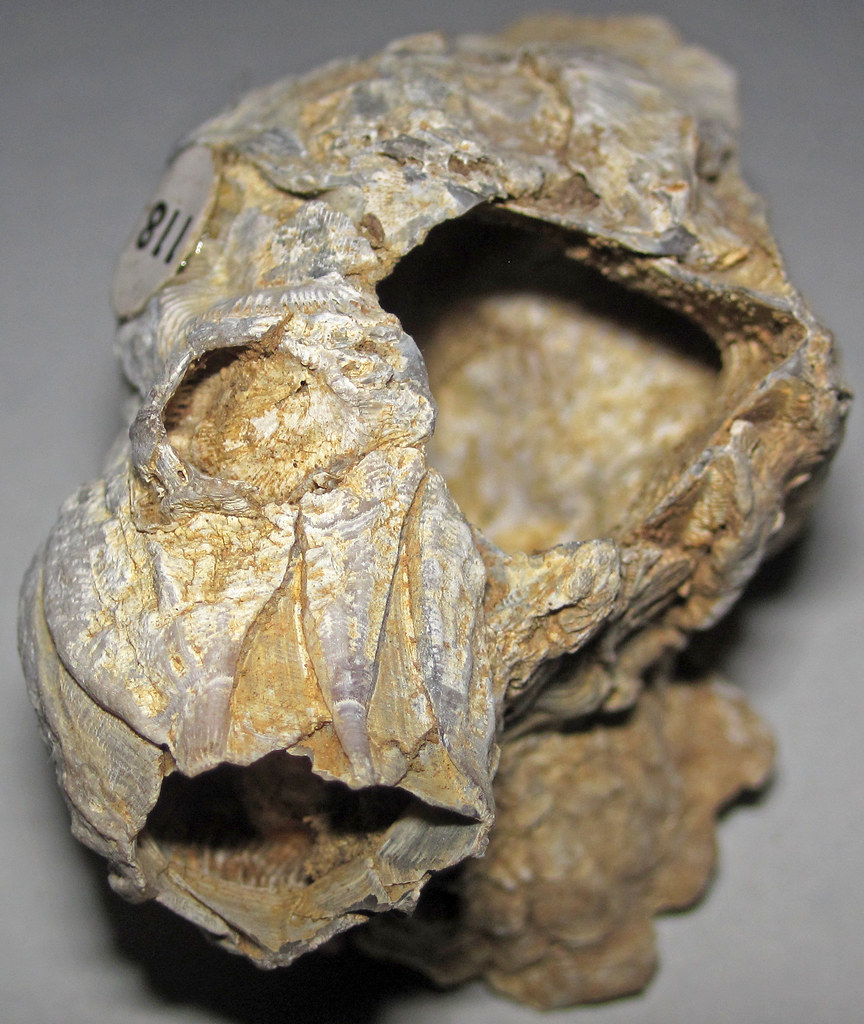
A fossil acorn barnacle looks like a tiny building whose roof has gone missing. Walls rise around an opening; seams divide the shell into separate pieces. The Miocene specimens photographed here make that construction unusually easy to see.[1] Each wall enclosed a crustacean, an animal related to crabs and shrimps, attached to a surface and feeding with modified limbs.[2]
How did such a body arise? Removing the flexible stalk from a stalked barnacle gets only partway there. Fossils preserve combinations of plates that help explain the remaining work: lowering the shell, closing its sides and fitting a movable lid into the opening.[3]
Attachment came before the acorn
The stalk of a goose barnacle can give it a loose, mobile appearance. Yet stalked barnacles are already attached adults. Losing the stalk changes how the body meets its support; it does not mark the original invention of a settled life. The free-swimming phase belongs to the larvae.[2]
That distinction matters when reading an evolutionary tree. “Stalked” and “stalkless” are useful descriptions, but they do not divide barnacles into two neatly separate ancestral families. Christine Ewers-Saucedo and colleagues' 2019 synthesis explains that stalk loss happened more than once, including in the lineage of the deep-sea barnacle Neoverruca. Similar silhouettes can therefore conceal different histories.[5]
The question becomes more exact: which parts changed in the lineage leading to acorn barnacles, and in what order?
A shoreline scattered into plates
At Ivö Klack in southern Sweden, roughly 80-million-year-old sediments preserve a Cretaceous rocky coast. Large gneiss boulders once stood among marine animals whose broken skeletons accumulated around them. Material recovered from pockets between the boulders includes abundant isolated barnacle plates.[3]
Andrew Scott Gale and Anne Mehlin Sørensen used these remains in a study published online in 2014 and in a 2015 journal volume. Their evidence was largely disarticulated: loose components requiring comparison and reconstruction. Their analysis placed several fossil forms along the branch leading toward the living acorn-barnacle group.[3]
The distinction between a branching analysis and a family portrait is essential. A fossil can preserve a useful combination of ancestral and later traits without being the actual parent population of another fossil species. Arranging specimens by their changing anatomy proposes a history that additional material can test.
Filling the gaps
In the reconstruction summarized by Benny Chan and colleagues in 2021, early stalkless forms retained a body raised above the attachment surface by overlapping scales. In Brachylepas, two large opposing plates left spaces along the sides. The proposed acorn-barnacle wall developed as scales enlarged into additional wall plates, eventually producing a more complete enclosure.[2]
This interpretation changes what counts as the same anatomical part. A plate occupying the side of an acorn barnacle need not correspond to a side plate in a stalked relative. Position alone can suggest a resemblance that evolutionary history does not support.
The proposed changes also make functional sense: a lower shell, tightly fitting wall plates and a flatter closing lid could reduce exposure to abrasion and drying. Gale and Sørensen assessed those advantages through comparison with living barnacles; the fossils preserve the structures, while their benefits are reconstructed.[3]
One low shell, several histories
The fossils have also changed the names on the family tree. In 2023, Andy Gale and Steven Vidovic compared 48 anatomical characters across 18 taxa. Their analysis supported a close relationship between acorn barnacles and the asymmetric verrucomorph barnacles. It also divided fossils formerly grouped together as Brachylepadomorpha between the stems of those two branches.[4]
A stem group contains extinct relatives closer to a particular living group than to its nearest living counterpart, but outside that group's last common ancestor and its descendants. Here, splitting the old grouping places superficially similar fossils nearer different surviving branches. The authors recommended abandoning the old order.[4]
That result remains a hypothesis with identifiable disagreements. Zhibin Gan and colleagues' 2022 mitochondrial-genome analysis did not recover acorn barnacles and verrucomorphs as sister groups. The 2023 fossil study also acknowledges continuing disagreement over the proposed correspondence of wall plates.[4][6]
The conflict concerns both relationships and the interpretation of anatomy. Resolving it requires testing whether proposed plate identities and genetic relationships can be reconciled across broader samples. Simply calling one animal “primitive” cannot do that work.
Ewers-Saucedo and colleagues' synthesis had already exposed extensive gaps in barnacle family-tree knowledge, particularly among deep-sea and Arctic forms.[5] A familiar shoreline animal can have an incompletely sampled ancestry.
Look again at the open fossil shells. Their sturdy outlines invite a single, simple origin story. The seams suggest a more interesting question: which pieces were inherited, which were enlarged, and which disappeared? Those small distinctions let loose plates recover changes that the finished silhouette conceals.
Sources
- James St. John, “Balanus concavus (fossil barnacles) (Choptank Formation, Miocene; Calvert County, Maryland, USA) 1” (2024) — original photograph and specimen provenance.
- Benny K. K. Chan and colleagues, “The evolutionary diversity of barnacles, with an updated classification of fossil and living forms,” Zoological Journal of the Linnean Society 193 (2021), 789–846 — adult attachment, feeding and the proposed evolution of shell plates; University of Portsmouth PDF.
- Andrew Scott Gale and Anne Mehlin Sørensen, “Origin of the balanomorph barnacles (Crustacea, Cirripedia, Thoracica): new evidence from the Late Cretaceous (Campanian) of Sweden,” Journal of Systematic Palaeontology 13 (2015), 791–824; online 2014 — Ivö Klack material, anatomical sequence and functional interpretation; accepted manuscript.
- Andy S. Gale and Steven U. Vidovic, “The origins of major sessile cirripede groups; a revision of Cretaceous Brachylepadomorpha and Verrucomorpha,” Journal of Systematic Palaeontology 21 (2023), 2258370 — revised fossil relationships and disputed plate homologies; University of Portsmouth PDF.
- Christine Ewers-Saucedo and colleagues, “Towards a barnacle tree of life: integrating diverse phylogenetic efforts into a comprehensive hypothesis of thecostracan evolution,” PeerJ 7 (2019), e7387 — repeated stalk loss and gaps in phylogenetic sampling.
- Zhibin Gan and colleagues, “Phylogeny and adaptative evolution to chemosynthetic habitat in barnacle (Cirripedia: Thoracica) revealed by mitogenomes,” Frontiers in Marine Science 9 (2022), 964114 — mitochondrial evidence challenging the proposed sister relationship of acorn barnacles and verrucomorphs.