A missing piece of shell opened a small window into an animal’s private life. In a broken specimen of Olenoides serratus, the familiar procession of trilobite legs changes near the rear of the body. Two successive appendages are unusually small and differently shaped. Their position became visible because part of the protective covering was gone.[2]
In Geology in 2022, Sarah Losso and Javier Ortega-Hernández proposed that these limbs were claspers, used by a male to hold a female during mating. Their interpretation draws on comparison with living animals.[1]
Looking below the shield
Olenoides serratus lived in the Cambrian sea recorded by the Burgess Shale of British Columbia. Its segmented shield, pointed margins and broad tail plate give it a recognizable outline. The Royal Ontario Museum’s fossil gallery also shows the less familiar animal underneath: jointed legs, antennae and other delicate structures preserved alongside the armor.[3]
Preservation favors the armor. Trilobite shields were reinforced with calcium carbonate; their appendages lacked that reinforcement and fossilized less readily. Even a preserved leg can remain concealed beneath the shield. An incomplete specimen can expose anatomy hidden in a whole one.[2]
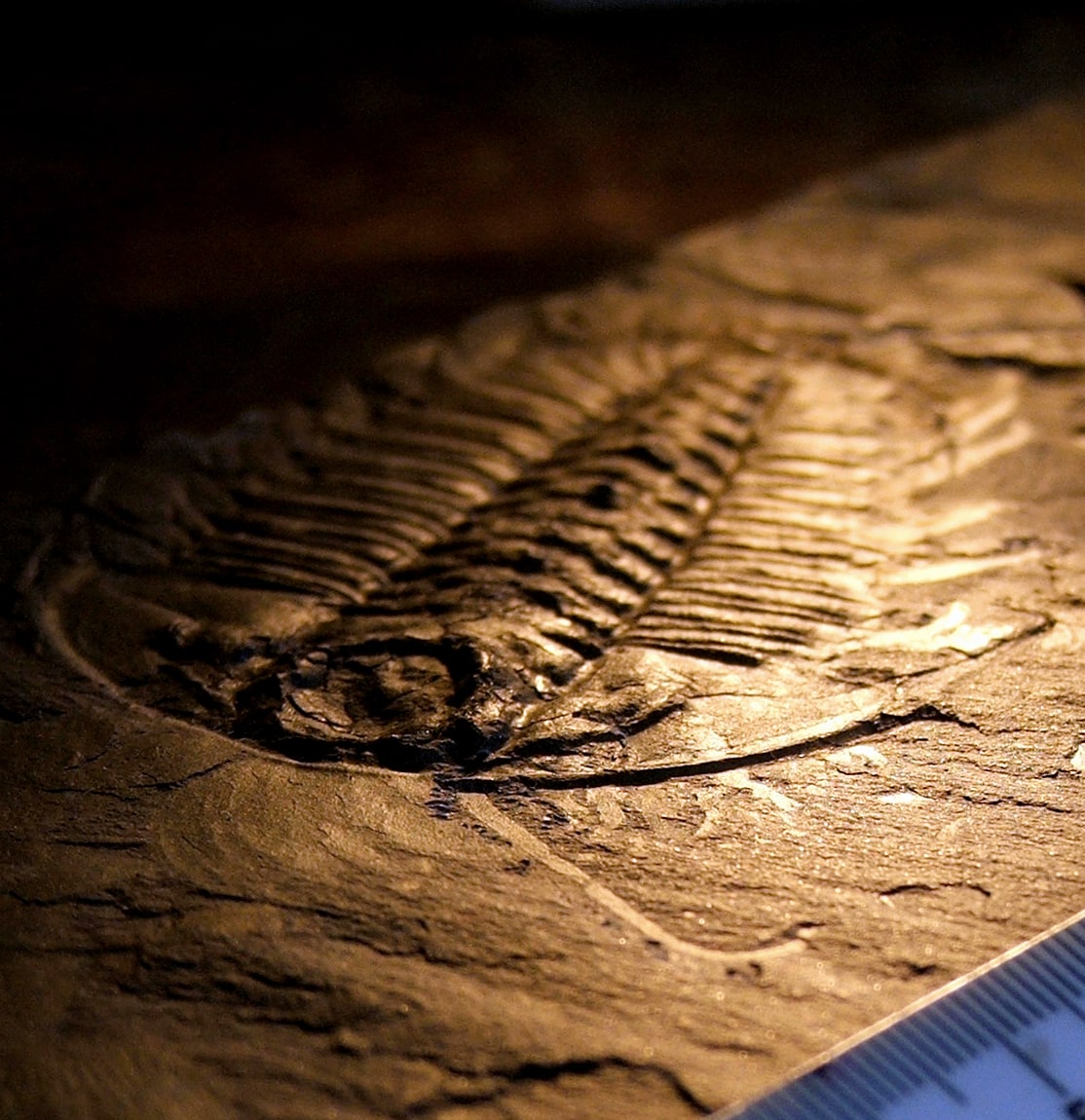
The photograph above makes the problem tangible. Light catches the thin remains of an antenna and appendages beside the body. This photographed fossil illustrates the kind of preservation that brings the underside into view; it is a different individual from the proposed male discussed here.[5]
The key research specimen, ROMIP 66299, belongs to the Royal Ontario Museum. It came from Walcott Quarry, whose deposits the 2022 paper places at approximately 508 million years old. The animal remains articulated despite its missing parts, allowing the researchers to locate the unusual appendages within the body.[1]
When a leg changes jobs
The modifications lie beneath the last thoracic segment and the first segment incorporated into the tail shield, or pygidium. These are the inner limb branches, called endopodites. Ordinary limbs survive elsewhere on the same fossil, providing a comparison within one individual. The researchers interpreted the distinctive reduced branches as parts of two clasper pairs; the exposed structures themselves are on one side.[1]
Smallness alone would be weak evidence. A damaged or regenerating limb could also be short. The Natural History Museum’s account of the study, including comments from its reviewer Greg Edgecombe, explains why the repeated, distinctive form mattered: the modifications occurred at successive positions rather than appearing as one isolated abnormality.[2]
That reasoning gives the damaged fossil an unexpected advantage. It contains both the proposed specialization and the ordinary equipment against which to judge it. The question becomes whether a consistent change in form fits a different task. An isolated tiny limb, detached from its owner, would leave far more room for competing explanations.
The distinction also changes what researchers can ask of museum collections. The promising place to look is a particular stretch of the underside. Another intact shield of the same species might be worth examining precisely because it covers the corresponding limbs.[2]
The grip is a hypothesis about behavior
The authors’ functional comparison was with living male horseshoe crabs, which hold females using modified appendages. They proposed that Olenoides could have gripped spines on a female’s tail shield. This makes the animal’s spiny outline part of a possible interaction between two bodies.[1]
The observation and the interpretation sit at different levels. The fossil shows differentiated appendages; identifying them as male mating equipment draws on comparative anatomy. The exact posture, the duration of attachment and the sequence of movements are not preserved. An illustration can supply those missing actions, but its apparent completeness should not be mistaken for additional evidence.
Nor does a useful comparison settle ancestry. The Royal Ontario Museum’s account notes continuing disagreement over trilobites’ relationships to other major arthropod groups. A limb that could perform a similar gripping task is evidence about function; placing an entire extinct group on the family tree requires a much broader set of characters.[3]
A comparison that can be tested
A later investigation made that boundary especially useful. In 2025, Losso and colleagues measured preserved limb-joint angles to reconstruct Olenoides mobility and compare it with the Atlantic horseshoe crab, Limulus polyphemus. Their BMC Biology study found that the trilobite’s legs had a more restricted range of motion, particularly toward their outer ends.[4]
The paper retained the clasper interpretation for ROMIP 66299. It also showed why exceptional flexibility alone would be a poor diagnostic feature: an ordinary limb could display similarly acute bending at a different joint. The case for a specialized grasping role rests on the combined shape, proportions and position of the modified limbs.[4]
This is how a living comparison becomes more informative. Similarity suggests a function worth investigating; measurements establish which parts of the analogy hold. The horseshoe crab supplies a plausible example of holding a mate without supplying every movement of a Cambrian trilobite.[4]
The most revealing feature of ROMIP 66299 is therefore a local interruption in a familiar pattern. Beneath a shield whose broad outline was already well known, a few limbs appear to have acquired another job. The missing shell gave those limbs a chance to be seen. Their significance emerged from keeping the ordinary legs, the altered ones and the inferred behavior in the same field of view.
Sources
- Sarah R. Losso and Javier Ortega-Hernández, “Claspers in the mid-Cambrian Olenoides serratus indicate horseshoe crab-like mating in trilobites.” Geology 50 (2022), 897–901; authors’ institutional publication record and abstract for the original study, DOI 10.1130/G49872.1.
- James Ashworth, “Trilobite fossil reveals how ancient arthropods mated.” Natural History Museum, 11 May 2022; interviews with the researchers and paper reviewer Greg Edgecombe on preservation and alternative explanations.
- Royal Ontario Museum, “Olenoides serratus.” The Burgess Shale fossil gallery; specimen photographs, body anatomy, locality and the uncertainty around trilobite relationships.
- Sarah R. Losso, Karma Nanglu, Walker C. Weyland and Javier Ortega-Hernández, “Quantification of leg mobility in the Burgess Shale Olenoides serratus indicates functional differences between trilobite and xiphosuran appendages.” BMC Biology 23, 238 (2025); measured mobility and discussion of the clasper specimen.
- Smith609, “Olenoides serratus oblique with antennas.jpg.” Wikimedia Commons; photographic image of preserved antenna and appendages, available under CC BY 2.5.