Deinotherium is often introduced as a prehistoric elephant with a pair of tusks hooked under the chin.[1][5] That shorthand is memorable and anatomically weak. Once the lower jaw becomes the center of the profile, the whole animal changes shape. The tusks did not erupt from the upper jaw as they do in living elephants. The cheek teeth were built for soft browse rather than abrasive grass. The limbs were long, the body was tall, and the best Miocene settings place the animal in wooded riverine landscapes rather than in an abstract megafaunal haze.[1][2][3][5]
That is why the genus still deserves a disciplined reading in 2026. The Natural History Museum Mainz page on the Miocene keeps the habitat in view: around 10 million years ago, the ancient Rhine ran through a broad valley with gallery forests along the banks and open forest behind them.[1] The Hessisches Landesmuseum Darmstadt page adds the specific deposit history. The approximately 10-million-year-old Dinotherium Sands of Rhine-Hesse preserve large mammals from that ancient Rhine system, and the area yielded the upper skull of a deinothere already in 1835.[2] The profile therefore begins in a real landscape and a real collection history, not in a lineup of monster mammals.
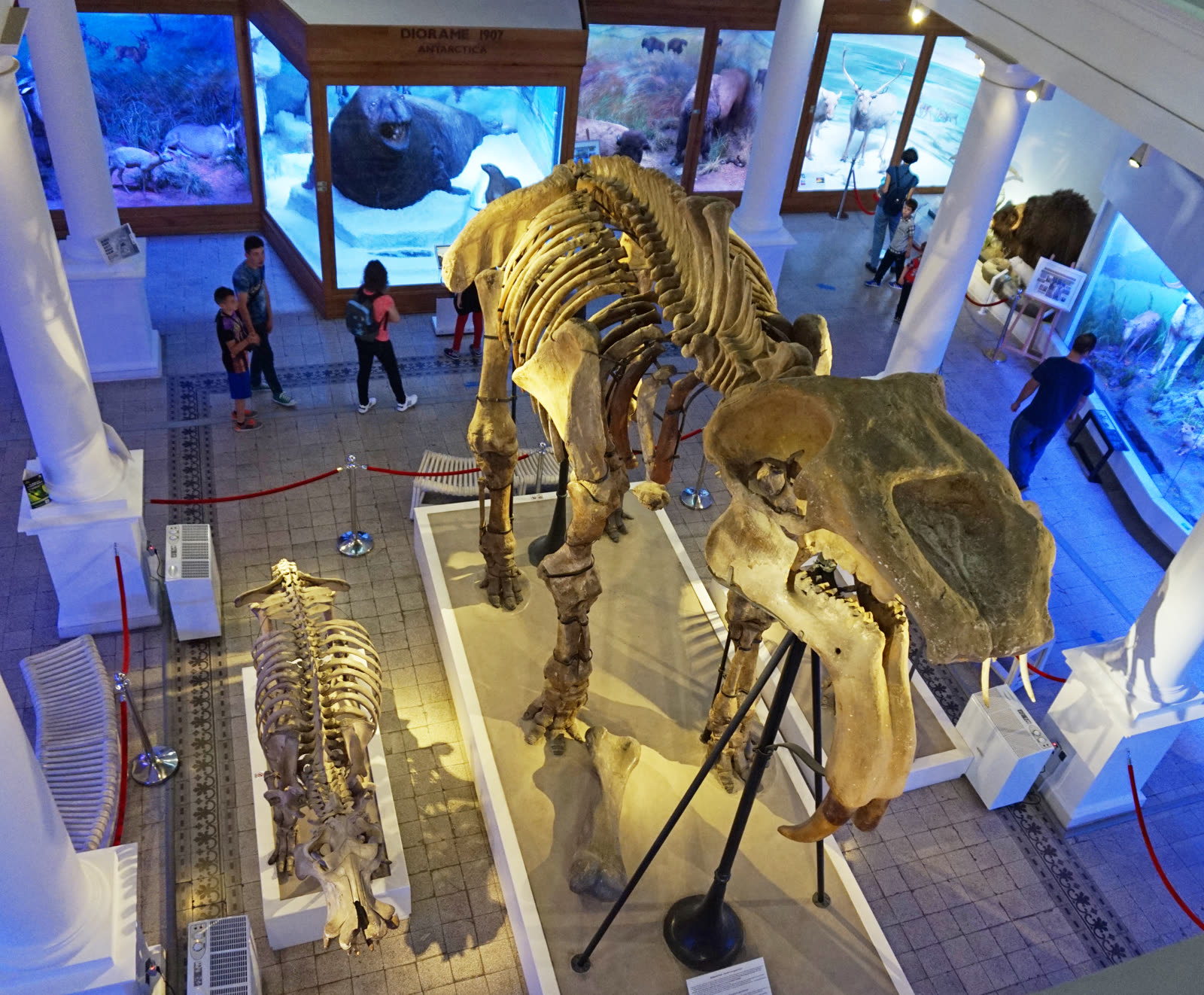
Image context: the cover uses a real Wikimedia Commons photograph of a mounted Deinotherium skeleton at the Grigore Antipa Natural History Museum in Bucharest.[6] It belongs here because the full body does more work than a detached tusk or an old restoration. The long legs, elevated shoulders, and downward-curving lower tusks hold the central point together: this was a giant browser with a feeding apparatus and stance unlike those of modern elephants.
1. The lower tusks matter because they reorganize the whole head
The most immediate correction is dental. Mainz summarizes the decisive feature clearly: Deinotherium giganteum carried backward-curving tusks in the lower jaw and was only distantly related to today's elephants.[1] The Burgas museum page makes the same contrast in plainer terms, noting that the tusks were positioned on the lower jaw and directed downward rather than projecting from the upper face as in living elephants.[5] This is not a cosmetic relocation. It changes how the skull met vegetation and how the trunk, jaw, and tusks would have interacted during feeding.
The old feeding-mechanics paper by M. R. K. Sanders remains useful precisely because it resisted the simplest guess.[4] Digging has long been an intuitive explanation for downward tusks, but Sanders argued that digging was unlikely and treated vegetation-stripping, purchase for the trunk, and display or recognition as more plausible functions.[4] That boundary still holds up well. The fossil evidence supports a highly unusual lower-jaw tool. It does not support a single fully closed behavioral script.
That uncertainty is a strength rather than a weakness. In paleontology, the best profiles often begin when one flamboyant structure stops being treated as a mascot feature and starts being read as a mechanical problem. Deinotherium keeps that problem open. The tusks are secure. Their exact behavior remains debated. The safe conclusion is already substantial: this was a proboscidean whose feeding apparatus diverged sharply from the line that later produced mammoths and living elephants.[1][4][5]
2. The body fits high browsing better than a generic elephant silhouette
Once the head is handled properly, the rest of the animal stops looking so familiar. Mainz notes that increasing body size let later deinotheres reach leaves on high branches.[1] That point matters because it links stature to ecology. A very large herbivore can be impressive in any environment, but Deinotherium becomes more specific when size is read as access. Long limbs and great height are not just spectacle here. They belong to a browser operating above much of the surrounding vegetation.[1][3]
The Hammerschmiede work sharpens this interpretation. The 2023 Journal of Mammalian Evolution paper describes deinothere material from fossil layers dated to 11.62, 11.44, and 11.42 million years ago, and its CT-scanned juvenile mandible shows erupting permanent lower tusks already developing deep in the bone.[3] The accompanying University of Tübingen release then makes the ecological split explicit: while the coexisting proboscidean Tetralophodon likely ate a mixed diet of leaves, twigs, and grass, Deinotherium is described there as a pure leaf-eater.[3][4]
That distinction helps the profile resist a common flattening move. Proboscideans are often grouped together so loosely that their diets blur into one giant-herbivore category. Here the sources point in a narrower direction. Deinotherium belongs in wooded feeding space, with a body plan and dentition suited to leaf browsing rather than to heavy grazing.[1][3][4] The important thing is not that every meal can be reconstructed. The important thing is that the profile has a stable dietary center.
3. The Rhine sands and later giants keep the genus inside environmental history
The Darmstadt and Mainz pages are especially valuable because they keep deinotheres tied to place.[1][2] The Dinotherium Sands were not a mythic age of giants. They were deposits of the ancient Rhine, stretched between Westhofen, Eppelsheim, Alzey, and Bingen, with alluvial forests and grassy riverbanks in the immediate habitat.[2] That setting helps explain why a tall browser would belong there naturally.
It also keeps the later giant species from being read as free-floating extremes. Mainz says deinotheres originated in Africa and migrated into Asia and Europe, where larger species developed over time.[1] The Tübingen release adds a climatic frame: after roughly 11 million years ago, increasingly humid conditions and stronger woodland development in Europe favored leaf-feeding deinotheres and supported the evolution of the larger species Deinotherium giganteum.[4] In that reading, gigantism is not just a record-book detail. It sits inside a shift in vegetation and available browse.
The extinction side should stay equally bounded. Mainz notes that the last European species died out about 3.5 million years ago and presents climate change, steppe expansion, and stronger seasonality as a plausible reason why the immense year-round food demand could no longer be met.[1] That is a disciplined explanation because it stays ecological. It does not pretend that one dramatic event solved the whole deinothere story. It says the body plan had become expensive in a world that was changing the wrong way for a giant browser.
4. The juvenile jaw is a reminder that life history matters too
One of the best recent additions to the profile is developmental rather than spectacular. The Hammerschmiede juvenile is important because it captured a short life-history phase rarely preserved in proboscideans.[3][4] Tübingen notes that this young deinothere preserved both the milk tusk and the permanent lower tusks developing beneath it, making it only the third such record worldwide for deinotheres.[4] That detail does not change the silhouette, but it changes the depth of the profile.
Instead of seeing the lower tusks only as adult ornament or adult weaponry, we can now place them in ontogeny. They were early and central enough in development to appear while the milk dentition was still present.[3][4] That is the kind of evidence that makes a fossil taxon feel less like a finished icon and more like an organism with a life history.
Put together, the strongest version of Deinotherium is cleaner than the old catchphrase. It was a giant Old World proboscidean, but not a generic fossil elephant.[1][2][5] Its lower tusks changed the whole head, its browsing ecology changed the meaning of its height, and its Miocene riverine settings keep the animal grounded in a specific environmental world.[1][2][3][4] That combination is enough to make the genus memorable on stronger terms. The profile lasts because anatomy, habitat, and development all point in the same direction: Deinotherium was one of the clearest browsing alternatives that proboscidean evolution ever produced.
Sources
- Natural History Museum Mainz, "Miocene" - exhibition page covering the ancient Rhine setting, gallery forests, Deinotherium giganteum, body-size increase, and the browsing-height interpretation.
- Hessisches Landesmuseum Darmstadt, "Palaeontology" - collection page on the Dinotherium Sands, the ancient Rhine habitat, and the 1835 excavated deinothere skull from Rhine-Hesse.
- George E. Konidaris, Thomas Lechner, Panagiotis Kampouridis, and Madelaine Bohme, "Deinotherium levius and Tetralophodon longirostris (Proboscidea, Mammalia) from the Late Miocene hominid locality Hammerschmiede (Bavaria, Germany), and their biostratigraphic significance for the terrestrial faunas of the European Miocene," Journal of Mammalian Evolution (2023).
- University of Tubingen, "Proboscideans from Hammerschmiede, contemporaries of the ape Udo" - research release on the juvenile deinothere mandible, milk tusk, permanent lower tusks, and leaf-feeding niche.
- M. R. K. Sanders, "Evolution of feeding mechanisms in the family Deinotheriidae (Mammalia: Proboscidea)," Zoological Journal of the Linnean Society 56, no. 4 (1975).
- Wikimedia Commons, "File:Deinotherium Gigantissimum skeleton.jpg" - source page for the museum skeleton photograph used as the lead image.