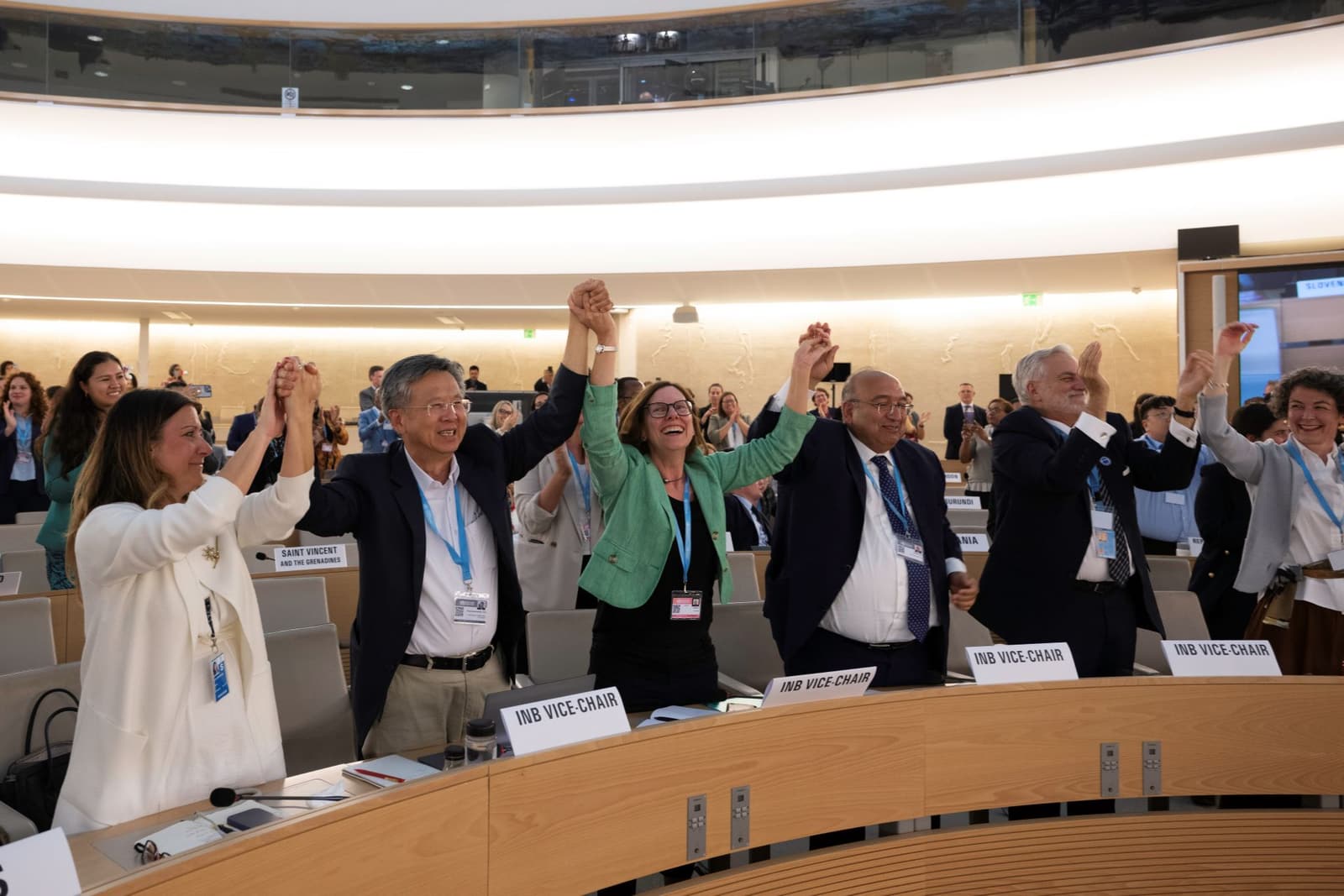
As of 2026-03-24 16:00 UTC, the WHO Pandemic Agreement is in an unusual position: it is already adopted, but it is not yet open for signature or ratification. Member States adopted the agreement at the Seventy-eighth World Health Assembly on 20 May 2025, but Article 31 ties the signature window to a later decision by the Assembly to adopt the Pathogen Access and Benefit Sharing (PABS) annex.[1][2][3] That annex is still under negotiation, and the sixth meeting of the Intergovernmental Working Group (IGWG) is running this week, from 23 to 28 March 2026.[4]
This means the core policy risk has shifted. The question is no longer whether governments can produce a treaty text. The question is whether they can finish the annex that starts the treaty's legal life as a signable, ratifiable instrument.[2][4][5]
What is already settled
The high-level political part is finished. WHO Member States approved the agreement in Committee A by 124 votes in favour, 0 objections, and 11 abstentions, and the Assembly then adopted it in plenary.[1] WHO's own implementation notes also make two downstream rules explicit: the agreement opens for signature only after the Assembly adopts the PABS annex, and it enters into force only after 60 ratifications.[1][2]
That matters because the agreement is not an aspirational declaration anymore. It is a completed legal text waiting on a final procedural and operational gate.
Why the PABS annex is the real bottleneck
The PABS annex is not a side document. WHO describes it as a priority task for the IGWG and as the mechanism meant to govern how pathogen materials and sequence information are shared, and how benefits flow back through equitable access arrangements.[2][4][5] The agreement's headline promise on access also runs through this pipe: WHO says manufacturers participating in the PABS system would be expected to make available rapid access targeting 20% of real-time production of relevant vaccines, therapeutics, and diagnostics during a pandemic emergency.[1]
So the current bottleneck is operational, not rhetorical. Countries already have the frame; what they still lack is the annex that turns the frame into a signature-ready package and gives national governments something concrete to cost, scrutinize, and take home for ratification.[2][5][6]
Facts that matter this week
- Status: adopted agreement, not yet open for signature.[1][2][3]
- Current live process: IGWG sixth meeting, 23-28 March 2026.[4]
- Next formal checkpoint: the PABS annex is expected to be submitted to WHA79 in 2026 for consideration.[5]
- Legal trigger after that: entry into force comes only after 60 ratifications, so even a successful May outcome starts the ratification phase rather than finishing it.[1][2]
Decision impact by horizon
Next 24 hours
Watch whether IGWG6 produces visible text convergence on governance, access conditions, and benefit-sharing mechanics. If the meeting remains mostly positional, the process heads toward WHA79 with too much unresolved language for a clean launch.[4][6]
Next 7 days
Health ministries, negotiators, donors, and manufacturers need to separate three questions that often get blurred together:
- the agreement has been adopted;
- the annex is still being negotiated;
- ratification cannot begin until the annex clears the Assembly.[1][2][5]
That sequencing determines whether May is a launch point or another rollover.
Next 30 days
The practical issue becomes calendar compression. If March negotiations narrow the unresolved text, WHA79 can function as an opening move for signature. If they do not, the agreement risks carrying symbolic success without starting its ratification clock.[4][5][6]
Scenario map
Base case: IGWG6 trims differences but does not fully close them. WHA79 receives a near-final annex, and Member States either adopt it with late compromise or narrow the remaining issues enough to set a short final drafting lane. The agreement then opens for signature on a delayed but still credible timetable.[2][4][5]
Upside case: March talks produce enough convergence that WHA79 adopts the annex cleanly. The treaty opens for signature with a clear schedule, and countries can shift from negotiation posture to domestic ratification planning before mid-2026.[2][5]
Downside case: the annex remains too contested on access, governance, or benefit-sharing terms. WHA79 cannot finish the job, and the agreement stays in a politically important but legally pre-signature state. That would not kill the accord, but it would extend uncertainty around implementation design and ratification sequencing.[4][5][6]
Action checklist
- Treat annex adoption, not the 2025 agreement vote, as the next decisive gate.[1][2]
- Monitor IGWG outputs for narrowing text, not only optimistic closing statements.[4][6]
- Model 60 ratifications as a second-stage hurdle after the signature window opens.[1][2]
- For manufacturers and access-focused governments, watch whether the PABS language makes the 20% access commitment operational rather than merely directional.[1][5]
Invalidation condition
The core claim here is that the agreement's main current bottleneck is the unfinished PABS annex.
That claim weakens quickly if WHA79 adopts the annex on schedule and opens signature with a clear timetable. It strengthens if March and May produce more process continuation without a signature-ready annex.[2][5][6]
Sources
- WHO, "World Health Assembly adopts historic Pandemic Agreement to make the world more equitable and safer from future pandemics" (20 May 2025).
- WHO, "Pandemic prevention, preparedness and response agreement" Q&A (27 June 2025).
- World Health Assembly, Resolution WHA78.1 and annexed WHO Pandemic Agreement text (2025).
- WHO, "Intergovernmental Working Group on the WHO Pandemic Agreement (IGWG)" timeline page.
- WHO, "Fifth meeting of the Intergovernmental Working Group (IGWG) on the WHO Pandemic Agreement" (9-14 February 2026).
- WHO, "Global commitment on display as countries negotiate key annex to the Pandemic Agreement" (17 February 2026).