As of 2026-03-25 02:10 UTC, the most visible Artemis headline is simple: NASA got Artemis II back to Launch Pad 39B on March 20 after a late-February rollback to troubleshoot interrupted helium flow to the upper stage, and the agency still says launch could begin as soon as April 1, with early-window opportunities through April 6.[1][2][3][4] Read narrowly, that is a recovery story. Read institutionally, it is also something larger. NASA's more consequential move came on February 27, when it rewired the Artemis sequence by adding a new 2027 mission and turning Artemis III into an in-space systems test rather than the first landing attempt.[5]
That distinction matters because the pad return and the architecture reset solve different problems. The first says NASA can still close out a near-term launch campaign after a ground-to-rocket hardware interruption. The second says NASA no longer wants the first crewed lunar flyby to sit immediately upstream of the highest-risk lander and surface operations. Put differently: the April question is whether Artemis II can fly; the larger March question is what NASA decided Artemis II should no longer have to prove.
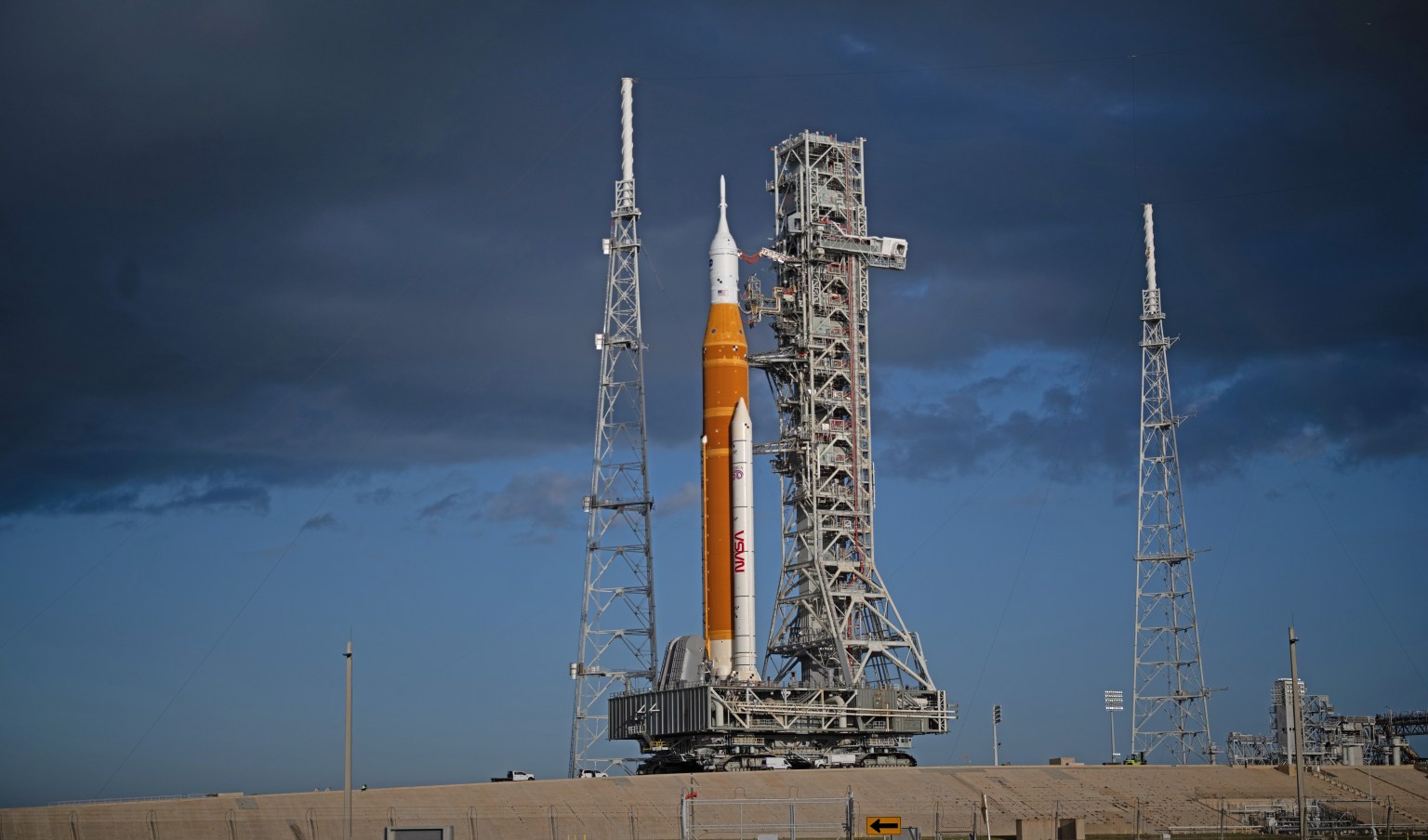
Lead image: NASA's March 20 rollout photo shows the Space Launch System and Orion heading back to Pad 39B. It is the right documentary image because this article is about the difference between restoring a launch flow and de-risking the larger Moon-landing architecture.
What the pad return actually proves
The physical recovery is real. On February 21, NASA said engineers had seen interrupted helium flow to the Interim Cryogenic Propulsion Stage after a wet dress rehearsal and warned that protecting troubleshooting options could require a rollback while still trying to preserve an April launch window.[4] On March 3, the agency said engineers found that a seal in the quick disconnect was obstructing the helium path, removed and reassembled the hardware, began validation, and used the Vehicle Assembly Building stop to refresh batteries and range-safety systems as well.[3]
By March 12, NASA completed its Flight Readiness Review and polled "go" to proceed toward launch, targeting rollout for March 19 and an April 1 attempt pending closeout of remaining work.[2] By March 20, the rocket was back at Pad 39B and NASA restored an explicit early-April launch lane.[1]
That sequence is more meaningful than a generic "schedule slip recovered" label. It shows the agency closed a specific interface problem between ground systems and the upper stage without letting it cascade into a long stand-down. For a program that has often looked vulnerable to compounded delay, the important short-term signal is that NASA found a bounded technical fault, repaired it, and got back to the pad inside the next window rather than months later.[1][2][3][4]
Why the architecture reset matters more than the launch headline
If the pad return is the visible story, the architecture revision is the strategic one. NASA's February 27 announcement did three things at once: it said the agency would standardize vehicle configuration, add an additional mission in 2027, and redesign Artemis III so it performs rendezvous, docking, in-space checkout, and suit and communications tests in Earth orbit before Artemis IV attempts a landing in 2028.[5]
That is not a cosmetic sequence tweak. It is NASA admitting that the old program shape was carrying too much development risk in one jump. The revised Artemis III is now supposed to absorb the systems-integration work that would otherwise have been bundled into the first landing stack: commercial landers, in-space interfaces, life-support checkout, propulsion integration, and xEVA suit testing.[5] In effect, NASA has inserted a buffer mission between the first crewed lunar flyby and the first landing.
Seen that way, Artemis II's renewed launch readiness is best read as a boundary marker. NASA is telling industry, Congress, and the public that the near-term crewed mission can proceed on its own terms while the agency stops pretending that lander maturity belongs on the same critical path. The April launch window therefore matters less as a referendum on the whole Artemis architecture than as proof that NASA wants to separate what can fly now from what still needs a larger systems test.
Why NASA had reason to separate those risks
The strongest evidence for that separation comes from NASA's own watchdog. The Office of Inspector General wrote on March 10 that human-landing-system development challenges will delay planned Artemis launch dates and that NASA still lacks the ability to rescue crew stranded in space or on the lunar surface.[6] That same warning does not erase the value of Artemis II; it explains the logic of the new sequence.
Once that OIG finding is put next to NASA's February architecture change, the underlying program logic comes into focus. Artemis II is being treated as a crewed deep-space operations mission with a clear, bounded objective: fly four astronauts around the Moon and back on an approximately 10-day mission.[1] The landing campaign, by contrast, still depends on commercial landers, transfer operations, suit readiness, and rescue planning that remain less mature.[5][6]
NASA's decision to insert a 2027 mission is therefore best understood as schedule separation rather than acceleration theater. The agency can still talk about higher future cadence, but the operational substance is that it moved the most fragile dependencies one mission farther away from the first crewed lunar return.[5]
What still moves the file from here
None of this means Artemis II is finished with risk. The immediate launch campaign still has to clear final closeout work, weather, range coordination, and the normal failure modes of a new crewed heavy-lift mission.[1][2] If the agency slips cleanly inside the April window, the thesis here survives. If hardware issues reopen after rollout, the short-term recovery story weakens fast.
But even a smooth Artemis II launch would not settle the harder Artemis question. The unresolved issue would still be whether NASA and its partners can turn the revised 2027 mission into a genuine de-risking step rather than a postponement label. The signal to watch is not just whether Artemis II flies; it is whether NASA publishes detailed objectives for the redefined Artemis III and whether commercial lander milestones begin closing at the rate the new calendar assumes.[5][6]
What to watch over the next 30 days
- Countdown integrity: whether NASA stays inside the April 1-6 opportunity set after final pad work.[1][2]
- Mission-boundary discipline: whether NASA continues talking about Artemis II as a flyby mission rather than quietly reloading it with expectations the February reset was designed to remove.[5]
- Post-reset specificity: whether the agency publishes the promised detailed objectives for the revised 2027 Artemis III systems test.[5]
- Lander reality: whether follow-on reporting from NASA or the OIG shows commercial landing-system milestones tightening or continuing to drift.[6]
The cleanest read, for now, is this: Artemis II's return to Pad 39B is important because it shows NASA repaired a near-term problem without losing the next launch window. The bigger news is that NASA also used March to redefine what counts as the critical path to the Moon. Artemis II is back on schedule. The landing stack, by design, is no longer directly behind it.
Sources
- NASA, "NASA's Artemis II Rocket Arrives at Launch Pad 39B" (March 20, 2026).
- NASA, "Artemis II Flight Readiness Polls Go to Proceed Toward April Launch" (March 12, 2026).
- NASA, "NASA Repairs Upper Stage Helium Flow, Preps Continue Ahead of Rollout" (March 3, 2026).
- NASA, "NASA Troubleshooting Artemis II Rocket Upper Stage Issue, Preparing to Roll Back" (February 21, 2026).
- NASA, "NASA Adds Mission to Artemis Lunar Program, Updates Architecture" (February 27, 2026).
- NASA Office of Inspector General, "NASA's Management of the Human Landing System Contracts" (March 10, 2026).
Editor’s Pick Review
This piece wins today’s pool because it keeps a clean separation between two timelines that most coverage blends: the immediate pad-return recovery and the deeper program-architecture reset. The argument stays falsifiable, numerically anchored, and source-traceable while avoiding launch-theater hype.
It also clears the stricter visual policy with a topic-grounded documentary image (actual March 2026 rollout context) and no analytical graphics. Chinese translation quality is publication-ready with stable terminology, coherent rhythm, and full metadata alignment (translationStatus, translationOf, sourceFile).