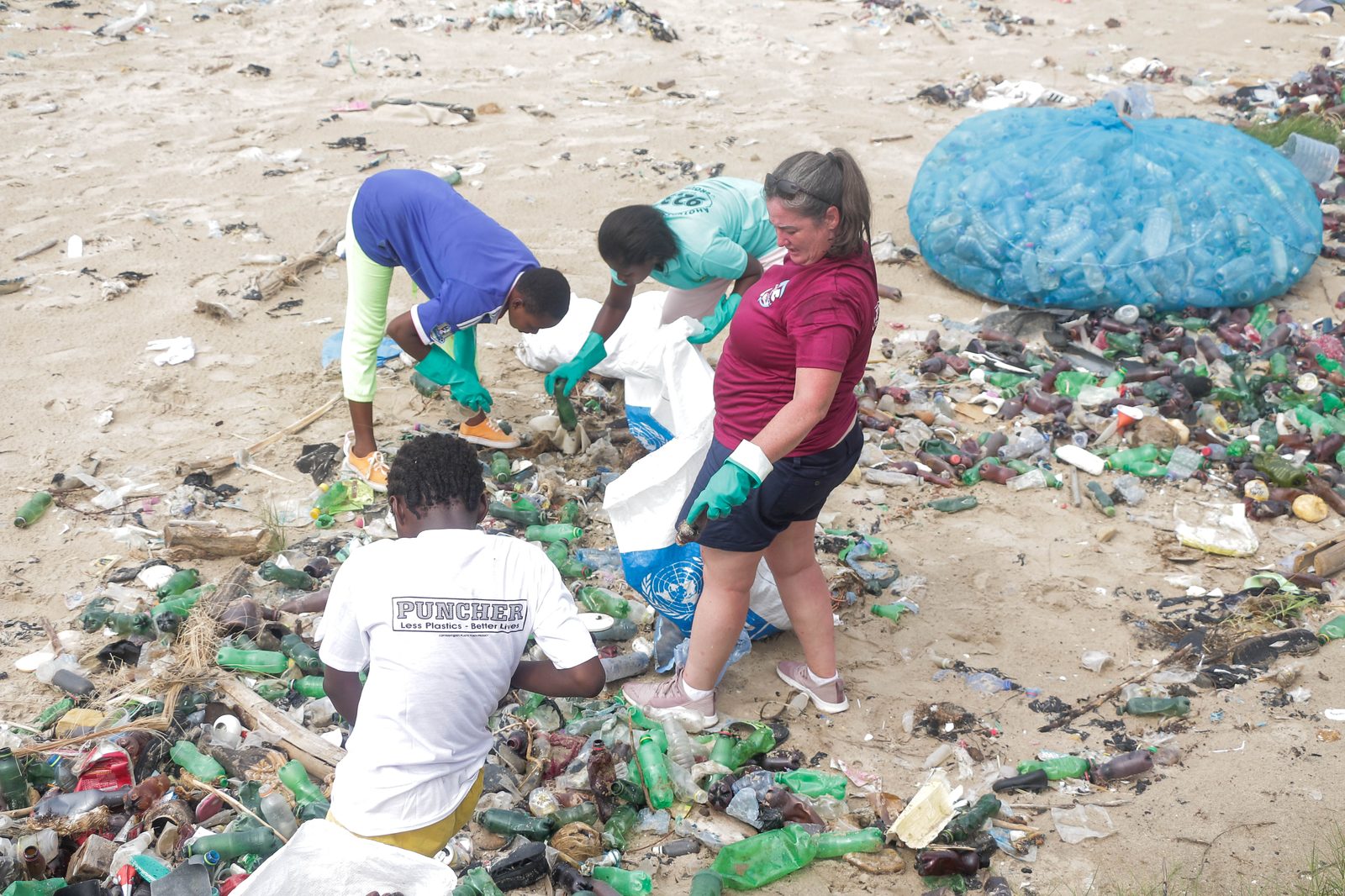
As of 2026-03-24 08:00 UTC, the Intergovernmental Negotiating Committee (INC) convened by UNEP to deliver a legally binding global plastics treaty has not produced a final agreement. The original mandate — set by the UN Environment Assembly at UNEA-5.2 in March 2022 — called for completing negotiations by the end of 2024.[1] INC-5, held in Busan, South Korea in late November and early December 2024, concluded without a binding text.[2][3] A resumed session has been called, but the structural divide that ended Busan has not been resolved.
The reason is not a lack of political will in the aggregate. The reason is that the negotiation contains two fundamentally incompatible positions on what the treaty should actually do.
What the INC process was supposed to deliver
The UNEA-5.2 resolution that launched the negotiations (Resolution 5/14, March 2022) called for a legally binding instrument covering the full lifecycle of plastics — from polymer production through design, use, disposal, and environmental remediation.[1] The scope language was deliberately broad, and that breadth has driven the negotiating conflict ever since.
Key milestones before Busan:
| Session | Location | Date | Key development |
|---|---|---|---|
| INC-1 | Punta del Este, Uruguay | Nov 2022 | Mandate framing; working groups established |
| INC-2 | Paris, France | May–Jun 2023 | Text options tabled; production language debated |
| INC-3 | Nairobi, Kenya | Nov 2023 | Consolidated text circulated; deep divide visible |
| INC-4 | Ottawa, Canada | Apr 2024 | Drafting continued; no convergence on production articles |
| INC-5 | Busan, South Korea | Nov–Dec 2024 | Session ended without final text; resumed session called |
Sources: UNEP INC secretariat communications and IISD Earth Negotiations Bulletin session reports.[1][2][3]
The fault line: production caps versus waste management
The technical disagreement at the centre of the stall is not complex. It is a binary choice about ambition.
Position A — the "High Ambition Coalition" and like-minded parties (EU, small island developing states, a significant share of the ~175 member negotiating bloc): The treaty should mandate measurable reductions in primary plastic polymer production. This position treats overproduction as the root cause of plastic pollution and argues that waste management alone cannot close the gap when global plastic output is growing by roughly 4% per year — already past 430 million tonnes annually as of 2023.[4][5] Under this view, a treaty that only governs the disposal end of the lifecycle is structurally unable to meet its own goals.
Position B — petrochemical-producing states and associated industry coalitions: The treaty scope should focus on waste infrastructure, recycling, and end-of-life management. Production levels are a matter of sovereign economic policy, not treaty jurisdiction. Saudi Arabia, Russia, Iran, and a group of Gulf and oil-producing states have consistently held this position, resisting any text that creates binding production reduction obligations.[2][3]
These two positions are not amenable to word-smithing. A treaty that contains binding production caps is categorically different from one that does not, and the difference cannot be bridged by softer language around "lifecycle approaches" or "extended producer responsibility" frameworks without choosing one framework over the other at a structural level.
Why Busan collapsed
INC-5 Chair Luis Vayas Valdivieso extended the Busan session and worked through bracketed text in an effort to produce a final agreement. The extension did not resolve the core divide. Multiple parties indicated they could not accept text that either locked in — or categorically excluded — production reduction obligations.[2][3]
The INC-5 outcome document acknowledged the impasse and called for a resumed session. The procedural move preserves the process, but it does not change the negotiating geometry.
There is a secondary complication worth noting. The political posture of major economies on plastic production is not fixed. The US position under different administrations has varied considerably, and the geopolitical context of 2025–2026 has continued to shift the alignment of major blocs on this file. Credible implementation of any production-reduction framework requires participation from the largest polymer-producing economies. Without it, a treaty with hard production caps could be agreed by a majority and then undermined by non-ratification from the economies that matter most for actual plastic output.[5]
What a workable path forward requires
Three things would need to shift simultaneously for negotiations to close:
-
A credible compromise on production language. The most frequently discussed pathway is a tiered framework: binding reduction timelines for high-income producers with demonstrated recycling infrastructure capacity, combined with longer adjustment windows and infrastructure-support mechanisms for lower-income parties. This satisfies neither end of the political spectrum fully, but it is the only structural form that has attracted serious cross-bloc attention in informal consultations.[3]
-
A differentiated instrument architecture. Some analysts and negotiating parties have raised the possibility of a core convention with optional protocols — allowing states that support binding production caps to move forward under a strengthened protocol regime while keeping broader participation in a framework convention. This approach has precedent in multilateral environmental agreements (notably the Basel and Rotterdam Conventions), but it also fragments enforcement authority and can reduce pressure on holdout states.[1][4]
-
Political cover for petrochemical states. This is the constraint that receives the least diplomatic attention but may be the most load-bearing. Without an economic transition narrative that allows oil-producing economies to move away from petrochemical revenue streams without collateral fiscal collapse, those governments face domestic political costs for any production-cap commitment that far exceed the costs of prolonged negotiation deadlock.[5]
The resumed session cannot produce an agreement that avoids all three of these requirements. What it can do is clarify which bracketed texts have any prospect of landing and which ones do not.
Scenarios as of March 2026
Base case: The resumed session produces a partial framework — agreed lifecycle principles, a waste management pillar, and a placeholder mechanism for production that is formally ambiguous on binding force. States with strong production-cap positions ratify conditionally; petrochemical-state parties ratify or join as observers. The treaty enters force with limited coverage of upstream production.
Upside case: A credible tiered production reduction schedule is accepted by a sufficiently large bloc including at least some petrochemical-producing states, creating enough ratification momentum to reach the entry-into-force threshold. Implementation timelines are long (2035–2040 horizons for hard production caps), but the binding legal architecture is established.
Downside case: The resumed session also fails to close. The political window narrows as national legislative cycles, energy security concerns, and competing multilateral priorities displace plastics treaty bandwidth. Countries move toward unilateral or regional instruments (EU single-use plastics legislation, national extended-producer-responsibility schemes) that reduce treaty urgency without delivering equivalent coverage.
Who should be watching and why
- Consumer goods and packaging companies: Treaty production caps, if agreed, affect feedstock availability and pricing windows beginning from the treaty's entry-into-force date. Extended producer responsibility obligations in any treaty variant affect product design and labelling requirements for goods sold in signatory markets.[4]
- Chemical and petrochemical producers: The difference between a treaty with production reduction obligations and one without directly alters the regulatory risk attached to capacity investment decisions with 20–30 year depreciation horizons.
- Institutional investors in plastics infrastructure: Any binding production trajectory shifts the residual value assumptions for polymer assets. Even a weak treaty with a stated production-reduction direction represents a shift in long-run regulatory signalling.
- Governments in small island and coastal states: Plastic pollution enters ocean ecosystems from land and sea-based sources at scale. These states are treaty advocates partly for environmental and ecological reasons, and partly because plastic-related marine degradation has direct fishery, tourism, and sovereign infrastructure costs that are already measurable.[5]
Key uncertainties
- The US domestic policy position under current administration and its effect on US negotiating posture in the resumed session.
- Whether UNEP Secretariat and INC chair leadership can maintain the political momentum that holds a resumed session together.
- The extent to which the EU's unilateral Packaging and Packaging Waste Regulation (in implementation) reduces or increases EU appetite for an ambitious global instrument.
Sources
- UNEP, "Intergovernmental Negotiating Committee on Plastic Pollution." UNEP, ongoing (treaty mandate, session records, Resolution 5/14 text).
- IISD Earth Negotiations Bulletin, "Summary of INC-5 on Plastic Pollution: 25 November–1 December 2024." IISD, December 2024.
- IISD Earth Negotiations Bulletin, "INC on Plastic Pollution" coverage archive. IISD, 2022–2025.
- OECD, "Global Plastics Outlook: Economic Drivers, Environmental Impacts and Policy Options." OECD Publishing, 2022.
- Jambeck, J. R. et al., "Plastic waste inputs from land into the ocean." Science 347(6223): 768–771, 2015 (foundational quantification of ocean plastic flows; updated estimate trajectories cited in subsequent UNEP and GESAMP assessments).
- CIEL (Center for International Environmental Law), "Plastic and Climate: The Hidden Costs of a Plastic Planet." CIEL, 2019 (lifecycle emissions analysis; cited in production-cap arguments at INC sessions).