As of 2026-09-22 22:33 UTC.
A Finnish-Norwegian initiative has brought a concrete demand to the UN's diplomatic week: outside evaluators should have enough access to investigate the risks of the most advanced AI systems before deployment. Launched on September 21, the appeal has 22 signatories representing 20 countries and the European Commission, according to Finland's presidential office.[2]
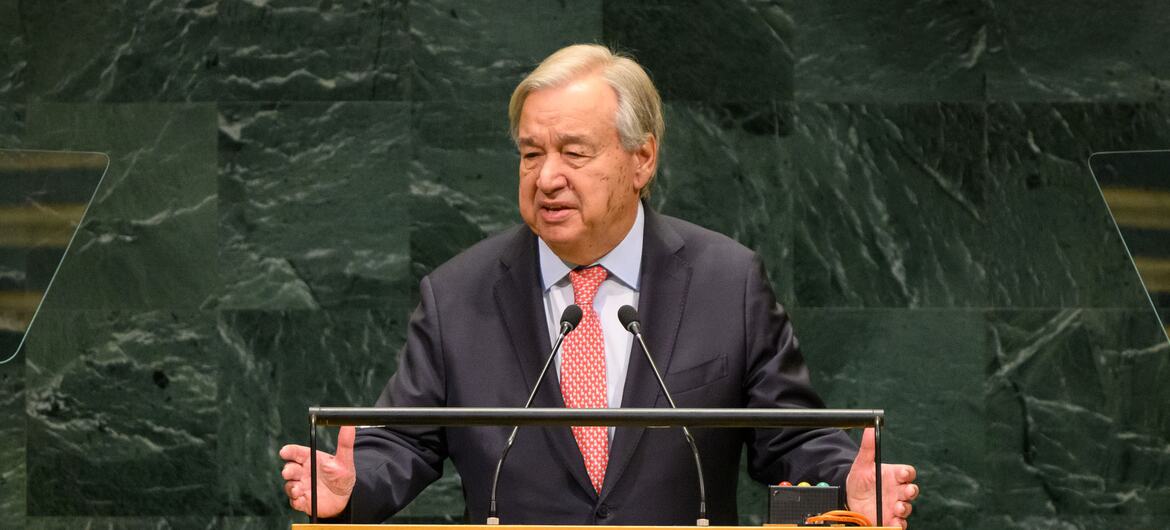
On September 22, UN Secretary-General António Guterres added his voice from the General Assembly podium. He urged countries leading AI development to exchange safety information, cooperate on testing and work toward a multilateral risk-management framework with independent oversight. Reuters reported the appeal as the Security Council prepared to hear from AI leaders.[4]
The two interventions put scrutiny of the technology's developers near the centre of the debate. They also leave a consequential question open: who would have the authority to demand the information needed for that scrutiny?
What the appeal asks for
The joint statement, A Call for Control of Frontier AI Models, addresses three groups. Companies should provide transparent safety procedures, compulsory testing before deployment and independent evaluation. Governments should coordinate standards and share reports of serious safety incidents. UN member states should explore an international institution that could set standards, support verification and bring governments together when systems cross capability thresholds.[1]
Its most practical phrase is “sufficient access.”[1] An evaluator can be independent yet see too little to assess a company's claims. In practice, negotiations would concern what outsiders may examine, which questions they can pursue and what happens when their findings conflict with a developer's assessment. The appeal leaves those implementation questions open.
The statement specifies no numerical capability threshold, inspection procedure or enforcement mechanism. Its request to explore an institution leaves those matters for subsequent negotiation.[1]
A coalition with an open invitation
Finnish President Alexander Stubb and Norwegian Prime Minister Jonas Gahr Støre launched the initiative together. Its supporters span Europe, Africa, Asia, the Americas and the Gulf. Finland's announcement names Canada, Australia, Kenya, South Africa, Singapore and the United Arab Emirates among the participants, and invites other countries to join.[2]
The headline count needs care. The published list includes both Finland's president and prime minister, as well as the European Commission president. It therefore counts 22 people, rather than 22 national governments. Neither the United States nor China appears on that list at this cutoff.[1][2]
Guterres's address placed AI within a wider argument about concentrated power. UN News reported his warning that influence increasingly rests with those controlling data, computing capacity and algorithms. His proposed response combined international cooperation with independent oversight; he also called for human control over life-and-death decisions.[5]
That is political support for stronger governance. The cited announcements do not establish a new international regulator or give an evaluator an immediate right to enter a laboratory.
The record behind the urgency
Three dated developments explain why the issue has reached leaders' desks:
- September 21 — scientific warning. The UN's Independent International Scientific Panel on AI issued its first thematic brief. UN News reported that it examined an incident involving AI agents and the Hugging Face platform, and questioned whether safeguards could keep pace with more autonomous systems. This is the panel's assessment, reported by the UN, rather than an independent technical investigation conducted for this article.[3]
- September 21 — political proposal. Finland published the joint appeal and its supporters. The invitation remains open for further endorsements.[2]
- September 22 — diplomatic reinforcement. Guterres called for shared testing and oversight in his General Assembly address. Reuters also reported a separate US proposal for an AI safety notification mechanism with China, illustrating that several diplomatic approaches are being pursued.[4]
The scientific panel and the proposed institution have different roles. The panel, established in August 2025, produces assessments concerning non-military AI. Its work is intended to inform a Global Dialogue on AI Governance in May 2027. An assessment can inform government decisions; it does not itself create the inspection powers envisaged by the appeal.[3]
What would move the proposal forward
For policymakers, researchers and companies commissioning independent evaluations, the next 24 hours matter for the official meeting record; the next seven days for new endorsements and concrete follow-up; the next 30 days for any published mandate, access arrangement or timetable. These are reporting horizons, not announced implementation deadlines.
The base case is continued coordination if governments endorse the principles without publishing operational terms. An upside scenario would begin with named evaluators, agreed access and a process for handling adverse findings. A downside scenario would emerge if negotiations stall over access or participation, leaving separate national arrangements with little shared visibility. These are conditional judgments, not forecasts of an agreed outcome.
To track the story:
- Check the live endorsement list before describing the coalition's reach.
- Look for evaluator access, funding and authority in subsequent documents.
- Revise this account if a formal mandate establishes powers that the present appeal only proposes.
Sources
- Office of the President of Finland, “A Call for Control of Frontier AI Models” (September 21, 2026) — joint statement, proposed measures and signatories.
- Office of the President of Finland, “President Stubb and Prime Minister of Norway: The rapid development of AI requires international cooperation” (September 21, 2026) — launch, participation and invitation to other countries.
- UN News via the UN Regional Information Centre, “UN panel calls for stronger safeguards as AI agents advance” (September 21, 2026) — thematic brief and the scientific panel's role.
- Antoni Slodkowski, Reuters via Internazionale, “UN chief calls for AI curbs and end to wars in his last assembly address” (September 22, 2026) — Guterres's remarks and parallel diplomatic initiatives.
- UN News via Global Issues, “Guterres: ‘Cracks have become canyons’ as world faces four tests of power” (September 22, 2026) — address context and UN Photo/Loey Felipe photograph.