As of 2026-09-26 00:34 UTC.
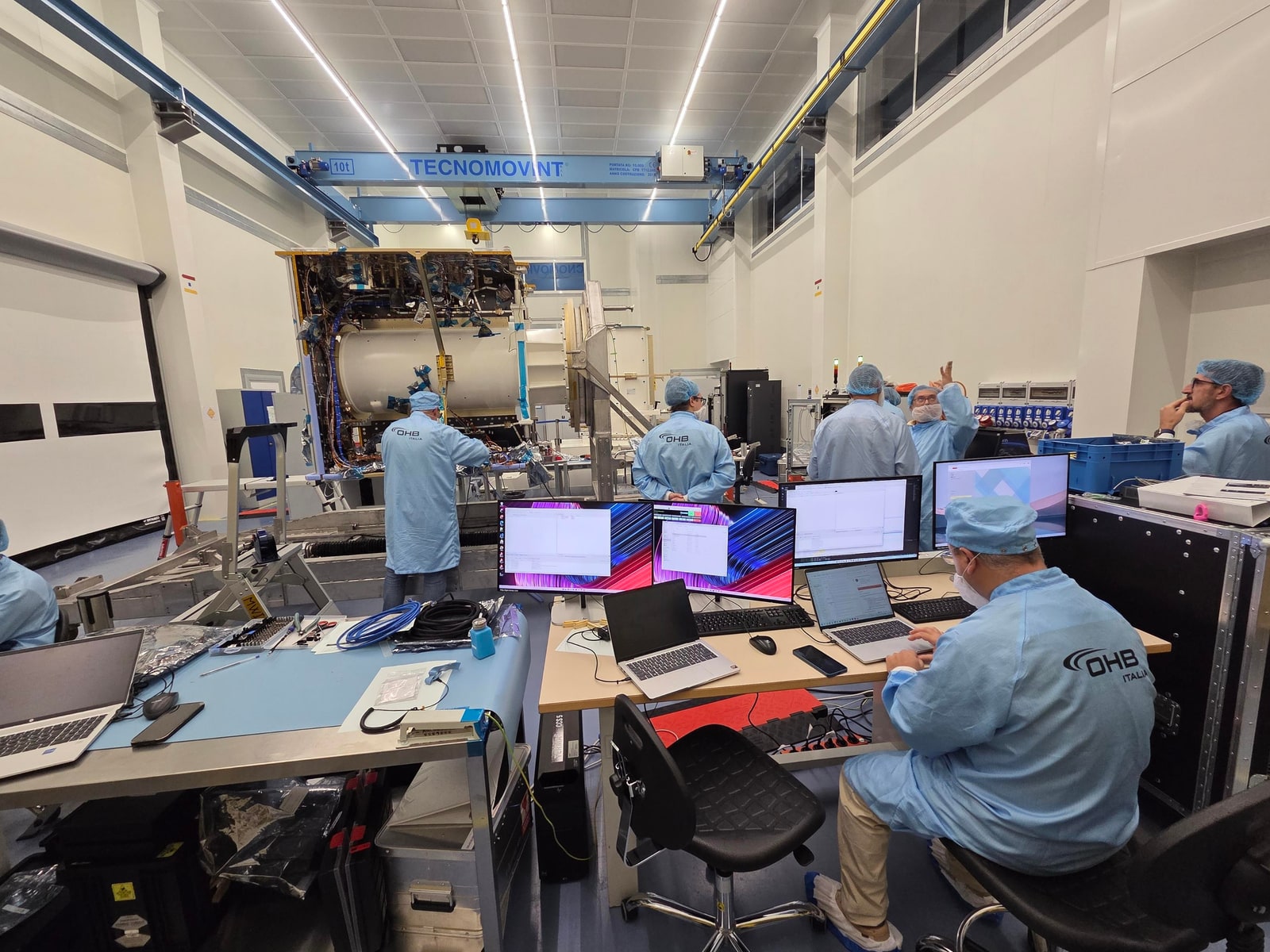
ESA announced on September 23 that Ramses's connected electronics have powered on for the first time, opening integrated functional testing ahead of a planned spring 2028 launch.[1] The event took place at OHB Italia in Milan on September 21.[2]
Ramses aims to join Apophis before its April 13, 2029 Earth flyby. By measuring the asteroid before and after Earth's gravity acts on it, researchers hope to learn how it holds together.[3]
The electronics begin working together
The onboard computer now connects to data-storage, power-distribution and instrument-interface equipment. Engineers can command these previously tested components together inside the spacecraft, checking how they interact.[1]
That is a meaningful transition in the evidence available to the team. A design review asks whether a system should work; assembled hardware lets engineers investigate whether the connections actually behave as intended. ESA's February contract announcement records the earlier step: Ramses completed its critical design review on February 6, clearing the detailed design against the mission's requirements.[4]
Three dated records establish the sequence:
| Date | Confirmed milestone | What the record supports |
|---|---|---|
| February 10, 2026 | ESA signed an €81.2 million development contract with OHB Italia | Construction, assembly and testing followed the design review; the award built on earlier preparatory work.[4] |
| May 7, 2026 | ESA and JAXA signed their Ramses cooperation agreement | JAXA's May 8 release confirms solar arrays, an infrared imager and an H3 launch as Japanese contributions.[5] |
| September 21, 2026 | First integrated switch-on in Milan | ESA's photograph documents the event and identifies its location and date.[2] |
These are primary institutional records. They establish reported milestones and commitments; none constitutes an independent audit of the remaining schedule.
JAXA's contribution ties the partnership to practical mission functions: supplying electrical power, measuring thermal infrared radiation and carrying the spacecraft into space. Its agreement also sits within wider cooperation on detecting and characterising near-Earth objects and preparing responses to possible impacts.[5] The international element therefore runs through the hardware and the journey, as well as the science team.
A close encounter that changes the visitor
Apophis will pass roughly 32,000 kilometres above Earth's surface. NASA's 2021 radar campaign and orbit analysis ruled out an impact for at least a century, after earlier observations had already eliminated the feared 2029 collision.[6] Ramses is an opportunity to learn from a safe encounter; its launch timetable does not signal an approaching impact emergency.
The scientific interest lies in how differently Earth's gravity acts across the asteroid. A study by C. J. Benson and colleagues models how that encounter could change Apophis's complicated tumbling motion. Their simulations predict substantial, measurable changes, but the outcome depends strongly on the asteroid's orientation during the encounter and the distribution of mass within it.[8]
That sensitivity makes observation valuable: measured changes could help constrain properties hidden inside the asteroid. The paper presents possible outcomes, rather than a single guaranteed transformation.[8] ESA plans to use Ramses's observations to improve understanding of asteroid structure and the evidence available for future deflection strategies.[3]
NASA supplies a complementary part of the planned investigation. Its OSIRIS-APEX mission, using the spacecraft that previously returned the OSIRIS-REx sample from Bennu, is scheduled to rendezvous with Apophis in June 2029. It will study the aftermath of the Earth encounter and use thrusters near the surface to disturb loose material, revealing what lies beneath.[7]
Read together, the mission plans explain the value of timing. Ramses would document the asteroid before Earth's intervention; OSIRIS-APEX would examine it afterwards. A later spacecraft can make valuable measurements, but it cannot recreate a close-up observation that was never taken before the flyby.[3][7]
The tests still ahead
ESA plans to join Ramses's separately assembled modules at ESTEC in spring 2027, before thermal-vacuum testing and a simulation of mission operations.[1] Those completed tests will provide stronger evidence of readiness.
For researchers planning observations and readers tracking readiness, three conditional outcomes now matter. The base case is continued integration towards the announced milestones. The upside would be successful combined testing that strengthens confidence in the launch plan. The downside would be a test failure or hardware delay requiring rework and threatening arrival before the encounter. These are reporting scenarios, not probabilities supplied by the agencies.
The immediate follow-up is to track evidence at the appropriate timescale:
- Next 24 hours: describe the result as integrated electronics testing, keeping it distinct from completion of the spacecraft.
- Next seven days: check any follow-up announcements for new test results or delivery changes; repeated descriptions of the switch-on add no new milestone.
- Next 30 days: watch ESA and JAXA for schedule updates. A quiet month alone would not demonstrate slippage against the announced milestones.
Revise the readiness assessment if either agency changes the integration, launch or arrival plan. The scientific test of the schedule is whether Ramses reaches Apophis early enough to watch the encounter unfold.
Sources
- European Space Agency, “First switch on for ESA-JAXA Ramses asteroid mission,” September 23, 2026 — connected electronics, assembly sequence and planned testing.
- European Space Agency / OHB Italia, “The moment of Ramses switch-on,” published September 23, 2026 — photograph and caption dating the Milan event to September 21.
- European Space Agency, “Ramses: ESA's mission to asteroid Apophis,” accessed September 26, 2026 — encounter timing, before-and-after observations and scientific objectives.
- European Space Agency, “ESA awards contracts for Ramses mission to Apophis,” February 10, 2026 — development contract, preparatory work and critical design review.
- Japan Aerospace Exploration Agency, announcement of the planetary-defence memorandum and Ramses cooperation agreement, May 8, 2026, in Japanese — May 7 signing and Japan's hardware and launch contributions.
- NASA / Jet Propulsion Laboratory, “NASA Analysis: Earth Is Safe From Asteroid Apophis for 100-Plus Years,” March 26, 2021 — radar observations, orbit analysis and safe encounter distance.
- NASA Science, “OSIRIS-APEX,” accessed September 26, 2026 — June 2029 rendezvous, spacecraft heritage and planned surface investigation.
- C. J. Benson and colleagues, “Spin State Evolution of (99942) Apophis during its 2029 Earth Encounter,” arXiv preprint, October 24, 2022 — modelled changes in tumbling motion and sensitivity to orientation and internal mass distribution.