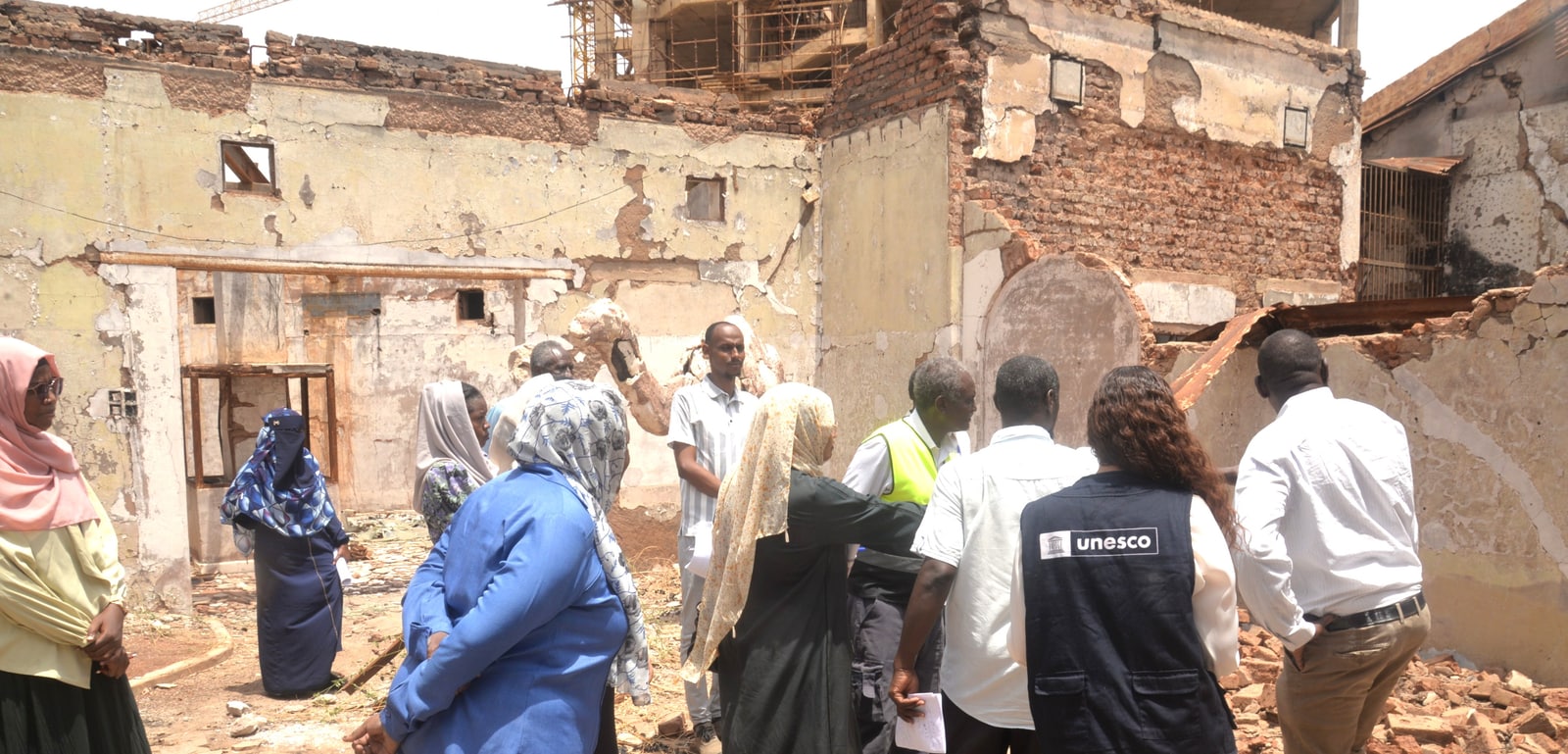
As of 2026-09-26 09:33 UTC, UNESCO had reported September training for 72 people from 15 Sudanese cultural institutions and damage assessments at 12 heritage sites. Its September 24 announcement describes work spanning museums, archives, a library and religious buildings.[1]
The practical significance is the possibility of making better choices under pressure: which collection needs shelter, which building requires stabilization, and which records could help identify a missing object. The next test is whether those findings bring staff, equipment and money to the places where further loss can still be prevented.
What the records establish
| Record and date | Finding | Confidence and limit |
|---|---|---|
| UNESCO, September 24, 2026 | Training and site assessments completed; ten Sudanese experts designated as resource persons.[1] | Direct organizer account; no site-by-site completion record for subsequent repairs. |
| Associated Press, April 14, 2025 | Destruction and looting at the Sudan National Museum; officials were still assessing losses.[2] | Independent reporting from an earlier stage, not a current inventory. |
| UNESCO, July 6, 2026 | Museum documentation, clearance and staff workspace improvements reported.[5] | Project account; comprehensive rehabilitation remained dependent on funding. |
These sources describe different stages and different scopes. Combining their numbers into a single measure of recovery would obscure what each actually establishes.
A damaged roof is also a future loss
The distinction between damage and risk is central to the task. Damage records what has happened. Risk asks what might happen next, to what, and with what consequences. ICCROM and the Prince Claus Fund's cultural heritage first-aid handbook treats stabilization and risk reduction as immediate, connected activities that support recovery. It also places this work alongside humanitarian relief and emergency response.[3]
A hypothetical storage room makes the distinction concrete. Recording a hole in its roof establishes damage. Determining whether rain could reach surviving objects establishes an ongoing threat. A photograph can support both judgments, but a useful assessment must help someone decide what protection is feasible and urgent. The assessment has practical value when it changes the order of work.
Sudan's museum records provide a specific example. UNESCO's Heritage Emergency Fund describes damage to the National Museum's annex store Z: a partially destroyed roof, collapsed wall sections and an insecure entrance. Its 2026 project entry lists $50,000 for an intervention combining documentation and inventory work with conservation, building reinforcement and storage improvements.[4]
That figure belongs to one defined activity. It cannot stand in for the cost of restoring the museum, much less Sudan's heritage sector. Nor does a project description establish that every listed task has been completed. Its value here is to show what an actionable assessment can become: a bounded package of work addressing both the collection and the structure around it.[4]
For donors, this changes the useful question. A request for support should make clear which danger the money addresses, who can carry out the work, and how completion will be checked. A count of surveyed buildings alone cannot answer those questions.
Records are part of protection
The problem also travels beyond the damaged building. In April 2025, AP reported shattered museum displays and looted storerooms, while a senior antiquities official said it was too early to establish the full extent of theft.[2] The gap between recognizing a loss and identifying precisely what is missing has consequences for recovery.
ICOM's Object ID standard explains the mechanism. It brings photographs together with descriptions of an object's material, dimensions, markings and distinguishing features, then requires secure storage of the documentation. Such records can be compared with databases of stolen objects. The point is to make an item recognizable across institutions that may never have seen the original collection.[6]
Consider a hypothetical vessel offered far from the museum that held it. A broad description of its period and material may fit many objects. A recorded inscription, unusual repair or distinctive mark gives investigators something more specific to compare. This is why documentation belongs within emergency protection: it preserves the ability to recognize a surviving or displaced object even when its surroundings and custody have changed.[6]
UNESCO's July project account reports that equipment enabled museum personnel to document more than 10,000 objects. It also describes clearance of rubble, war debris and unexploded ordnance, and rehabilitation of three office spaces for staff. Structural assessments were intended to guide wider rehabilitation once funding became available.[5]
Those are different kinds of progress. A documented object is not necessarily a recovered object; a usable office does not mean the whole museum is restored. Yet the combination matters. Staff need a place to work, records need tools and continuity, and repairs need an understanding of what the building can support. The July account offers evidence of that interdependence, without settling the museum's remaining needs.
The next month should test delivery
For funders, museum partners and reporters, the next 24 hours are an opportunity to distinguish completed assessments from proposed interventions in any account of the announcement. Over seven days, follow-up should establish who owns each priority task and whether staff and funds are available. Over 30 days, the useful evidence would be completed protective work and updated records. These are suggested review horizons, not deadlines announced by UNESCO.
Three conditional paths would change the assessment:
- Base case: survey findings inform a sequence of limited interventions. The confirming evidence would be an assigned, costed work plan followed by documented completion.
- Upside: safe access, equipment and funding allow local teams to address urgent risks while maintaining inventories. Repeated condition checks showing reduced exposure would support a stronger claim of recovery.
- Downside: access or resources prevent action after assessment. Unresolved priority hazards or documented additional losses would undermine confidence that the surveys are delivering protection.
A short follow-up checklist keeps the distinction visible:
- Ask which urgent risk has actually been reduced and what evidence verifies it.
- Keep surveyed sites, catalogued objects, recovered objects and repaired buildings in separate counts; correct claims that confuse them.
- Revisit priorities when access or conditions change. An old assessment should not justify a claim of present safety.
The most persuasive next update would connect a finding to a completed intervention: a collection protected from exposure, a workspace made usable, or an object identifiable because its record survived.
Sources
- UNESCO, “UNESCO strengthens Sudan's expertise for cultural heritage recovery,” September 24, 2026 — training, site assessments, national resource persons and photograph.
- Fatma Khaled, Associated Press, “Home to centuries of heritage, Sudan's biggest museum is looted and wrecked by a 2-year war,” April 14, 2025 — museum damage and the limits of the initial loss assessment.
- Aparna Tandon, ICCROM and Prince Claus Fund, “First Aid to Cultural Heritage in Times of Crisis,” 2018 — institutional handbook and toolkit record; stabilization, risk reduction and coordination with humanitarian response.
- UNESCO Heritage Emergency Fund, “Urgent Safeguarding Response for the Damaged Collections at the Sudan National Museum,” 2026 project entry — annex store Z, proposed interventions and the activity's budget.
- UNESCO, “Renewing Commitment to Sudan's National Museum,” July 6, 2026 — documentation, staff facilities, clearance work and remaining rehabilitation needs.
- International Council of Museums, “Object ID” — documentation categories, photographs, secure records and their role in identifying stolen cultural objects.