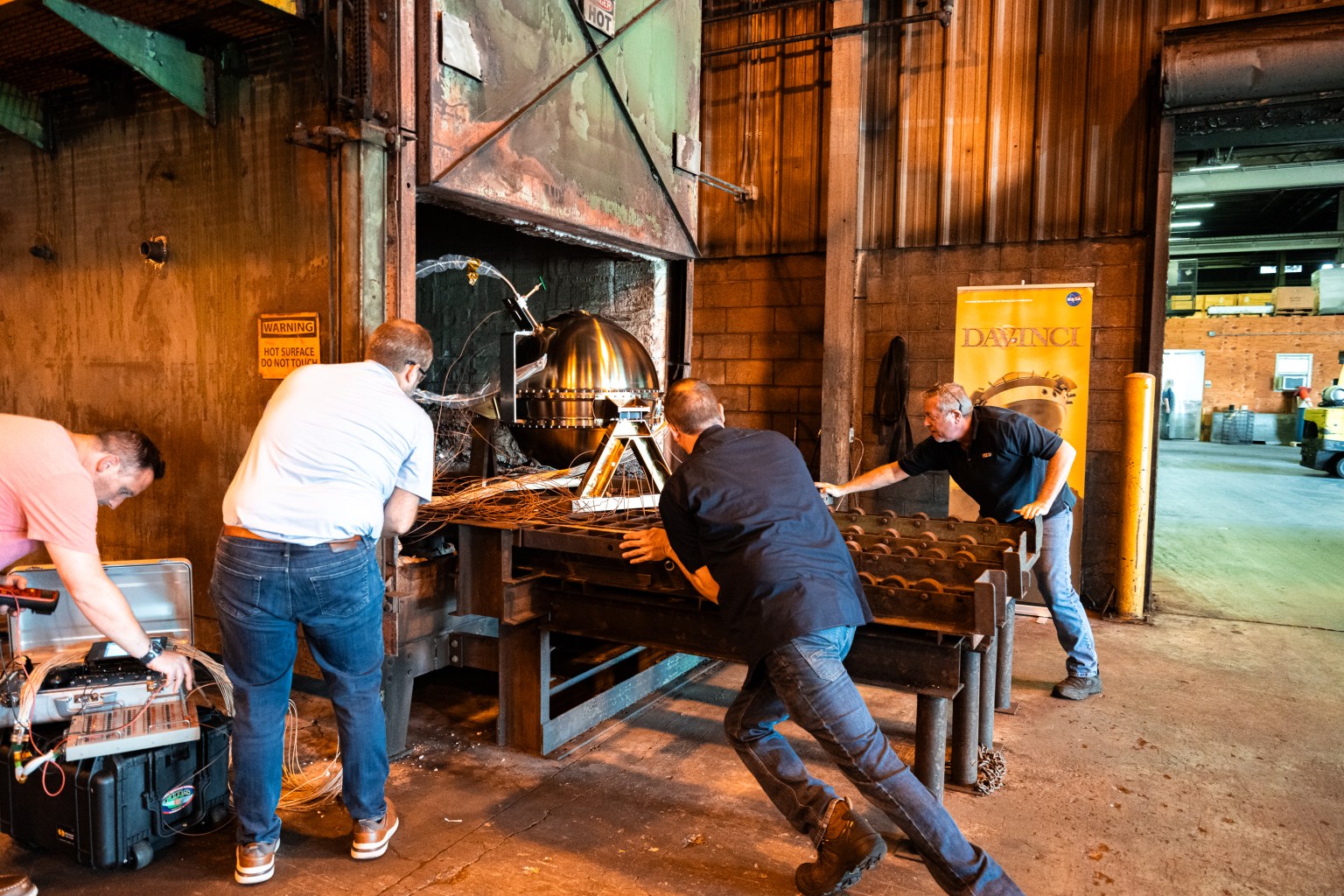
As of 2026-09-25 02:33 UTC, NASA reports that an engineering model of its DAVINCI Venus probe has survived six furnace runs reaching 465°C on a roughly hour-long descent schedule. The campaign took place from August 28 to September 10; NASA announced the result on September 24.[1]
The important part is the clock. DAVINCI must keep its instruments working as the atmosphere around them becomes hotter and denser, then get their measurements off the probe before impact. Understanding that sequence explains both the value of this week’s announcement and the work it leaves unfinished.[2]
Why test a descent in a furnace?
Venus presents a particularly unforgiving destination: a thick carbon-dioxide atmosphere, clouds containing sulfuric acid and surface pressure about 93 times Earth’s at sea level. Its greenhouse effect holds the surface at temperatures high enough to melt lead.[3] A spacecraft approaching the planet must eventually become an instrument operating inside that environment.
At Rex Heat Treat in Bedford, Pennsylvania, engineers heated the probe model on the timescale it would experience while descending. More than 100 thermal sensors monitored hardware standing in for the scientific instruments.[1] This tests a changing exposure: how the protected interior responds while the exterior becomes progressively hotter.
The distinction is practical. A material’s ability to tolerate a high temperature does not, by itself, establish whether an assembled instrument can continue taking useful measurements throughout a flight. Insulation, the vessel and the equipment inside must work together. NASA’s earlier instrument description explains why most of DAVINCI’s systems sit inside a strong, insulated sphere, while selected sensors must remain exposed to the atmosphere they measure.[4]
Three records put the new result in context:
| Record | What it establishes | Evidence boundary |
|---|---|---|
| September 24 heat-test announcement | Six completed heating runs with instrument stand-ins | NASA’s reported engineering result; no full flight qualification claim.[1] |
| July 14 account of June fieldwork | Descent images reconstructed known Utah terrain | An Earth-based imaging demonstration.[5] |
| Mission architecture and descent study | Science must be acquired and relayed during the fall | A design requirement, rather than a completed Venus observation.[2][6] |
How can a protected instrument measure the outside?
That tension is central to the mission. Seal everything away too completely and the instruments lose contact with what they came to study. Expose everything and the environment can overwhelm the equipment.
The Venus Atmospheric Structure Investigation, or VASI, illustrates the compromise. Its temperature sensor sits within a thin metal tube that responds to the surrounding atmosphere while shielding the sensor from corrosive conditions. Pressure measurement uses the deformation of a silicon membrane. Motion sensors and radio tracking help determine winds.[4]
These readings also give chemical measurements their location in the atmosphere. A gas abundance becomes more informative when scientists know the pressure, temperature and altitude associated with it. VASI supplies the principal altitude reference for the atmospheric composition instruments.[4] The resulting dataset should describe a vertical journey, with measurements related to one another as conditions change.
Why does the science have to leave before landing?
The mission’s descent study states that surviving a landing is not required: the critical science must be transmitted to a relay spacecraft before the probe strikes the surface. Instrument activity, deployments and communications therefore have to be coordinated with a trajectory whose exact timing carries uncertainty.[2]
Think of the falling sphere as a travelling laboratory with a closing transmission window. A successful measurement still needs a successful radio handoff. Keeping an instrument cool enough buys useful observing time only if the rest of that sequence also works.
NASA’s current mission description pairs the probe with a spacecraft that will conduct flyby observations. The descent targets Alpha Regio, a mountainous region that may preserve some of the planet’s oldest terrain. Atmospheric samples and close views of its rocks are intended to help reconstruct how Venus evolved, including whether it was once wet and habitable.[6] Those are questions for the future measurements; the furnace result supplies no new evidence that an ocean actually existed.
What did the Utah rehearsal add?
During June 23–25, the imaging team carried prototype equipment beneath a helicopter over Crater Island, Utah. Ten flights visited seven geological sites. Descending views allowed researchers to build terrain reconstructions and compare them with existing geological maps; infrared images also distinguished important differences between rock types.[5]
This is a useful companion to the furnace campaign because it tests another link in the mission. The images must preserve enough information to recover geology while the camera moves towards the ground. A photograph can be sharp and still be insufficient for the scientific interpretation researchers need.
NASA reported that the reconstructed landscapes matched established maps, while further analysis would continue. The Earth trial offers a reference landscape against which to check the method.[5] Its success supports the approach without reproducing the complete Venus environment.
What should change after this announcement?
For readers following mission readiness, the new evidence supports confidence in the reported thermal demonstration. NASA says DAVINCI is still seeking approval to enter final design and fabrication.[1] A launch-readiness conclusion would go beyond that statement.
The next developments can be read through three conditional scenarios:
- Base case: engineering work continues towards the next project review. The confirming signal would be further test results consistent with the present design.
- Upside: NASA announces approval for final design and fabrication, with supporting evidence that the remaining systems can meet their requirements together.
- Downside: later testing identifies a mismatch between the model and the flight design, prompting changes that consume time or reduce performance margins.
These are ways to interpret future evidence, not predictions of a decision date. The practical follow-up is brief:
- Next 24 hours: describe the result accurately as an engineering-model thermal test.
- Next seven days: check follow-up reporting for test conditions and instrument performance, rather than treating repeated coverage as additional confirmation.
- Next 30 days: watch for a formal project-stage update; no such decision within that period is promised here.
Revise this assessment if NASA changes the reported outcome, identifies a material test limitation or announces a different project status. The lasting measure of progress will be whether DAVINCI can turn its short descent into a complete, transmitted scientific record.
Sources
- Ashley Balzer, “NASA’s DAVINCI Beats Heat in Preparation for Blistering Venus Descent,” NASA, September 24, 2026 — test dates, conditions, model hardware, project status and NASA/Mike Guinto photograph.
- Matthew Garrison and colleagues, “The Big Plunge at Venus: The DAVINCI Descent Phase,” NASA Technical Reports Server, manuscript acquired September 28, 2022, for the 2023 IEEE Aerospace Conference — descent operations and the requirement to relay science before impact.
- NASA Science, “Venus Facts,” accessed September 25, 2026 — atmospheric composition, surface pressure and greenhouse heating.
- Brooke Hess and Anil Oza, “NASA Instrument to Measure Temperature, Pressure, and Wind on Venus,” NASA, October 20, 2022 — VASI sensor design, exposure and altitude reference.
- Lonnie Shekhtman, “Utah Helicopter Flights Test NASA’s DAVINCI Mission to Venus,” NASA, July 14, 2026 — June field campaign, geological comparisons and remaining analysis.
- NASA Science, “DAVINCI,” accessed September 25, 2026 — spacecraft and probe architecture, Alpha Regio target and scientific objectives.