As of 2026-10-23 02:35 UTC.
Sarawak’s museum department brought community representatives, researchers and students together in Kuching on October 22, extending this week’s international heritage gathering into a discussion about who carries cultural knowledge forward. BorneoTalk reported 258 participants from 16 ethnic groups at the Borneo Cultures Museum event.[1]
The discussion took place during the first General Assembly of the International Council on Monuments and Sites, or ICOMOS, held in Southeast Asia. Its official calendar lists the main programme for October 17–23.[2] Across the week’s speeches and exhibitions, a common question has emerged: how can conservation give people a meaningful role in decisions about the places and practices they sustain?[1][4][5]
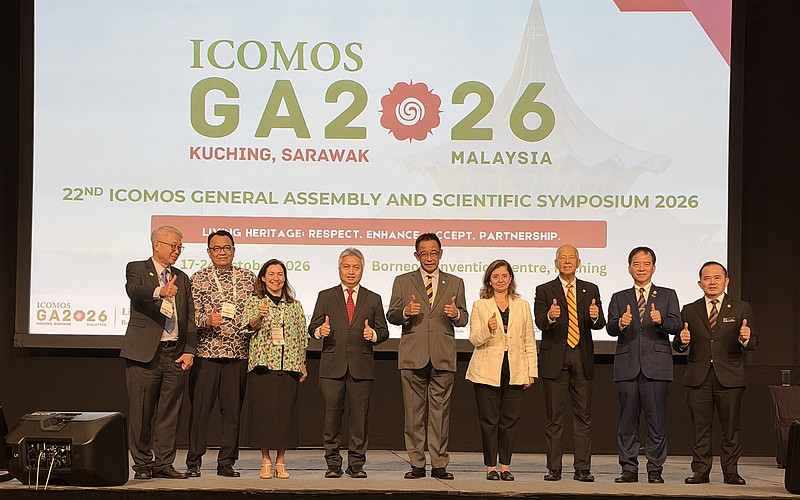
A week extending beyond the conference hall
Three reports establish the sequence, while describing different parts of the gathering:
- October 18: the assembly’s opening ceremony took place at Borneo Convention Centre Kuching. BorneoTalk’s October 19 account identifies Snowdan Lawan as the official who opened it on the minister’s behalf.[3]
- October 20: Sarawak’s Land and Survey Department reported its participation in the heritage exhibition alongside four other state agencies. This is confirmation of exhibition activity, rather than an advance programme listing.[5]
- October 22: the museum discussion brought together professional and community participants. Its reported attendance describes that event, not the entire international assembly.[1]
The wider programme deliberately connects professional meetings with museums, crafts and historic places. ICOMOS listed a free public heritage exposition for October 19–22, while reserving the scientific symposium for paid participants.[2] Those different entry points matter: a conference can circulate specialist knowledge through papers, but a public event gives people another way to encounter and question it.
Tourism brings the question of consent into view
At the October 19 gathering, Sarawak tourism, creative industry and performing arts minister Abdul Karim Rahman Hamzah called for Indigenous people and local communities to have a central role in conservation decisions, according to reporting by Nancy Nais for DayakDaily.[4]
His remarks identified a practical tension. Cultural tourism can support incomes, crafts and connections between generations. Yet communities also need authority over what visitors can see and which practices remain private or sacred. He argued that documenting traditions and protecting associated places would not, by themselves, ensure that those traditions continued.[4]
The implication is that success includes how decisions are made. The report records the minister’s position without establishing that a new consent procedure has been adopted.
Land records enter the conservation conversation
The state exhibition supplied a less ceremonial connection. The Land and Survey Department’s October 20 account describes presenting its work in land administration, surveying, mapping and geospatial technology. It also records a briefing by Abdullah Julaihi on urban planning’s role in heritage and conservation.[5]
These are tools through which a broad conservation ambition can reach a particular site. Maps can help establish what is present and where proposed work will take place. They cannot, on their own, settle whose account of a place should guide a project. Bringing administrative expertise into a heritage exhibition creates an opportunity to connect those questions; the department’s report offers no evidence yet of resulting changes to planning practice.
At the museum discussion, director Anielia Anak Siam described stewardship moving from research and assessment through registration, recognition where appropriate, preservation, exhibitions and education. She called for stronger professional capabilities and opportunities for younger people.[1] Her account connects the gathering’s theme to a museum’s work: moving knowledge between specialists, collections and communities.
From discussion to decisions
The scientific symposium’s published themes explicitly connect community knowledge with disaster and conflict response. They ask how conservation can accommodate different interests, support local leadership and strengthen cooperation. These are questions set for participants, rather than findings demonstrating that the desired changes have occurred.[6]
The distinction carries weight because ICOMOS has an established advisory role. UNESCO identifies it as the body providing evaluations of cultural and mixed properties proposed for the World Heritage List.[7] Discussions within this professional network therefore matter to conservation practice, even though a symposium theme is not a new World Heritage decision.
For museum teams, planners and community organisations, the next useful evidence will be specific responsibilities and projects. Three possible paths provide a reporting framework, not forecasts:
- Base case: published proceedings identify proposals and partners; those documents establish what participants intend to pursue.
- Upside: a named project follows with resources, community participation in decisions and a clear way to assess results.
- Downside: follow-up material remains limited to attendance totals and ceremonial statements, leaving implementation unclear.
Over the next 24 hours, check organisers’ closing updates; over seven days, look for published recommendations; over 30 days, check for named follow-up activities. These are review intervals, not announced delivery deadlines.
- Separate an invitation to participate from evidence of influence over a decision.
- Look for who controls access, interpretation and the sharing of cultural knowledge.
- Update this account if adopted resolutions or funded implementation plans appear. Either would change its present description of a documented exchange whose practical outcomes remain unverified.
Sources
- BorneoTalk, “Sarawak Museum Talk ICOMOS 2026 champions living heritage and stronger collaboration” (October 22, 2026 dateline) — museum event, participation and the director’s account of stewardship.
- ICOMOS, “ICOMOS General Assembly 2026” (current event listing) — main programme dates, regional first and public exposition arrangements.
- BorneoTalk, “ICOMOS GA2026: Sarawak champions community participation in heritage conservation” (October 19, 2026 dateline) — report of the previous evening’s assembly opening.
- Nancy Nais, DayakDaily, “Minister: Indigenous voices must lead heritage conservation, tourism must respect cultural authenticity” (October 19, 2026) — ministerial remarks, community authority and photograph of the October 19 launch.
- Land and Survey Department, Sarawak, “22nd ICOMOS General Assembly and Scientific Symposium 2026 (Hari Kedua)” (October 20, 2026; Malay-language report) — participating agencies, planning briefing and mapping services.
- ICOMOS GA2026, “Theme & Sub-themes” — published symposium questions and their relationship to the 2024–2027 scientific plan.
- UNESCO World Heritage Centre, “Advisory Bodies” — ICOMOS’s role in evaluating proposed cultural and mixed World Heritage properties.