As of 2026-10-21 21:34 UTC, the World Meteorological Organization’s October 16 account describes MeteoGate as operational, with a common route to discovering and accessing European weather data. EUMETNET highlighted that account on October 19. These are progress reports on an existing service, rather than evidence that every national dataset has just become available.[1][2]
The practical question is how much work disappears between finding a promising dataset and using it. A shared catalogue can shorten the search. For someone following rainfall across a border, the more consequential test comes afterward: whether the observations cover the right places and times, arrive dependably, and mean the same thing on either side.
What the October update establishes
WMO describes two connected layers. Its Information System 2.0, or WIS2, supports international exchange, including dataset descriptions and notifications when fresh data arrives. MeteoGate adds tools for people to search, preview and retrieve material. The underlying approach is federated: providers can expose their holdings through shared standards without surrendering them to a single central repository.[1]
Three distinctions keep the announcement in proportion:
- October 16, WMO: MeteoGate is described as up and running after development beginning in 2023. This is an institutional status report, without a published measurement of users’ time savings.[1]
- October 19, EUMETNET: the network points readers to WMO’s account. That corroborates the programme’s message; it is not an independent performance evaluation.[2]
- Current service FAQ: available datasets depend on contributing providers. Participation by a network of 33 national services does not establish complete coverage of every variable or period.[4]
There is a substantial cooperative system beneath the website. The Met Office’s account of EUMETNET’s thirtieth anniversary traces the organisation’s work from coordinating observations to shared forecasting and warning services. It describes MeteoAlarm, which brings national weather warnings together, separately from MeteoGate’s data infrastructure.[3]
That history matters. A useful access service can build on years of public investment in instruments, processing and professional cooperation. Its contribution should be assessed by what becomes easier to do with those holdings.
Rainfall makes the promise concrete
Consider an illustrative task: a researcher follows a rain system across a border and compares it with an earlier event. The task needs compatible observations and a retrievable history.
EUMETNET’s Open Radar Data guide lists European radar volumes, OPERA composites and links to national products, including KNMI reflectivity composites. It describes a latest-24-hour store for volumes, with their longer archive still planned. OPERA composites have a longer archive; national-product links cover only 24 hours, with longer series directed to national interfaces.[6]
National scanning strategies, processing and resolutions vary. The guide also distinguishes anonymous trials with low query limits from API-key access offering higher limits.[6]
The implication is that easier retrieval cannot establish comparability or supply missing history. Both must be checked before a cross-border study can use the files.
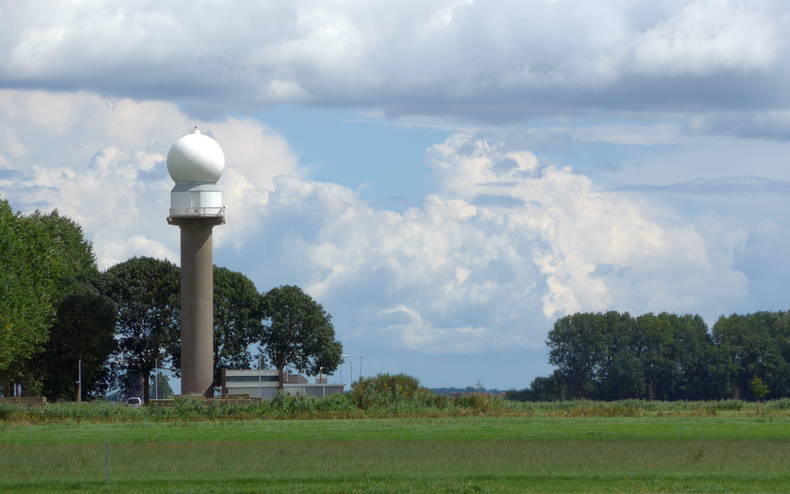
The photograph gives that dependency a physical form. KNMI’s 2017 opening report explains that Herwijnen replaced a radar in De Bilt whose view was increasingly obstructed by buildings. It places the new installation within a European network for exchanging precipitation observations.[7] Access software ultimately inherits the strengths and limits of such measurements.
Shared access leaves some work with the user
MeteoGate’s FAQ says most data can be accessed without an API key, while some restricted datasets require one. It also directs users to each dataset’s terms. A common gateway therefore simplifies entry without making all access conditions identical.[4]
The user documentation is more explicit about the remaining work. Some supply services use local accounts that a MeteoGate key cannot replace. Large bulk downloads may require approaching the provider directly. Dataset descriptions identify available parameters, geographical coverage and time ranges.[5]
These qualifications are useful information. They allow a user to distinguish a small exploratory query from a recurring operational workload. For a team developing a rainfall service, my reading is that MeteoGate offers a promising place to begin a trial; the October reports alone cannot establish how that team’s chosen feeds will perform under sustained use.
What would demonstrate progress over the next month
For researchers, public authorities and weather-service developers, three conditional paths follow from that distinction. These are analytical scenarios, not announced programme milestones.
The base case is a shorter search followed by some provider-specific integration. Its confirming signal would be successful discovery and retrieval, with remaining differences clearly documented. The upside case is repeatable access across several providers with little additional adaptation; a measured reduction in integration work would strengthen the case for wider adoption. The downside case is that catalogue entries lead to incomplete, stale or unsuitable responses, leaving users to rebuild much of the connection themselves.
A bounded trial can make the distinction visible:
- Within 24 hours: choose one cross-border question and record the required variables, area and historical window before searching.
- Over seven days: compare retrieved timestamps, coverage and failures with the source provider’s information; record how much manual intervention remains.
- By 30 days: repeat the retrieval and comparison. Missing history, incompatible measurements or persistent access failures would invalidate adoption for that use case, even if discovery had improved.
The most persuasive next evidence would be a user completing the same task with less repeated integration work and a clear account of the data’s limits. That would show how a shared catalogue becomes a useful public service.
Sources
- World Meteorological Organization, “MeteoGate Opens the Door to Europe’s Weather Data,” October 16, 2026 — operational status, development history and relationship with WIS2.
- EUMETNET, “EUMETNET’s MeteoGate opens the door to Europe’s weather data,” October 19, 2026 — the network’s notice highlighting WMO’s account.
- Met Office, “EUMETNET at 30: Strengthening European meteorological cooperation,” 2026 — the history of shared observations, warning services and data infrastructure.
- MeteoGate, “Frequently Asked Questions,” accessed October 21, 2026 — provider coverage, API keys, data location and dataset-specific conditions.
- EUMETNET, MeteoGate documentation, “2. Discovering and Accessing Data,” accessed October 21, 2026 — metadata, local authentication and bulk-access limits.
- EUMETNET, Open Radar Data documentation, “1. Overview,” accessed October 21, 2026 — radar collections, available histories, national-product links, measurement differences and access limits.
- KNMI, “KNMI opent neerslagradar in Herwijnen,” May 12, 2017 — radar relocation, European exchange and the archival photograph credited to Hans Beekhuis; in Dutch.