As of 2026-09-13 21:42 UTC, the U.S. National Science Foundation had announced more than a tidy-up of its grant forms. A September 10 leadership letter says NSF will organize funding more deliberately as a portfolio, mix investigator-led research with agency-directed challenges, create four cross-disciplinary Frontier Initiatives and establish an Office of Metascience to test how the agency funds science.[1]
Some of that agenda is already visible. Twelve funding opportunities announced on August 17 offer more than $1.5 billion in total and allow a wider range of award lengths, including long-term funding of five years or more where justified.[2] Other consequential details remain absent: NSF has not published a dollar allocation for the four initiatives, a formula dividing investigator-driven and directed work, or a schedule showing which existing programs will expand, contract or merge.[1][5]
That gap matters in a fiscal year when the American Institute of Physics reports that NSF had issued more than 40% fewer research grants than at comparable points in recent years.[6] The snapshot does not prove that the portfolio policy caused the slowdown, but chronology does not rule out a broader connection: NSF publicly described the approach on August 17, and the September 10 letter says implementation had begun.[1][2] The immediate story is therefore not that NSF has stopped funding scientists' questions. It is that the agency has announced a more explicit portfolio framework before showing how funding and priority-setting will change within it.
This is a reported, document-driven Q&A synthesized from agency statements, current NSF policy and independent science-policy reporting. No participant was interviewed for this article.
The record at a glance
| Timestamp | Source | What the record establishes | Confidence and boundary |
|---|---|---|---|
| July 21, 2026 | White House OMB–OSTP memorandum | Agencies were told to consider nine R&D priorities as appropriate and account for the guidance in FY2028 budget submissions, including more foundational research, new funding mechanisms and systematic evaluation of science funding.[3] | High on executive-branch planning direction. The memo is budget guidance, not an enacted appropriation or an NSF program allocation. |
| August 17, 2026 | NSF funding announcement | NSF released 12 opportunities totaling more than $1.5 billion, with long-horizon and rapid, short-term pathways.[2] | High on announced opportunities. The headline amount is prospective funding, not proof that every dollar has been awarded. |
| September 9, 2026 | American Institute of Physics | AIP found that NSF had issued more than 40% fewer research grants so far in FY2026 than in recent years and relayed a projection that NSF was on track to finish the year with roughly 46% fewer grants, mainly because $1 billion was being held for Grand Research Challenges.[6] | Medium-high for the reported snapshot. The 46% figure is a projection, not an agency target; FY2026 does not end until September 30, and the analysis does not trace program-level transfers to the new Frontier Initiatives. |
| September 10, 2026 | NSF leadership letter | NSF announced a more explicit portfolio framework, four Frontier Initiatives, an Office of Metascience and experiments with review and funding mechanisms.[1] | High on announced direction. Allocation, staffing, timetables and program-level implementation remain incomplete. |
| September 11, 2026 | Nature | Independent reporting highlighted that NSF had not said how the new initiatives would be funded and recorded staff concern about pressure on core science.[5] | High that the funding source was undisclosed; limited on internal sentiment. Staff concern is reported and should not be treated as an agency finding. |
What did NSF actually change?
The letter divides NSF's work more explicitly into four purposes: discovery, translation, infrastructure and talent development. It says the form of support should match the field, stage, time horizon and risk of the work rather than forcing every proposal through the same grant shape.[1]
That can mean longer awards for questions that need continuity, or brief applications and faster decisions for exploratory and time-sensitive work through existing pathways such as EAGER and RAPID. It can also mean prizes, challenges and milestone-based support when NSF defines a technical objective but leaves teams to choose a method. Universities and investigator-led laboratories remain part of the model, alongside time-limited organizations, research institutes and joint university–industry centers.[1]
The most visible organizational change is a set of four Frontier Initiatives: Future of Intelligence, Frontier of Quantum Phenomena, Advanced Materials and Matter, and Foundations of Biological Design. Their leads will sit in the Office of the Director and coordinate work that crosses NSF's existing directorates.[1] The names reveal priority fields. They do not yet reveal grant totals, competitions or the share of NSF's budget they will command.
So who gets to set the research question?
The honest answer is both the investigator and NSF—but the balance is unknown.
NSF says its portfolio will include investigator-driven opportunities in which researchers choose questions without having to promise a practical application. It also plans more directed opportunities linked to national missions and strategic technologies. In those programs, the agency says it will specify the objective rather than dictate the scientific method.[1]
That is a meaningful boundary, but not a complete allocation rule. An investigator still has wide methodological freedom inside a prize or milestone program while working toward a question the funder selected. Conversely, a broad discovery solicitation can remain scientist-led even if NSF later builds a portfolio by choosing among excellent proposals. What determines the real balance is not the prose alone; it is the distribution of dollars, awards and success rates across open-ended programs and directed initiatives. No such breakdown appears in the September 10 letter.[1][5]
Is conventional peer review being replaced?
No replacement has been announced. NSF's standing process uses external experts and the National Science Board-approved criteria of intellectual merit and broader impacts. Program officers can also consider portfolio factors after receiving reviews.[4] The new letter calls merit review central to NSF grantmaking while proposing experiments around it.[1]
Those experiments include “Golden Tickets,” which would let an individual reviewer champion a proposal that might not survive panel consensus, and distributed review intended to reduce burden and speed decisions. NSF also wants new measures for recognizing unusual research.[1] The letter says every funded proposal must meet an appropriate scientific-rigor threshold, but it does not say that either experiment will apply agency-wide or change the two core criteria.
For applicants, that distinction is operationally important. A named experiment is not yet a submission rule. Until an applicable solicitation, amendment or policy notice changes applicant-facing requirements, researchers should follow the review criteria, page limits and deadlines in the opportunity actually open to them.[2][4]
What is already usable, and what is still a promise?
The August 17 package is the clearest implemented layer. Its 12 opportunities span NSF directorates, use shorter and more consolidated notices, and include longer-duration awards—five years or more where the science justifies them. NSF also encourages greater use of existing rapid, short-term mechanisms to test and de-risk ideas.[2]
The Frontier Initiatives are one step earlier. They have names, scopes and an intended home in the director's office, but the September 10 materials do not name their leads or provide budgets, first deadlines or award instruments. The planned Office of Metascience likewise has an announced mandate but no public staffing chart, launch date or initial experiment register in the reviewed record.[1] NSF says more Dear Colleague Letters and announcements will follow. Those later documents—not the umbrella letter—will tell researchers whether and how a particular laboratory can apply.
Why does the current grant count change how the announcement should be read?
AIP's September 9 analysis provides both scarcity context and evidence of a possible policy connection. It reports an agency-wide research-grant count more than 40% below recent-year pace, with astronomy awards down by half and materials-research awards down by more than 40% against the 2021–2024 average; physics showed a smaller decline. It also relays a projection that NSF was on track to finish FY2026 with roughly 46% fewer research grants, mainly because the White House was holding back $1 billion for Grand Research Challenges.[6]
Nature reports that NSF staff expected at least some Frontier Initiative funding to come from that centrally held pool, while the agency had not disclosed the initiatives' funding source.[5] That makes displacement more than a free-floating fear, but it still does not establish a program-by-program transfer. The portfolio approach was public by August 17, and the September 10 letter says implementation was under way, so chronology cannot settle causation.[1][2] What remains missing is an accounting that ties withheld or redirected funds to named initiatives; late-year awards can also change the totals before September 30.[6]
This is the central uncertainty boundary. A longer award can reduce an investigator's renewal burden while also producing fewer awards if the total budget is fixed. A faster exploratory mechanism can widen access, or merely accelerate decisions within a smaller pool. A cross-directorate initiative can fund work that fell between organizational seams, or draw money away from the disciplines it is meant to connect. The design has plausible benefits and tradeoffs; allocation and implementation will determine which ones dominate.
Who will judge whether the experiments work?
The letter assigns that job to the planned Office of Metascience. It says the office will employ metascience specialists and data scientists, build evaluation infrastructure, run prospective tests across directorates and publish results and postmortems for successes and failures. Candidate measures include grant turnaround time, the ambition enabled by longer awards and whether rapid awards surface valuable ideas missed by conventional routes.[1]
It also sets an ambition to double scientific productivity and impact per federal dollar by 2036.[1] That is a target, not a forecast. The letter does not define the baseline, how “productivity” and “impact” will be combined, how long-lag basic discoveries will be credited, or how portfolio changes will be separated from budgets and outside conditions. A credible evaluation program will need to publish those choices before it announces victory: hypotheses, comparison groups where feasible, field-sensitive measures, time horizons and negative results.
What should applicants do now, and what evidence comes next?
Next 24 hours: applicants should keep using the requirements of live solicitations unless an applicable solicitation, amendment or policy notice says otherwise. A project does not become eligible for a Frontier Initiative merely because it can be described with the word “frontier.” Research offices can map the 12 August opportunities against predecessor or related solicitations and identify actual changes in duration, scope and review.[2][4]
Next seven days: do not assume NSF will publish on this clock; it promised further materials only in the coming weeks and months. Decision-grade documents would include an Office of Metascience charter, named leadership, the first Frontier Initiative lead or a Dear Colleague Letter that states eligibility, funding source and review method. Any announcement without those fields adds direction but not an application path.[1]
Next 30 days: the September 30 fiscal-year close should sharpen the grant-count baseline reported by AIP.[6] New NSF notices can then be compared with final FY2026 awards and program-level funding. The White House's FY2028 memorandum already guides budget formulation and related planning, but it does not itself establish an applicant-facing NSF program; agency actions and notices will define those consequences.[2][3]
Three ways the portfolio model could develop
Base path — a dual system takes shape. Investigator-led programs continue while selected priority areas use challenges, longer awards and cross-directorate management. Trigger: new solicitations state both their source of funds and whether they are investigator-driven or NSF-directed, while NSF continues to publish broad discovery opportunities.
Upside path — experimentation improves access without narrowing the question set. Faster decisions reduce burden, longer awards permit riskier work and the Office of Metascience publishes credible evidence—including failed trials. Trigger: public protocols and postmortems show faster turnaround or broader participation without a material decline in disciplinary breadth or review quality.
Downside path — strategic portfolios become an opaque reallocation. Named initiatives grow while core programs lose awards, and neither the transfer nor its opportunity cost is visible. Trigger: program and directorate data show sustained reductions in open-ended awards alongside new directed spending whose funding source or evaluation record remains undisclosed.
Keep the next claims auditable
- Applicants: answer the solicitation in front of you. Do not redesign a proposal around an umbrella announcement until NSF publishes a relevant opportunity or amendment.
- University research offices: compare old and new notices line by line—award duration, estimated award count, total funding, review criteria and due date—rather than treating “portfolio” as a single procedural change.
- NSF: publish a crosswalk from existing programs to discovery, translation, infrastructure and talent portfolios, plus budgets and award targets for each Frontier Initiative.
- Oversight bodies and newsrooms: keep announced, appropriated, obligated and awarded separate. The $1.5 billion is the total attached to 12 announced funding opportunities; the reviewed sources do not show that all of it has reached recipients.[2]
- Readers: treat staff fears as attributed concerns and agency productivity language as an aspiration until public data test them.[1][5]
Update and invalidation conditions: revise this account when NSF publishes initiative budgets, names Frontier Initiative or Office of Metascience leaders, changes the agency-wide merit criteria, releases an experiment protocol or postmortem, or reports final FY2026 award totals. Its central conclusion—that the direction is clearer than the allocation—is invalid once a complete program-level funding map shows what grows, what shrinks and which questions remain investigator-led.
NSF has supplied a theory of better grantmaking: fit the instrument to the science, make selected national objectives explicit and test the funding system with some of the rigor expected of researchers. The next proof is administrative, not rhetorical. Researchers need to see the calls, the review rules, the budgets and eventually the results.
Sources
- Brian Stone, U.S. National Science Foundation, “NSF Leadership in a New Golden Age of Science” (September 10, 2026) — full leadership letter on portfolio grantmaking, Frontier Initiatives, review experiments and the Office of Metascience.
- U.S. National Science Foundation, “NSF announces $1.5B for foundational research to drive scientific breakthroughs for American technological leadership” (August 17, 2026) — 12 funding opportunities, award-duration options and implementation details.
- Executive Office of the President, “Ushering in a New Golden Age of American Innovation: Fiscal Year 2028 Administration Research and Development Budget Priorities” (July 21, 2026) — official OMB–OSTP planning guidance and its nine portfolio priorities.
- U.S. National Science Foundation, “How We Make Funding Decisions” — current merit-review process, criteria and portfolio factors.
- Dan Garisto, Nature, “NSF moves to overhaul funding approach in line with White House priorities” (September 11, 2026) — independent reporting on the undisclosed funding source and staff concerns.
- Clare Zhang, American Institute of Physics, “Astronomy, Materials Science Awards Plummet at NSF” (September 9, 2026) — contemporaneous grant-count analysis, field differences and fiscal-year caveats.
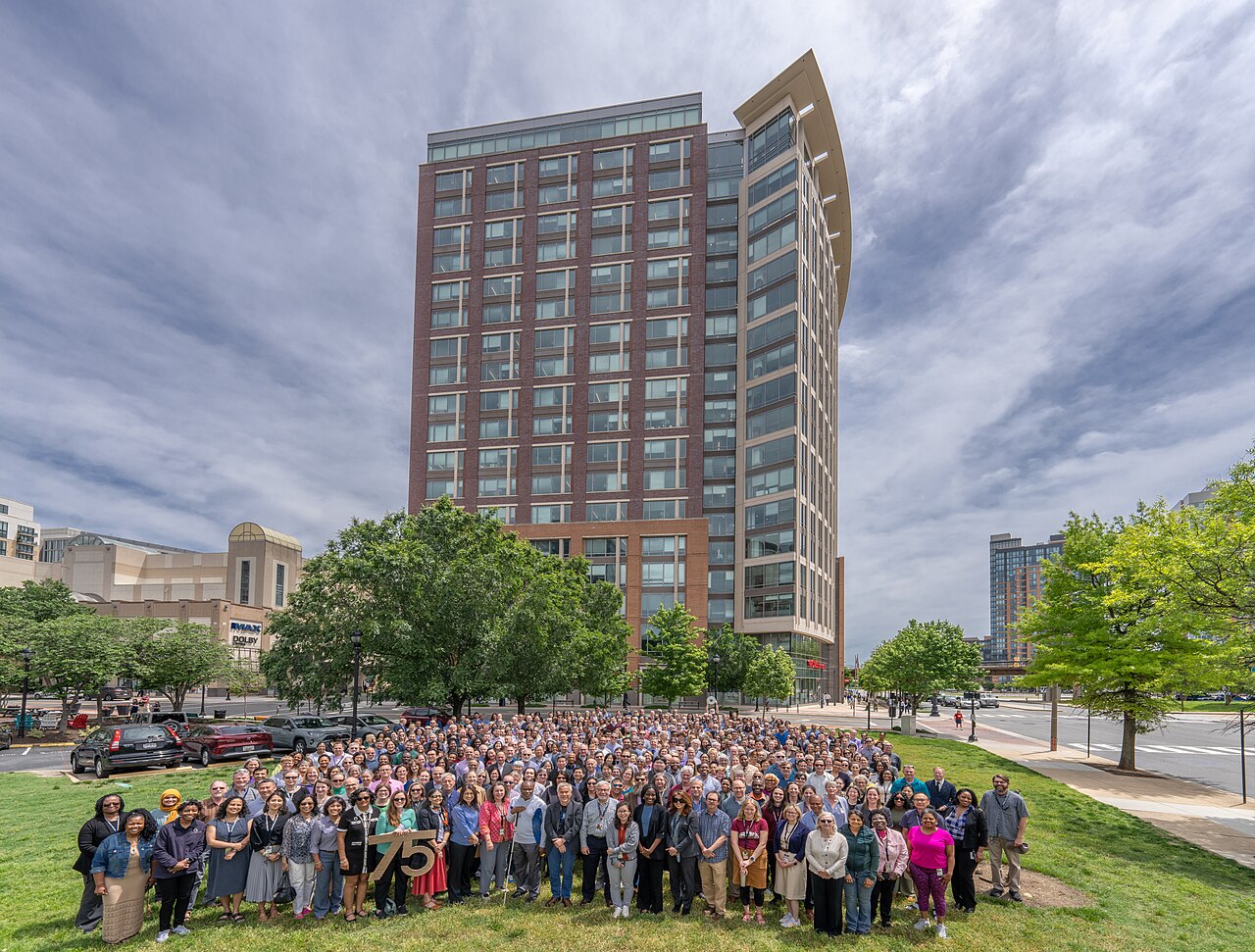
- Wikimedia Commons, “National Science Foundation Staff and Building 05202025.jpg” — source page for Matthew Herron's May 20, 2025 documentary photograph of NSF staff and the Alexandria headquarters.