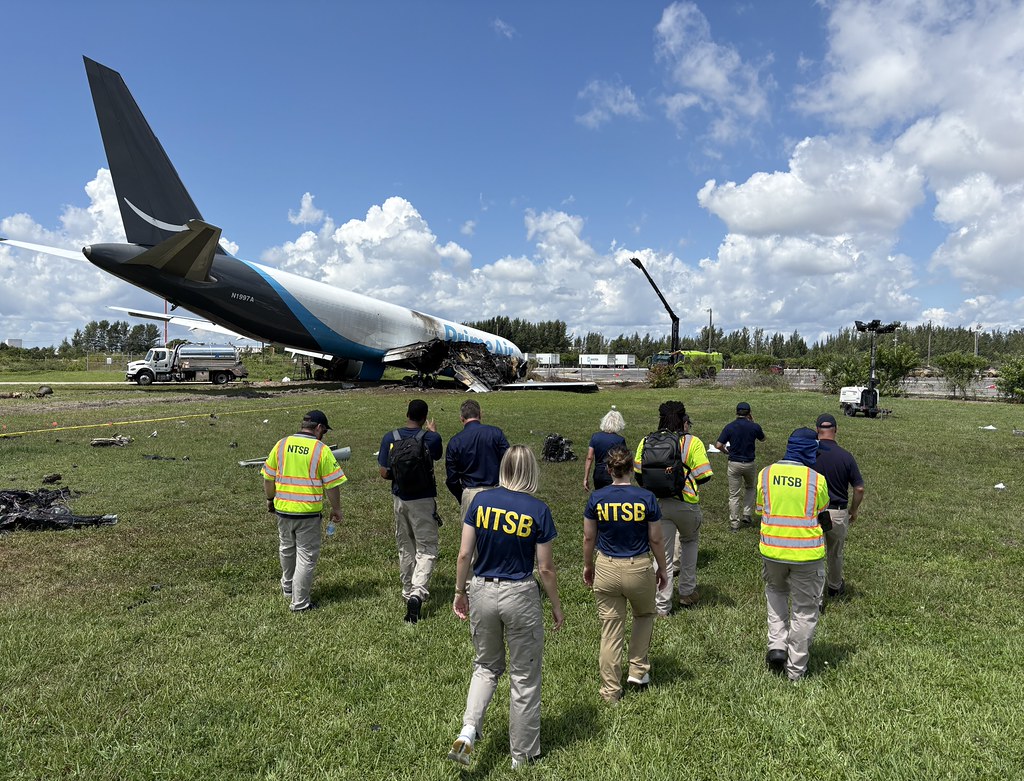
As of 2026-09-12 18:34 UTC, investigators had published an unusually detailed but still preliminary account of the last recorded moments of 21 Air Flight 7598. The Boeing 767 cargo flight from San Juan overran Miami International Airport's Runway 30 on September 6.[1][3] It struck a van, passed through a perimeter fence and then struck an SUV on Northwest 67th Avenue.[2] Five people were killed and five were injured.[2]
The new recorder summaries establish a disturbing set of events. On the cockpit audio, one pilot cautioned that the aircraft was too fast and made additional comments about excessive speed; after a sound similar to touchdown, a go-around was called. Separately, flight data showed recorded gear touchdown and throttles increasing to a value consistent with go-around thrust; four seconds later, the throttles were reduced to idle and the brakes were reapplied. The cockpit audio also captured a sound similar to the aircraft departing the paved surface.[1] The summaries do not establish an exact interleaving of the two recorder streams or a probable cause. The National Transportation Safety Board labels every time and description preliminary, warns that the clocks have not been precisely synchronized, and still lists the investigation as ongoing.[1]
That boundary matters. The public record now supports a reconstruction of what was recorded. It does not yet support a verdict about why the approach continued, why the throttles were subsequently reduced, or why the released data showed no indication of speed-brake or thrust-reverser deployment.
The verified record at a glance
| Question | What is public | Confidence and boundary |
|---|---|---|
| What flight was involved? | 21 Air Flight 7598, a Boeing 767-33A operating under Part 121 from San Juan to Miami, overran Runway 30 after landing.[1][3] | High. The FAA and NTSB agree on the basic event. |
| What did investigators recover? | More than two hours of good-quality cockpit audio and about 54 hours of flight data covering more than 400 parameters.[1] | High on recorder condition. Only selected events and parameters have been released. |
| Was speed challenged in the cockpit? | The cockpit summary says one pilot cautioned that the aircraft was too fast and made further speed comments, without a consistent verbal response from the other pilot.[1] | High on the summarized exchange. The full transcript, target approach speed and complete airspeed record are not public. |
| Did recorded touchdown precede the go-around-related events? | On the CVR's clock, the sound similar to touchdown preceded the verbal go-around call. Separately, on the FDR's clock, recorded gear touchdown preceded the throttle increase to a value consistent with go-around thrust.[1] | High within each recorder's sequence, limited across them. The CVR and FDR clocks are not precisely synchronized. |
| What do the data show about deceleration systems? | The released FDR summary says there was no indication that speed brakes or thrust reversers deployed.[1] | High for the released parameters, not explanatory. The lack of a recorded indication does not reveal whether procedures, commands, system logic, hardware or another factor explains it. |
| Has a cause been found? | No. NTSB guidance says preliminary material is factual and incomplete; probable cause belongs to the final analysis.[4] | High. Any causal declaration at this stage outruns the agency's record. |
Two clocks, not one stopwatch
The cockpit voice recorder and flight data recorder describe the same ending from different instruments. Their timestamps count backward from when each recording stopped. Because the clocks have not been synchronized, events from one stream cannot responsibly be interleaved to the second.[1]
On the cockpit recording, a pilot called for flaps 20 about 1 minute 42 seconds before the recording ended. The other pilot cautioned that the airplane was too fast and continued making speed comments. An autopilot-disconnect sound followed. During the next minute, electronic callouts announced “sink rate” twice and “too low terrain” repeatedly. Flaps 30 were called roughly 41 seconds before the end. A sound similar to touchdown came at about 31 seconds; the go-around call came about 16 seconds later; a sound similar to the aircraft departing the paved surface came another five seconds after that.[1]
On the flight data recording, the nose gear and right main gear touched down at 158 knots groundspeed about 30 seconds before the data ended. The brakes were recorded applied seven seconds later. The left main gear touched down four seconds after that. At roughly 15 seconds before the end, the brakes were released and the throttles moved to a value consistent with go-around thrust at 120 knots. Four seconds later, the throttles returned to idle and the brakes were recorded applied again at 117 knots. The final recorded groundspeed was 65 knots.[1]
The safe synthesis is narrow but important. Within each recorder's own clock, a touchdown indication precedes its go-around-related event. On the FDR clock, the recorded throttle increase lasted about four seconds before the throttles returned to idle and the brakes were recorded applied again. On the separate CVR clock, the sound similar to the aircraft departing the paved surface came about five seconds after the verbal go-around call. The NTSB says the released data contained no indication of speed-brake or thrust-reverser deployment.[1]
What the synthesis cannot do is manufacture an exact master timeline. It cannot prove that the verbal call and throttle movement happened simultaneously. It cannot locate each event along Runway 30 without synchronized time, validated position data and the investigators' performance work. An unofficial runway diagram cannot be validated from this release alone.
“Too fast” is evidence—but it is missing its denominator
The cockpit caution is unambiguous on one point: a pilot thought speed was excessive. The released 158-knot figure is groundspeed at recorded gear touchdown and cannot be compared directly with a target approach speed, which is an airspeed. Reference speed depends principally on landing weight and flap or aircraft configuration; target approach speed commonly incorporates wind or gust adjustments under operator procedures. Runway condition matters to landing-distance and braking assessments, not ordinarily to the target-speed calculation itself. The public packet does not provide Flight 7598's calculated target, landing weight, complete airspeed series, wind components, landing-distance assessment or company stabilization gates.[1][5][7]
That missing denominator prevents two common shortcuts. First, the public cannot subtract a generic Boeing 767 landing speed from 158 knots and call the remainder the flight's verified excess. Second, a generic “stable by 1,000 feet” slogan cannot substitute for 21 Air's applicable, operator-specific procedures and the actual conditions of this approach.
FAA flightpath-management guidance for Part 121 operators treats trajectory, automation, pilot monitoring and energy management as one system.[5] A 2024 Aviation Rulemaking Committee recommendation documents variation among operators' stabilized-approach gates, callouts and go-around policies. Submitted to the FAA for consideration, it proposes retaining stabilization policies while treating a deviation from stabilized parameters as a prompt to consider a go-around, requiring a go-around when a safe landing is in doubt, and defining safe-landing and latest-touchdown criteria for training.[6] That proposal is context, not Flight 7598's rulebook or an FAA finding about this accident. The investigation needs the carrier's manuals, training records, FOQA or other flight-data-monitoring records if available, and crew accounts before it can test what should have happened against what did.
“No indication” is a result, not an explanation
The sentence attracting the strongest reaction is the NTSB's statement that there was no indication in the recorded data that speed brakes or thrust reversers deployed.[1] Speed brakes or spoilers unload the wing and improve wheel-brake effectiveness, while reverse thrust contributes to deceleration.[7] The absence of a recorded indication of their deployment is therefore a central investigative result. It still is not a diagnosis.
The unreleased evidence must distinguish among questions that currently collapse into one word—“why.” Were the speed brakes armed or commanded? Were the reverse-thrust levers selected? What cockpit indications were available? Did the recorded four-second throttle increase change crew actions or system state? Were the recorded parameters complete and valid through impact? Did any component fail, or did the system behave as designed for the inputs it received? What did the pilots understand at each transition?
Each question is a request for evidence, not a proposed answer. “The data contain no indication of reverser deployment” does not mean “the reversers malfunctioned.” “The recorded throttle values increased to a value consistent with go-around thrust” does not mean a safe go-around remained physically available at that point. “There was no consistent verbal response” does not reveal unheard gestures, control inputs, task allocation or intent. A full cockpit transcript, synchronized data, systems examination and interviews may narrow those possibilities; the selected-event summary cannot.[1][4]
Earlier Flight Safety Foundation research framed failure to go around as a major approach-and-landing risk while warning that go-around execution has hazards of its own.[8] The 2024 committee recommendation addresses a narrower policy question: it says an unstable approach by itself does not predict an adverse landing outcome and proposes requiring a go-around when a safe landing is in doubt, rather than for every deviation from stabilized parameters.[6] These are generic, differently scoped industry contexts. Neither establishes that Flight 7598 violated 21 Air's stabilization criteria or that its go-around-related actions were improper.[1]
The investigation extends beyond the cockpit
The reported impact path extended roughly 1,300 feet beyond the paved surface: the airplane hit a van carrying seven people and owned by the airline's contract cleaning company, passed through a perimeter fence, struck an SUV on Northwest 67th Avenue and continued into grass before hitting another fence.[2] Those facts make the survival-factors and airport-side inquiry inseparable from the flightpath inquiry.
The public record still needs to explain the van's assigned route, work authorization and applicable airfield-vehicle procedures; the protections between the runway end and occupied roads; the sequence of impacts; rescue access; and the layout and intended function of perimeter infrastructure. None of those questions reduces the urgency of the cockpit evidence. They recognize that the consequences were borne by people on the ground, and that accident prevention can involve several layers even when investigators eventually identify one initiating chain.
NTSB's media guidance separates continuing fact gathering from the agency's later causal analysis. Even after the on-scene team leaves, investigators may keep collecting interviews, records, lab work and other evidence; only after that phase is complete does the NTSB analyze the record and develop findings.[4] The recorder sequence is one strong layer in that process. It is not the whole record.
What can change in 24 hours, seven days and 30 days
Next 24 hours: watch the NTSB investigation page for a corrected or expanded sequence, not anonymous claims about cockpit intent. An official change to the injury or fatality count, or a new airport or operator statement, can update consequences and operations; it cannot amend recorder evidence unless investigators validate it. The current causal confidence remains low.
Next seven days: the useful releases would be synchronized timing, confirmed weather and runway conditions, an aircraft-performance frame, or a more complete description of the systems and crew interviews. Any one would narrow the question set. None alone would necessarily establish probable cause.
Next 30 days: the useful development would be an official preliminary report or substantive factual update, but the NTSB's media guidance does not promise a one-month deadline for this major investigation. Any preliminary report would contain factual information, not analysis or a probable-cause finding. The docket, opened after fact gathering is complete, may later add interview transcripts, laboratory reports and other documents. A final report can take one to two years.[4]
Three paths for the public record
Base path — the sequence gains context without a cause. A preliminary report confirms the broad order and adds aircraft, weather, runway and crew facts while reserving analysis. Trigger: a new NTSB report explicitly labeled preliminary and limited to factual information, without analysis or a probable-cause finding. This is the most conservative near-term path.
Upside for prevention — a discrete hazard prompts early action. Investigators identify a recurring, time-sensitive safety problem and issue an urgent recommendation before the final report. Trigger: an NTSB recommendation naming a specific system, procedure, airport protection or oversight action. The agency can recommend action during an open investigation.[4]
Downside — inference hardens faster than evidence. Partial data are treated as a final judgment, unsynchronized timestamps become a viral exact timeline, or operator and system claims circulate without documents. Trigger: a headline declaring cause before an NTSB finding, or presenting a source allegation as an agency conclusion.
Keep the next claims auditable
- Newsrooms: label every released recorder detail preliminary. Distinguish groundspeed from target airspeed, a go-around call from a completed maneuver, and a lack of recorded deployment indication from a malfunction.
- The operator and investigative parties: preserve manuals, dispatch material, training records, maintenance history, and FOQA or other flight-data-monitoring records if available. The NTSB controls the release of investigative information, and parties can be removed from an investigation for releasing it without permission.[4]
- Airport and contractors: document vehicle routing, work authorization, fence and roadway conditions, and emergency-response timing so the ground consequences receive the same evidentiary discipline as the cockpit sequence.
- Readers: use investigation number DCA26MA352 to follow the official page and eventual docket. Treat unattributed “inside” accounts and reconstructed runway positions as unverified until they match a released record.[1][4]
Update conditions: this reconstruction must be revised if the NTSB synchronizes the recorders, changes any selected event, publishes the preliminary report, releases performance or systems findings, opens a substantive docket, or issues a safety recommendation. Its causal uncertainty is resolved only when official evidence explains the decisions and system behavior—not when the current sequence is retold with greater confidence.
Flight 7598's last recorded seconds are no longer a blank. They are a chain with several visible links and crucial connections still missing. The responsible reading is to preserve both facts at once.
Sources
- National Transportation Safety Board, “Runway Overrun of 21 Air Flight 7598” (investigative update September 9, 2026) — official preliminary CVR/FDR sequence, recorder scope, uncertainty warning and case status.
- Edward Helmore and Maya Yang, The Guardian, “Federal investigators search for cause of Amazon cargo jet crash that killed five” (September 7, 2026) — scene, casualty, impact and investigation-scope reporting.
- Federal Aviation Administration, “FAA Statements on Aviation Accidents and Incidents” (September 6, 2026 entry) — flight, aircraft, route and federal-investigation confirmation.
- National Transportation Safety Board, “Media Resources” (updated March 10, 2025) — limits of preliminary reports, docket contents, investigative sequence and typical reporting horizons.
- Federal Aviation Administration, Advisory Circular 120-123, “Flightpath Management” (November 21, 2022) — active Part 121/135 guidance on energy management, automation and pilot monitoring.
- Air Carrier Training Aviation Rulemaking Committee, FAA Flight Standards Service, Recommendation 24-2, “Stabilized Approach Policy” (September 19, 2024) — operator-policy survey and proposed monitoring, landing-performance and go-around practices.
- Federal Aviation Administration, Advisory Circular 91-79B, “Aircraft Landing Performance and Runway Excursion Mitigation” (August 28, 2023) — active guidance on landing-performance inputs, runway-excursion risk and deceleration devices.
- Flight Safety Foundation, “Go-Around Decision-Making and Execution Project” — research overview on unstable-approach compliance and the distinct risks of go-around execution.
- National Transportation Safety Board, “NTSB investigators at the site of the 21 Air Flight 7598 runway excursion at MIA” (photographed September 7, 2026) — source page for the public-domain cover photograph.