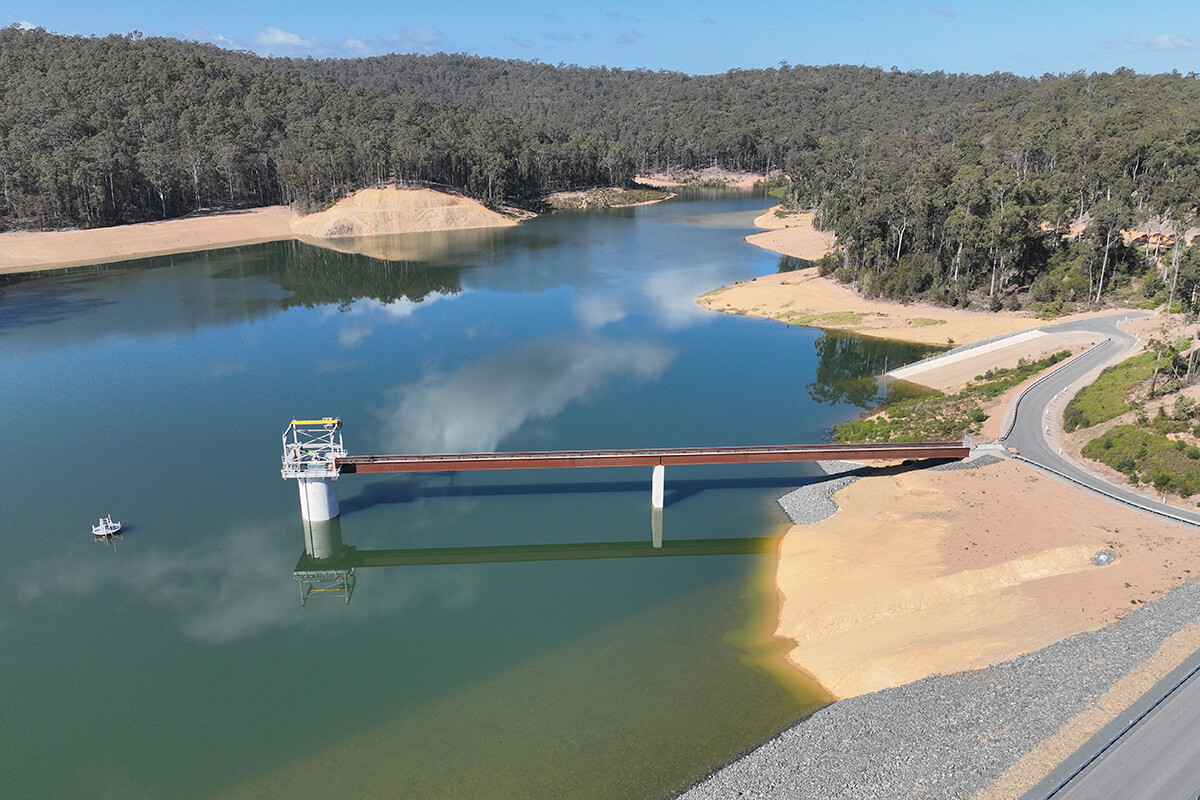
As of 2026-09-15 04:34 UTC, Eurobodalla's new Southern Storage Facility near Bodalla, on the New South Wales coast, was complete and taking in water. The Australian, NSW and local governments marked the A$150 million project's completion on September 11. Its 3,000-megalitre reservoir is expected to fill by mid-2027, depending on conditions in the Tuross River.[1]
That dependence is central to the project. The storage sits off the river, receiving pumped water when flows allow. It gives the shire somewhere to keep water gathered in wetter periods for use when supplies come under pressure.[3]
The opening also arrives amid a local argument about how much water should remain in the region's rivers. On September 15, broadcaster 2EC reported concerns from Eurobodalla's Aboriginal Advisory Committee about the Deua River and calls for the new storage to help relieve that pressure.[7]
The position at the cutoff
| Record | What it establishes | Confidence and limit |
|---|---|---|
| September 11 government announcement | Confirms the completion milestone.[1] | High confidence in the announced status; the filling forecast is conditional. |
| Council's June project update | Pumping and equipment testing had begun.[2] | High for that earlier milestone; it is not a live operating log. |
| Council's September water snapshot | Deep Creek Dam at 98%; no water restrictions; permanent conservation measures still apply.[5] | Official monthly snapshot, not a same-day gauge reading. |
| Dams Safety NSW's April–June report | The scheduled commissioning audit for Southern Storage was completed by the end of June.[6] | Confirms an audit occurred; the summary does not publish a project-specific finding. |
Saving the water that arrives at the right time
NSW Public Works traces the need for another storage facility to the council's 2003 water strategy; a site was selected in 2006. Its project account identifies a practical constraint behind the scheme: extraction is restricted when the Tuross runs low. Additional storage lets the system retain water collected during permitted flow conditions.[3]
The completed installation connects a river intake to the reservoir and provides an outlet to the existing treatment plant. Council lists instruments for reservoir levels, seepage and water quality among its features.[2] These are the working parts between a completed earth wall and water that can support the supply network.
The distinction matters for residents reading the opening announcement. Storage capacity describes how much the basin can hold. The reserve available to a community depends on how much water has actually accumulated and can be delivered. A large new basin improves the opportunity to prepare for drought; its capacity figure alone cannot describe today's protection.
From a finished wall to a filled reservoir
The public record contains several milestones. In December 2025, council announced that the wall was finished, with electrical and mechanical installation, testing and revegetation still ahead. Infrastructure director Graham Attenborough said filling would require suitable river flows after testing.[4]
Council's June 2026 update then reported pumping underway and expressed hope that the storage would be ready by year's end.[2] The September 11 announcement gives mid-2027 as the expected point for reaching capacity.[1] Those statements refer to different stages. They do not, by themselves, establish that an identical completion deadline slipped.
Council's December account also explained the intended initial role. Project manager Harvey Lane described Southern Storage as a backup to Deep Creek, to be drawn upon during drought when that main storage was depleted.[4] That earlier description helps explain why the council's current public water snapshot still centres on Deep Creek. The September snapshot lists that dam at 98%, without active restrictions.[5]
For households, the immediate message is continuity. There is no newly announced permission to disregard conservation measures. For businesses planning around seasonal demand, the useful future update will specify the volume available and the facility's operating status, alongside the existing supply position.
The river question survives the opening
The new asset has already become part of a broader debate. In 2EC's September 15 report, Aboriginal Advisory Committee chair Ben Stainer relayed concerns about low flows, pooling and habitat in the Deua. He called for more water to remain in that river and suggested using the new southern storage to help.[7]
Those are reported community concerns and a proposal. The article does not establish the ecological threshold needed to protect the Deua, or demonstrate that the suggested transfer is technically available. It carries no council response resolving those questions. The Deua concerns also concern a different river from the Tuross intake supplying the new storage.[7]
A useful council response would therefore explain both systems: what water the new reservoir can supply, where it can go, and whether that changes extraction elsewhere. Treating the opening itself as an answer would leave the committee's substantive questions unresolved.
What the next month can establish
Over the next 24 hours, residents should use council's current water notices for restrictions and supply information. Over seven days, the valuable development would be an updated project status that distinguishes filling, testing and availability. Over 30 days, a dated reservoir volume and pumping record would help readers assess progress. These are reporting priorities, not announced deadlines.
Three conditional paths frame that assessment:
- Base: permitted pumping adds water gradually. Trigger: operating updates show accumulation without a revised readiness forecast.
- Upside: a usable reserve becomes available sooner. Trigger: council publishes measured storage and confirms readiness for its intended supply role.
- Downside: limited opportunities to pump slow accumulation. Trigger: council reports interruptions tied to river flows and revises its filling outlook.
What to check next
- Read the latest restrictions notice before changing household or business water use.
- Look for actual stored volume and an operational update when assessing drought readiness.
- Seek a documented response to the Aboriginal Advisory Committee's river concerns.
Update conditions: revise this account when council publishes a new filling forecast, confirms a change in supply operations, changes restrictions or answers the proposed river-management changes. Until then, the completed project gives Eurobodalla additional capacity to prepare for dry periods. The next evidence of its value will be water accumulated, available and managed through those periods.
Sources
- NSW Government, “$150 million investment strengthens Eurobodalla’s water security” (September 11, 2026) — completion, filling forecast and photograph.
- Eurobodalla Council, “Southern Water Supply Storage” (project update: June 2026) — pumping milestone, infrastructure and monitoring.
- NSW Public Works, “Southern Water Supply Storage” (accessed September 15, 2026) — planning history and the relationship between extraction restrictions and off-stream storage; older construction forecasts are not used as current status.
- Eurobodalla Council, “Southern storage, new dam wall now damn well done” (December 4, 2025) — wall-completion milestone and the project's intended initial backup role.
- Eurobodalla Council, “Water” (snapshot labelled September 2026; accessed September 15) — Deep Creek level, restrictions status and permanent conservation measures.
- Dams Safety NSW, “Compliance and enforcement activity report: April–June 2026” (updated August 3, 2026) — completion of scheduled new-dam audits, including Southern Storage.
- Darren Cutrupi, 2EC, “Concern Deua River habitat is at risk from low water level” (September 15, 2026) — Ben Stainer's concerns and proposal; not an independent hydrological assessment.