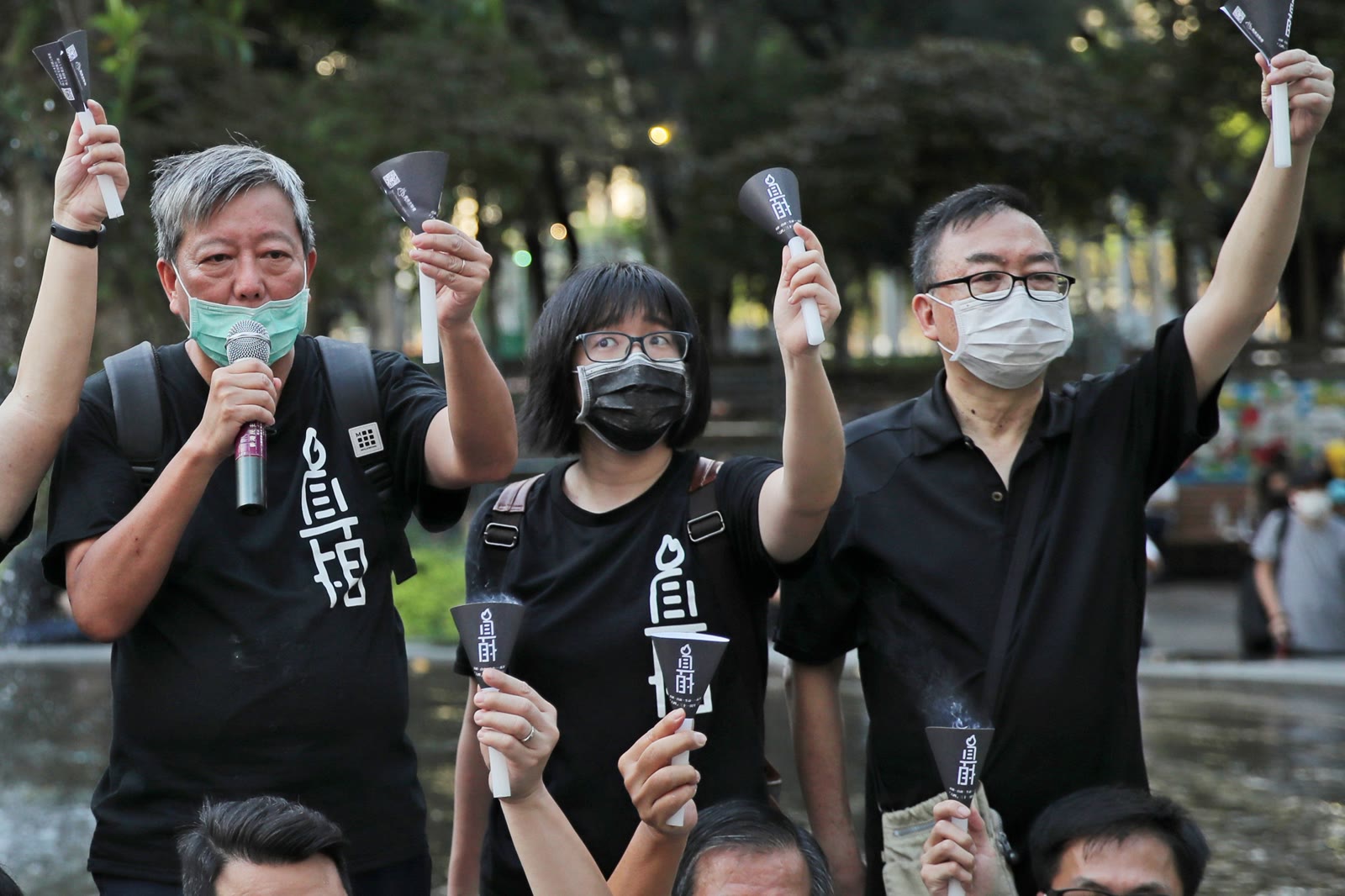
As of 2026-08-23 05:37 UTC, Hong Kong's Court of First Instance had convicted the now-disbanded Hong Kong Alliance in Support of Patriotic Democratic Movements of China and two of its former leaders, Lee Cheuk-yan and Chow Hang-tung, of inciting subversion. Albert Ho, another former leader, had pleaded guilty earlier. Mitigation is scheduled for August 28; sentences have not been imposed.[1][2][3]
The most accurate short version is not that the court outlawed mourning the victims of the 1989 Tiananmen crackdown. The judgment instead made the Alliance's long-standing demand to "end one-party dictatorship" central to its reasoning. It held that Communist Party leadership is an indispensable element of China's constitutionally protected fundamental system, read the slogan in context as a call to overthrow or undermine that system, and found that the defendants incited others to do so while intending or believing their audience would use unlawful means with a subversive purpose. Those "other unlawful means," the court held, need not involve violence or conduct that is otherwise criminal.[1][4][5]
That distinction is narrow enough to matter in reporting and wide enough to matter far beyond one annual vigil. It moves the immediate question from whether a candle or commemoration is illegal to how a court infers subversive purpose from peaceful political advocacy, historical activity and the meaning assigned to a slogan.
The verified record at the cutoff
| Record | What it establishes | Confidence and boundary |
|---|---|---|
| August 21 judgment, HKSAR v Hong Kong Alliance and others, neutral citation 2026 HKCFI 4794 | The Alliance, Lee and Chow were convicted after trial under Articles 22 and 23 of the national security law. The charged period ran from July 1, 2020, to September 8, 2021.[1] | High on the verdict and court's reasoning. The reasons are published in Traditional Chinese; English legal terminology here is cross-checked against contemporaneous wire and local reporting.[3][4][5] |
| Court and government accounts | The court treated the demand to end one-party dictatorship as a call to overthrow or undermine Communist Party leadership, and found that the defendants intended or believed others would use unlawful means with that subversive purpose.[1][2] | High on what the court found. Whether that interpretation properly protects freedom of expression is sharply disputed.[2][6] |
| Treatment of violence | The court held that "other unlawful means" can encompass conduct contrary to the Constitution even when it is not violent and is not otherwise a criminal offence.[1] | High on the stated legal construction. Its future reach depends on how later courts apply it to different words, speakers and evidence. |
| What happens next | The court will hear mitigation on August 28. Lee and Chow face a maximum of ten years' imprisonment; sentencing remains pending.[2][3][4][5] | High on the next hearing and statutory ceiling. Unknown on the eventual terms, credit for time in custody and any appeal timetable. |
The defendants' position also belongs in the verified record. Lee argued that the slogan called for democratization and public choice, not destruction of the Communist Party. Chow, a barrister who represented herself, argued that it meant ending government without meaningful limits. The panel rejected those readings after examining the Alliance's words and activities across time.[1][3][5]
How the court reached the incitement finding
The verdict is easier to understand when its constitutional, conduct and mental-state questions are kept separate.
The protected system. Article 22 of the national security law covers acts aimed at overthrowing or undermining the fundamental system established by the Constitution of the People's Republic of China. The court held that the socialist system is the fundamental system and that Communist Party leadership is an indispensable element of it.[1]
The constitutional-amendment boundary. The panel expressly rejected the prosecution's argument that even the National People's Congress could not amend the relevant constitutional provisions. It proceeded on an alternative basis: these defendants were not advocating constitutional amendment, and the court found that they intended or believed supporters would act by unlawful means to overthrow or undermine the fundamental system.[1][5]
Unlawful means and incitement. The statutory routes are force, threats of force or "other unlawful means." The court held that the last category can include conduct that violates the Constitution even when it is nonviolent and not otherwise criminal. Separately, incitement can take the form of encouragement or persuasion; the prosecution still had to prove that the defendants intended or believed the audience would use unlawful means with a subversive purpose.[1]
Nonviolence alone therefore did not defeat the charge. But the court did not hold that a political objective makes every possible route to it unlawful: its finding joined the objective attributed to the slogan with the unlawful conduct it found the defendants intended or believed their audience would use.[1]
Meaning in context. The words "end one-party dictatorship" did not decide the case in isolation. The panel considered the Alliance's five operational goals, speeches, publications, annual events and the conduct of its leaders. It found that "end" carried the practical meaning of overthrowing or undermining Communist Party leadership rather than advocating a change through constitutional amendment.[1][4][5]
That contextual reading supplied evidence about both the prohibited act being encouraged and the defendants' mental state. The court concluded that they used the Alliance and its public activities to encourage supporters to wait for an opportunity to pursue the goal, and that they intended or believed supporters would use unlawful means with a subversive purpose. They persisted after the national security law took effect on June 30, 2020; conviction did not require proof that anyone acted on the encouragement.[1][2][3]
The article's reasoning map is therefore protected fundamental system → incitement to overthrow or undermine it → intent or belief that the audience would use unlawful means with a subversive purpose. Context supplied evidence about the slogan's meaning and the required mental state; it was not a separate statutory element. This explains why the peaceful form of the defendants' speech did not end the analysis without treating the political objective alone as automatically unlawful.
The vigil and the slogan do different work
South China Morning Post's account of the judgment says the panel did not treat organizing a Tiananmen vigil as inherently unlawful. It found instead that the Alliance used the annual gathering to attract support and advance its operational goal.[5] That boundary is important because the group organized large public commemorations for three decades, and police had previously issued notices of no objection and helped maintain order at many of them—a history also recorded in the judgment.[1]
It would therefore be imprecise to report that Lee and Chow were convicted simply for lighting candles, remembering Tiananmen or running a vigil. The offence found by the court concerned incitement during the post-law charged period, with the earlier history used as evidence of organizational purpose, meaning and intent.[1]
But the narrower description does not make the civil-liberties issue disappear. A peaceful vigil can remain nominally distinct from the offence while speeches, slogans and institutional history associated with it become the evidence from which criminal intent is inferred. Amnesty International rejects the court's distinction, calling the convictions punishment for peaceful commemoration and part of an effort to erase public memory.[6] That is an advocacy organization's assessment, not a judicial finding, but it identifies the practical tension the judgment creates.
The Hong Kong government states the opposite boundary. It says the defendants were tried on law and evidence rather than political belief and that the court found their conduct exceeded the lawful scope of expression.[2] The judgment says expression and peaceful assembly are fundamental but not absolute, and can be restricted to protect national security and public order.[1]
Both positions now point to the same operational question: what evidence separates vigorous criticism or democratic advocacy from an intention or belief that others will use unlawful means to undermine the protected system? The judgment answers that question for this Alliance, this slogan, this record and this charged period. It does not publish a simple vocabulary list that resolves every future case.
What the verdict settles—and what it does not
The verdict settles guilt at the trial level for the Alliance, Lee and Chow. It establishes that, on this evidentiary record, the court was willing to treat peaceful advocacy for ending one-party rule as incitement to subversion. It also confirms that the panel did not require a violent plan, a scheduled attempt to seize power or proof that an audience member actually carried out the encouraged objective.[1][3][4]
It does not yet establish the punishment. The maximum sentence is not the sentence, and an August 28 mitigation hearing is not a sentencing date.[2][3] It does not establish how an appellate court might assess the constitutional reasoning, the interpretation of the slogan, the proof of intent or the proportionality of speech restrictions. No appeal outcome exists at this cutoff.
Nor does the verdict establish that every Tiananmen commemoration, criticism of the Communist Party or call for political reform is automatically criminal. The judgment says Articles 22 and 23 do not prohibit all speech that is inconsistent with the Constitution; the offence instead concerns unlawfully overthrowing or undermining the protected fundamental system.[1] The harder implication is evidentiary: organizers, lawyers, researchers and editors can no longer assume that nonviolence alone supplies the legal boundary in a subversion case. Under this ruling, political meaning and historical context can support inferences about what a slogan means and what speakers intend or believe their audience will do.
Decision impact: 24 hours, seven days, 30 days
Next 24 hours — describe the conviction precisely. Newsrooms and public bodies should separate four statements: the vigil itself was not declared inherently unlawful; the Alliance's political goal was central; the court found incitement plus an intent or belief that the audience would use unlawful means with a subversive purpose; and sentencing is pending. Compressing those into either "candles were criminalized" or "ordinary speech was untouched" removes the disputed mechanism.[1][2][5][6]
Next seven days — read the mitigation record, not just the final number. On August 28, watch how the parties address role, seriousness, the charged period, time already spent in custody and the relationship between organizational and individual conduct. Any announced appeal ground should be matched to the part of the reasoning it contests—the protected system, the act incited, the construction of unlawful means or proof of intent or belief—rather than described generically as a challenge to the national security law.[1][3][5]
Next 30 days — watch for generalization. The strongest evidence that this is a case-specific holding would be later official guidance or judgments preserving room for peaceful advocacy whose content and intent differ. The strongest evidence of a broader boundary would be investigators, prosecutors or institutions applying the same reasoning to other nonviolent demands for political alternation, especially without the Alliance's long organizational record. At this cutoff, that broader application is a risk to monitor, not a verified event.
Three conditional paths
Base path — sentencing follows, then the legal fight narrows to reasons and appeal. The August 28 hearing proceeds, sentences are imposed later, and one or both defendants seek to challenge the interpretation of unlawful means, the slogan or inciting intent. Trigger: a sentencing decision or appeal filing that identifies the contested legal or evidentiary issue. This is a procedural branch, not a prediction of the outcome.
Upside path — later review draws a clearer speech boundary. An appellate judgment narrows one part of the reasoning, demands a more concrete connection between advocacy and unlawful action, or otherwise specifies how protected criticism remains distinguishable. Trigger: binding reasons that alter or confine the court's reasoning on the protected system, unlawful means or inciting intent, not a diplomatic statement calling for release.
Downside path — the reasoning becomes a template for other peaceful advocacy. New investigations or charges allege that other speakers incited Constitution-violating conduct and intended or believed their audience would use unlawful means, even without violence or a concrete operational plan, extending the verdict beyond the Alliance's unusual record. Trigger: a filed charge, warrant or judgment that expressly applies this logic to a materially different slogan, group or event.
Action and invalidation check
- Editors: use "convicted of inciting subversion" and identify the court's reasoning about the slogan, unlawful means and intent or belief. Keep conviction, mitigation, sentencing and appeal as separate procedural stages.
- Legal monitors: map every later ruling to the protected system, the act alleged to be incited, the construction of unlawful means and proof of intent or belief, so a change in one is not mistaken for endorsement of the entire trial judgment.
- Rights groups and governments: label normative claims as claims. The Hong Kong government's rule-of-law defense and Amnesty's erasure-of-memory critique are relevant evidence of the dispute, not substitutes for the judgment.[2][6]
- Archives and researchers: preserve the difference between pre-2020 lawful vigils, the post-law charged period and later restrictions. Combining them into one undated narrative obscures what the panel treated as historical context and what it treated as the offence period.[1]
- Update condition: revise the punishment section when sentencing reasons appear and the appellate section when a notice or judgment is filed.
- Invalidation condition: invalidate this explainer's central reading if an authoritative corrected judgment shows that the vigil alone—not the political goal, attributed meaning and inciting intent—was the legal basis for conviction, or if a higher court rejects a necessary part of the trial court's reasoning.
The durable fact is the verdict. The durable question is how far its reasoning travels. For now, the court has not issued a general ban on remembrance; it has done something legally more specific and potentially more expansive by treating the promotion and contextual meaning of a peaceful political slogan, together with the defendants' intent or belief about their audience's use of unlawful means, as incitement to subversion.
Sources
- Hong Kong Court of First Instance, HKSAR v Hong Kong Alliance in Support of Patriotic Democratic Movements of China and others, HCCC 155/2022, neutral citation 2026 HKCFI 4794 (August 21, 2026; Traditional Chinese DOCX) — full reasons for verdict, charge period, constitutional analysis, treatment of unlawful means, evidence, intent and convictions.
- Hong Kong SAR Government, "HK Alliance must face justice: CE" (August 21, 2026) — official account of the verdict, mitigation schedule, court findings and government's rights-and-national-security position.
- Kanis Leung, Associated Press, "2 organizers of Hong Kong's Tiananmen vigils convicted in national security case" (updated August 21, 2026) — courtroom report, defendant positions, penalty ceiling, reactions and source page for the Kin Cheung cover photograph.
- Joyce Zhou and Clare Jim, Reuters via Internazionale, "Hong Kong court convicts Tiananmen vigil group leaders of inciting subversion" (August 21, 2026) — wire account of the judgment, nonviolence finding, slogan analysis, detention and mitigation.
- Brian Wong, South China Morning Post, "Hong Kong Tiananmen vigil organiser, former leaders guilty of inciting subversion" (August 21, 2026) — local legal reporting on the judgment, vigil-versus-advocacy distinction and August 28 hearing.
- Amnesty International, "Hong Kong: 'Dismaying' Tiananmen convictions part of campaign to erase Chinese history" (August 21, 2026) — rights-group critique and historical account of the vigils, explicitly treated in this article as advocacy rather than a neutral adjudication.