As of 2026-04-17 12:05 UTC, the useful way to read DOJ and FTC's current competitor-collaboration file is to ignore two easy overreactions at once. The first says Washington is quietly giving rivals more room to coordinate. The second says the agencies are only reopening an old lawyerly debate with no practical effect. Neither fits the record. What the agencies actually opened on February 23, 2026 is a bounded public inquiry on whether and how to restore guidance for collaborations among competitors, with comments capped at 18 pages and due on April 24, 2026.[1][2][3] The live task is not to suspend antitrust law. It is to rebuild a usable rule-of-the-road document after the government withdrew the prior one and left firms back in a more ambiguous, case-by-case world.[1][2][4]
That distinction matters because the agencies themselves define the file in double terms. They say many collaborations and joint ventures among competitors can expand output, support innovation, and lower costs, while also warning that some arrangements can raise prices, suppress competition, or turn information exchange into a competitive hazard.[1][2] The inquiry is therefore best understood as a boundary reset. It is an attempt to recover predictability without declaring that modern collaborations are presumptively safe.
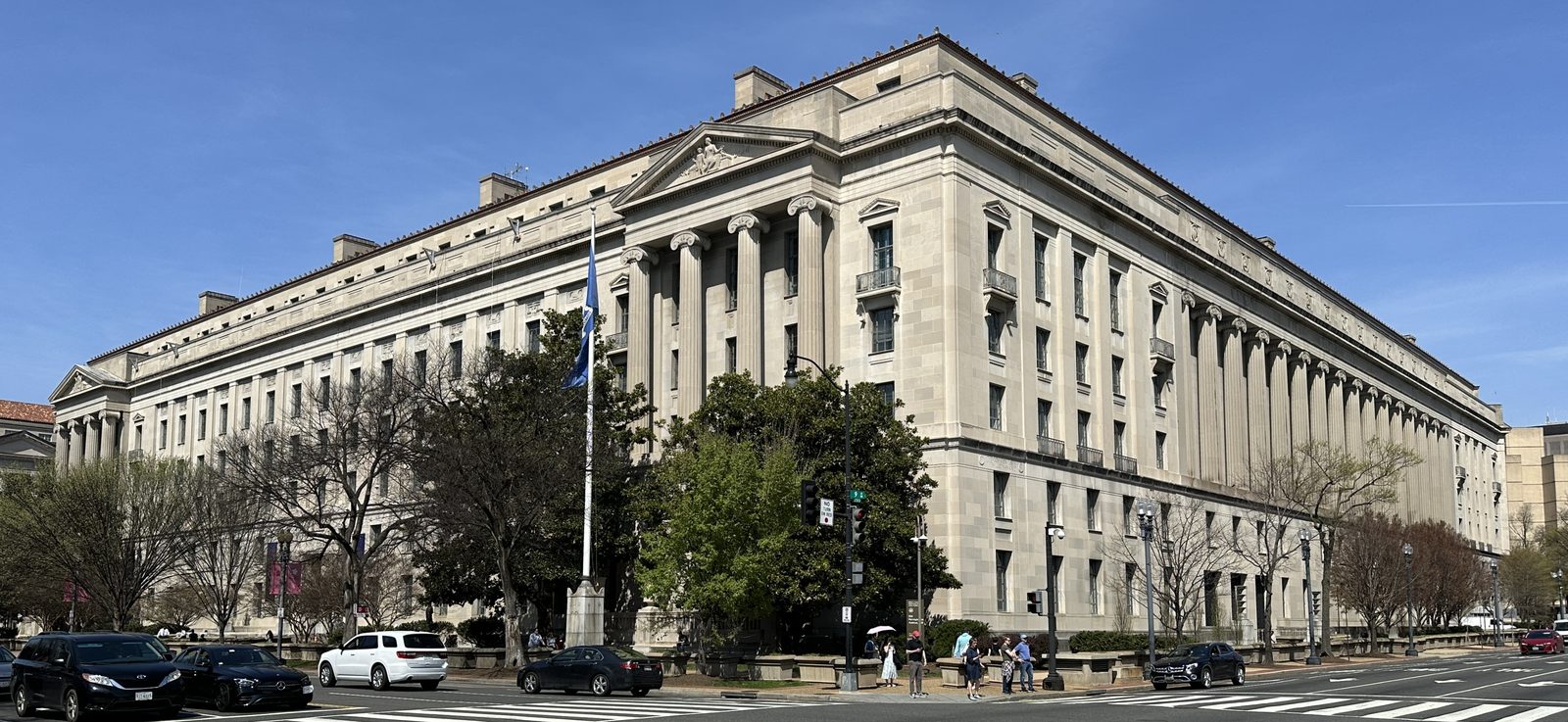
Image context: the header photo shows DOJ headquarters in Washington because this story turns on federal antitrust administration, not on a specific courtroom or a symbolic handshake visual. The practical question is what kind of written framework the agencies want businesses and counselors to rely on again before the April 24 record closes.[7]
What actually changed
The most important background date is December 11, 2024. That is when FTC and DOJ jointly withdrew the 2000 Antitrust Guidelines for Collaborations Among Competitors, saying the old document no longer provided reliable guidance for how enforcers assess competitor collaborations and telling businesses to return to statutes and caselaw when judging legality.[4] That move did not repeal the Sherman Act or create a new safe harbor. It removed a shared interpretive playbook.
The February 2026 inquiry is the agencies' acknowledgment that the vacuum has practical costs. Both agencies now say the 2024 withdrawal left businesses without enough guidance in an important area and that updated guidance could restore predictability while still deterring anticompetitive conduct.[1][2] The short version is that Washington is not reversing from enforcement to permissiveness. It is trying to replace a withdrawn framework before uncertainty itself becomes a problem.
That is also why the deadline matters. The comment window is not open-ended policy musing. It is a near-term administrative clock for businesses, trade groups, lawyers, economists, and academics who want to shape how competitor collaborations are described going forward.[1][2][3]
Why this is not a green light for coordination
The strongest evidence sits in the agencies' own question set. If the government were trying to relax the field by default, it would not frame the inquiry around topics such as algorithmic pricing, information and data sharing, and labor collaborations.[1][2] Those are not low-risk placeholders. They are modern pressure points where operational cooperation can slide toward coordination, exclusion, or sensitive information exchange.
The December 2024 withdrawal page makes the enforcement posture even clearer. The agencies did not say competitor collaborations had become less important or less risky. They said they would continue vigorous, case-by-case enforcement because such collaborations can still harm competition and distort the competitive process.[4] The implication is straightforward: the current inquiry is about interpretive structure, not about forgiving conduct that antitrust law already treats as dangerous.
That is why the right reading is narrower and more useful than a deregulation headline. Businesses are not being told to collaborate first and ask permission later. They are being asked what kinds of guidance would help distinguish lawful joint activity from conduct that still crosses the line.[1][2][3][4]
Why the old 2000 framework is back in the story
The 2000 guidelines mattered because they were written for a world in which firms increasingly used collaborations to reach foreign markets, fund expensive innovation, and lower production or distribution costs without merging outright.[5] The document's point was not to bless every alliance. It was to provide an analytical framework that let companies and their advisers think through when a collaboration looked more like a legitimate integration and when it looked more like a restraint on competition.[5]
That historical function is exactly what the agencies are now trying to recover. The 2000 document gave counselors a reference point. The 2024 withdrawal removed it. The 2026 inquiry is effectively asking what a replacement should look like when the economy is more digital, more data-intensive, and more dependent on cloud, software, and platform infrastructure than the one the 2000 text was built for.[1][2][4][5]
So the story is not simply that an old guideline might come back. The story is that the government now appears to want a modernized version of the interpretive middle layer it had just deleted.
Why the file feels more urgent in the AI era
The modern pressure is easiest to see in the FTC's own work on large AI partnerships. In its January 2025 explanation of the Commission's 6(b) report on major AI developer and cloud-provider partnerships, FTC staff highlighted structures that sound very contemporary but also very recognizable to antitrust lawyers: billions in cloud commitments, consultation and control rights, discounted computing resources, sharing of technical and business information, potential exchange of talent and data, and switching costs that may bind one partner more tightly to another platform.[6]
That matters for the February 2026 inquiry because competitor collaboration now often travels through technical infrastructure rather than through a classic standalone joint venture. Information-sharing may happen through APIs, model-development loops, co-design arrangements, or data-access architecture. Dependence may arrive through compute credits, committed cloud spending, or technical migration barriers. A collaboration can look operationally indispensable and competitively sensitive at the same time.[1][2][6]
This is where the agencies' reference to algorithmic pricing and information sharing becomes especially important.[1][2] The government is signaling that any new guidance has to deal with collaborations that are partly commercial, partly technical, and sometimes embedded inside shared software or platform relationships rather than a simple written alliance agreement.
What to watch before April 24
There are five high-signal questions inside the current comment window.
First, will the agencies rebuild a relatively stable analytical framework, or will they preserve more discretion by keeping the document high-level? The more concrete the guidance becomes, the more useful it is for planning and compliance. The vaguer it stays, the more it functions as a statement of posture rather than a practical tool.[1][2][5]
Second, how will they treat information exchange? The inquiry's express reference to data sharing suggests that the new document may need sharper distinctions between operational interoperability, ordinary benchmarking, and exchanges that can facilitate coordination or exclusion.[1][2][6]
Third, will AI and cloud partnerships appear explicitly? The agencies do not name specific firms in the inquiry, but the FTC's own AI-partnership analysis shows why these relationships are now central to the competitor-collaboration question.[1][2][6]
Fourth, how will labor collaborations be handled? The fact that labor appears in the agencies' examples suggests they may want a more visible treatment of collaborations that affect hiring, staffing, compensation, or talent access.[1][2]
Fifth, how much of the 2000 logic survives? The original framework was designed to help businesses assess challenge risk in a world of globalization and technology-driven alliances.[5] A modern rewrite may keep that structure, narrow it, or reorganize it around newer hazards such as algorithmic coordination and platform-mediated information access.[1][2][5][6]
Bottom line
The inference from the agencies' documents is narrower than the easiest political spin. DOJ and FTC are not using the April 24, 2026 clock to legalize collaboration among rivals by default. They are trying to refill a guidance vacuum they created in December 2024, when they withdrew the prior framework before a successor existed.[1][2][4] The practical issue now is not whether antitrust enforcement disappeared. It is what kind of written map businesses will have when they evaluate joint ventures, data-sharing arrangements, AI-era partnerships, labor collaborations, and other forms of cooperation that sit between clean competition and illegal coordination.[1][2][5][6]
Sources
- U.S. Department of Justice, "Justice Department and Federal Trade Commission Seek Public Comment for Guidance on Business Collaborations" (February 23, 2026).
- Federal Trade Commission, "Federal Trade Commission and Department of Justice Seek Public Comment for Guidance on Business Collaborations" (February 23, 2026).
- Regulations.gov, "ATR-2026-0001: Guidance on Business Collaborations" (public docket page, accessed April 17, 2026).
- Federal Trade Commission, "FTC and DOJ Withdraw Guidelines for Collaboration Among Competitors" (December 11, 2024).
- Federal Trade Commission and U.S. Department of Justice, Antitrust Guidelines for Collaborations Among Competitors (April 2000 PDF).
- Federal Trade Commission, "Behind the FTC's 6(b) Report on Large AI Partnerships & Investments" (January 17, 2025).
- Wikimedia Commons, "File:Robert F. Kennedy Department of Justice Building.jpg" (image source page).