As of 2026-04-17 11:05 UTC, the Federal Aviation Administration's new Chicago O'Hare order should be read less as a traveler-annoyance memo and more as a public admission that schedule growth outran workable capacity. The headline number is simple: peak summer schedules had climbed above 3,080 daily operations, and the FAA has now imposed a limit of 2,708 operations per day from May 17 through October 24, 2026.[1][2] The harder point is what that implies. O'Hare is not being trimmed because Washington wants a tidier timetable. It is being cut back because the federal government concluded that simultaneous airline expansion and a construction-constrained airfield were on track to produce delays worse than last summer's already weak performance.[1][2][3]
That distinction matters because airport delay stories are often told as if they were weather stories, or staffing stories, or generic summertime stories. The O'Hare file is narrower and more revealing. FAA's own documents say the airport is facing airport construction, a constrained taxiway environment, and competitive scheduling dynamics occurring between the two largest carriers at the airport.[1][2] In other words, the system did not simply drift into overload. Airlines tried to grow into the same peak hours while the field itself remained partially constrained.
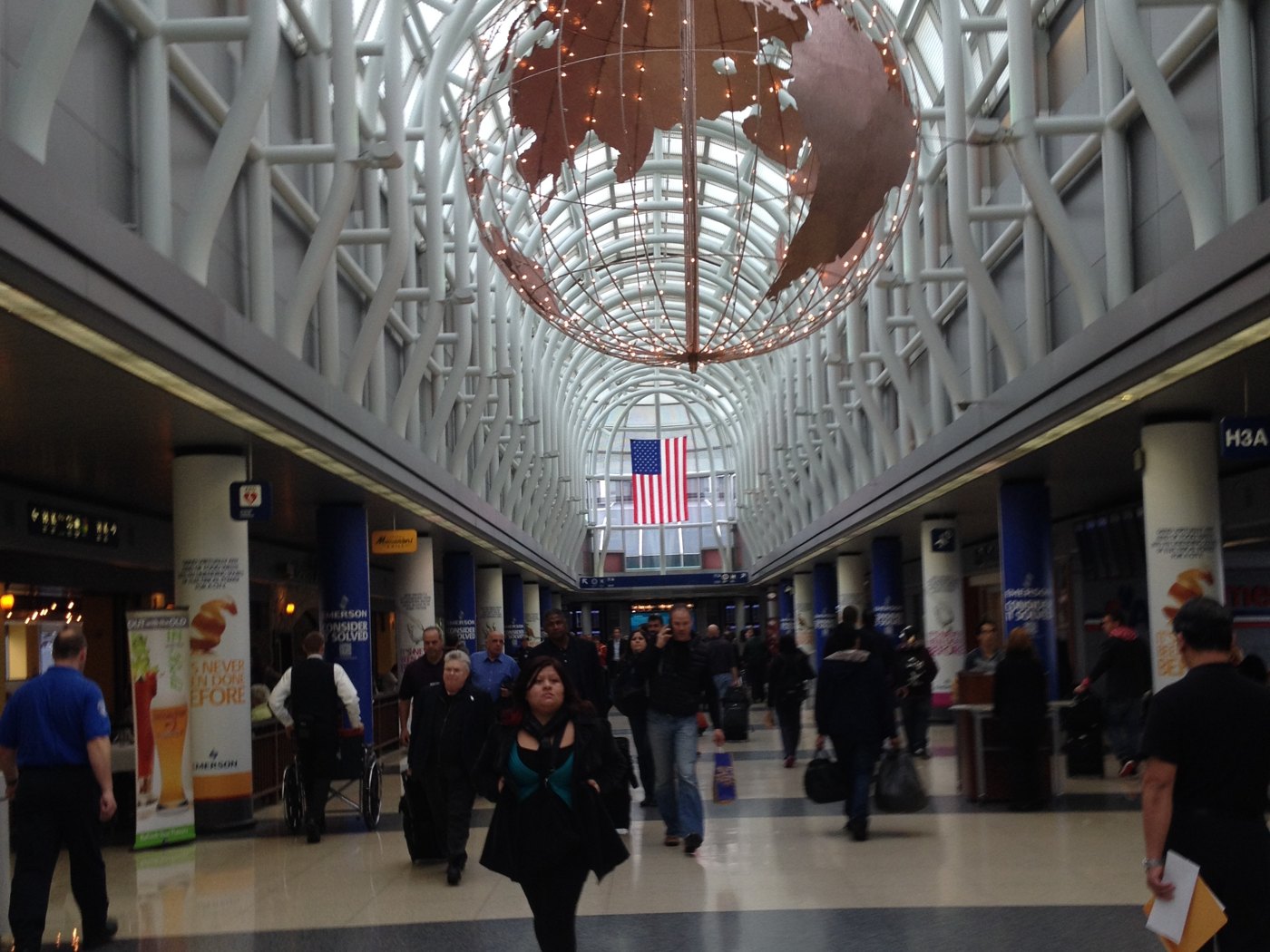
Image context: the cover image is a ground-level photograph of O'Hare Terminal 3. It replaces the earlier overhead view with a more immersive airport scene, because the article is ultimately about how a schedule cap becomes visible in terminal flow, curbside movement, gates, and the daily choreography of a constrained hub.[5]
What the order actually does
The FAA's April 16 announcement offers the cleanest topline. O'Hare, which the agency calls the busiest U.S. airport by flight volume, had more than 3,080 flights planned on peak days for Summer 2026, a 14.9% jump from Summer 2025. The agency responded by limiting the airport to 2,708 daily operations and allocating those operations among airlines using their approved Summer 2025 schedules as the baseline.[1]
The unpublished final order adds the real policy meaning. It says 2,708 operations per day is the level that will "maximize capacity at the airfield" in Summer 2026 without causing delays worse than Summer 2025, and it explicitly ties that number to current factors including airport construction and competitive scheduling dynamics.[2] That is not the language of temporary inconvenience. It is the language of a regulator saying the airport's practical ceiling is lower than the market's preferred schedule.
The cut is also not trivial. The Associated Press summarized the effect as roughly 300 flights per day being removed on the busiest summer days.[4] That is large enough to change bank structures, connection planning, and aircraft utilization, not just pad a few buffers at the margins.
Why the FAA cut below the initial freeze line
One useful clue sits in the gap between the March proceeding and the April order. In its March 18 Federal Register notice, the FAA said currently published schedules were above 3,080 daily operations and noted that Summer 2025 had peaked around 2,680 total daily operations.[3] The agency initially proposed a cap around a broad freeze line, saying O'Hare could manage about 100 hourly departures and 100 hourly arrivals, or roughly 2,800 daily operations, given current infrastructure and staffing.[3]
By the time the final order arrived, the cap had moved lower to 2,708.[2] That is the most revealing part of the story. The FAA did not simply ratify a status quo ceiling. It tightened it after the airline meetings and after reviewing the proposed schedule mix against what the airport could actually sustain.[2][3] The regulatory message is that even a flat, no-growth summer was no longer conservative enough once the agency weighed construction progress, schedule concentration, and competition for peak periods.
That is also why the order leans on the previous equivalent season. Instead of letting Summer 2026 claims settle the fight, the FAA chose final Summer 2025 schedules as the baseline for allocating reductions.[1][2][3] The effect is to privilege recent operating history over fresh market-share grabs. Operationally, that is a way to spread pain without reopening a peak-hour land rush. Politically, it is the government saying that when the field is constrained, reliability outranks expansion rhetoric.
Why this is bigger than one Chicago summer
O'Hare matters because it is not just a local airport; it is a network hinge. The March notice says disruptions there spill into the broader National Airspace System, forcing traffic-management responses when congestion gets out of hand.[3] The final order goes further and frames the cap as a way to prevent widespread operational disruption across the NAS during Summer 2026.[2] That means the FAA is not only managing Chicago passengers. It is managing knock-on delay risk for the national network.
This is where the order becomes an investigation into airline strategy as much as airport operations. A growing hub schedule can look rational carrier by carrier. More banks mean more connection options, more local departures, and a stronger claim on corporate demand. But if multiple carriers press those same hours while the taxiway environment is constrained, the gain on paper can turn into network fragility in practice. The FAA's documents repeatedly circle that point. The airport is not being punished for growth in the abstract. It is being capped because the timing and density of that growth stopped matching what the airfield could absorb.[1][2][3]
The order's own wording makes the airline angle hard to miss. The final order refers to competitive scheduling dynamics between the airport's two largest carriers, and AP reports that both American and United had announced expansion plans that could have intensified the summer squeeze.[2][4] That does not make either airline uniquely culpable. It does show that the core problem was not simply one-off bad luck. It was a competition problem expressed through infrastructure.
What to watch from here
The immediate watchpoint is whether the cap actually produces the reliability improvement the FAA is promising. If Summer 2026 performance stabilizes at materially better levels, the agency will have shown that O'Hare's problem was overscheduling into a constrained field rather than some broader systems failure.[1][2] If delays still stack up heavily even after the cut, that will suggest the bottleneck sits deeper in taxiway availability, gate flow, staffing, or weather recovery than the order alone can solve.
The second watchpoint is whether the cap remains temporary. The final order expires on October 24, 2026, and the FAA says it expects enough progress on airfield construction during the season to reduce the likelihood that the limit will need to continue beyond summer.[2] That is a concrete claim, and it is testable. If construction relief and seasonal normalization are real, the cap can stay a one-season discipline file. If not, O'Hare may be heading toward a more durable debate about whether its competitive timetable is structurally heavier than its present operating geometry.
The practical conclusion is narrower than "flying is broken" and sharper than "summer will be busy." O'Hare's new cap shows what happens when carrier growth, construction friction, and hub competition collide at one of the country's most important transfer points. The FAA has now said, in effect, that the airport's market schedule had become less real than the airport itself.[1][2][3][4]
Sources
- Federal Aviation Administration, "Trump's Transportation Secretary Sean P. Duffy Takes Action to Prevent Endless Delays, Cancellations at Chicago O'Hare" (April 16, 2026).
- Federal Register public inspection, "Order Establishing Scheduling Limits: Operating Limitations at Chicago O'Hare International Airport" (filed April 16, 2026; scheduled for publication April 20, 2026).
- Federal Register, "Operating Limitations at Chicago O'Hare International Airport, Notice of Meeting and Request for Information" (March 18, 2026).
- Associated Press, "Federal officials order flight cuts at Chicago O'Hare to reduce airport delays" (April 17, 2026).
- Christophe95, "O'Hare International Airport terminal 3" (Wikimedia Commons photograph, taken October 30, 2013).