As of 2026-04-18 08:05 UTC, the cleanest way to misread the Supreme Court's latest Chevron ruling would be to treat it as a verdict on whether the company did or did not damage Louisiana's coast. That is not what the justices decided on April 17, 2026. The Court answered a narrower but still consequential question: whether Chevron plausibly showed a close enough link between the conduct challenged in Plaquemines Parish's wetlands suit and Chevron's wartime aviation-gasoline work for the federal government to remove the case into federal court under the federal-officer removal statute.[1]
That procedural move matters because forum affects pace, leverage, appellate path, and settlement pressure. But the ruling is still best read as a venue reset, not as a cleanup of the merits record. The 2025 state-court jury verdict ordering Chevron to pay $744.6 million remains the political and factual backdrop to the fight, and the state's physical land-loss problem remains exactly where it was before Friday morning.[2][4][5][6]
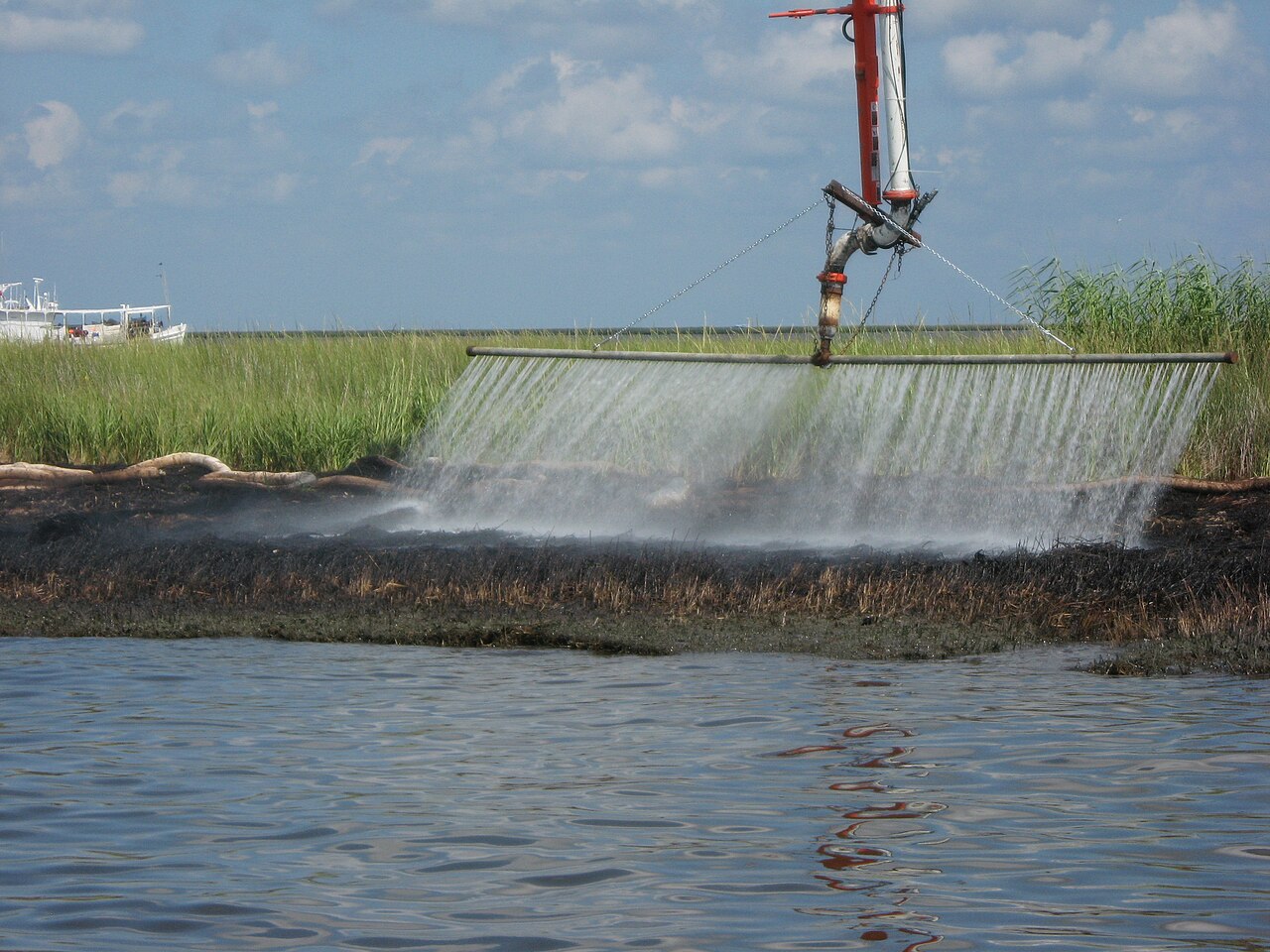
Image context: the cover photo shows heavy oil impacts documented at Bay Jimmy in Plaquemines Parish in September 2010. It is the right image for this file because the legal action may now move through a different courthouse, but the dispute still grows out of damaged marsh, canals, pits, and restoration claims tied to a real stretch of coast.[7]
Facts that changed on April 17
- Decision date: April 17, 2026.[1]
- Vote: 8-0; Justice Ketanji Brown Jackson concurred in the judgment, and Justice Samuel Alito took no part.[1]
- Holding: Chevron plausibly alleged a sufficiently close relationship between the challenged crude-oil production and its federal wartime avgas-refining duties to satisfy the statute's "for or relating to" language.[1]
- Immediate consequence: the Supreme Court vacated the Fifth Circuit's contrary ruling and remanded for further proceedings.[1]
- What the Court did not decide: liability, damages, restoration scope, or whether every related Louisiana coastal case now automatically belongs in federal court.[1][3]
The opinion's core move was textual and practical at the same time. Justice Clarence Thomas wrote that "relating to" sweeps broadly, though not infinitely broadly, and that Chevron had plausibly alleged a connection that was not merely "tenuous, remote, or peripheral."[1] The Court emphasized the wartime production context: the parish's expert theory challenged Chevron's reliance on canals, vertical drilling, and earthen pits in ways that the Court said were tightly connected to the federal push to maximize crude production for aviation-gasoline refining during World War II.[1]
That is why the ruling matters beyond one headline. The Court did not say every contractor wins removal merely by invoking a federal relationship somewhere in the background. It said Chevron had cleared the threshold here because the alleged field practices and the federal war-production assignment were close enough to one another. In practical terms, that is a more defendant-friendly reading of the removal doorway than the Fifth Circuit had adopted.[1]
What the ruling did not clean up
The missing piece is the one readers are most likely to assume away. Friday's opinion did not say Chevron is free of coastal-restoration liability under Louisiana law. It did not reverse the 2025 jury on the factual question of wetland damage. It did not hold that the 1978 State and Local Coastal Resources Management Act is invalid or unenforceable. It resolved a forum fight first.[1][2][4]
That distinction matters because the underlying record is still substantial. In April 2025, a southeast Louisiana jury ordered Chevron to pay $744.6 million after finding long-running coastal damage connected to the company's predecessor Texaco's conduct in the parish. AP described that verdict as the first of dozens of pending coastal cases to reach trial, and plaintiffs treated it as a possible template for much larger exposure across the broader docket.[4] Friday's Supreme Court ruling changes the route of travel more than the destination of the factual dispute.
It also leaves scope uncertainty hanging over the rest of the litigation stack. When the Court agreed to hear the case in June 2025, plaintiffs argued that the appeal encompassed at least 10 related cases, while Chevron argued the implications could be broader.[3] The new opinion clearly helps defendants press removal arguments in related files, but it does not by itself answer how many of Louisiana's other coastal suits can satisfy the same relationship test on their own records.[1][3]
Why venue is the real story
Federal-versus-state-court fights can look dry until they are attached to a live damages number. Here, the procedural question carries obvious strategic weight. Federal court changes the judge, the path of motions practice, the appellate sequence, and the settlement temperature. For defendants, that is the point. AP noted directly that federal courts are seen as a friendlier venue for the companies.[2]
The better analytical frame, then, is not "Chevron won" in a final sense. It is that Chevron won the right to keep contesting the case from a procedural position it regards as materially safer. That is a meaningful gain. Yet it still sits one layer above the underlying question of what decades of dredging, waste handling, and field development did to the Louisiana marsh.[1][2][4]
This is also why the ruling should be read with some restraint in the next 24 hours and 30 days. The fast implication is doctrinal: removal arguments just got stronger where defendants can build a wartime-federal-duty record. The slower implication is case-management specific: parties will now test which other files actually resemble Chevron closely enough to move. A headline that compresses those two horizons into one "Big Oil beat Louisiana" line is missing the operative distinction.[1][3]
The coast itself remains the larger file
Nothing in Friday's opinion shrinks the scale of the physical problem. USGS's long-run mapping showed a net land-area change of about -1,883 square miles in coastal Louisiana from 1932 to 2010, roughly a 25% decline from the 1932 land base.[5] Louisiana's Coastal Protection and Restoration Authority now says the state has lost nearly 2,000 square miles since the 1930s and could lose up to another 3,000 square miles over the next 50 years under the 2023 Coastal Master Plan's higher environmental scenario if action falls short.[6]
That is the most important boundary to keep in frame. The Supreme Court changed courtroom geography. It did not change coastal geography. The legal system can still end up deciding money, forum, and remediation obligations in stages, but none of those procedural pivots cancel the state-level reality that marsh loss, flood exposure, and restoration finance remain live public problems.[5][6]
Bottom line
The ruling is consequential because it resets leverage, not because it resolves liability. Chevron now has a stronger path to litigate in federal court, and that path may influence a meaningful slice of the wider Louisiana coastal docket.[1][3] But Friday's opinion left the core environmental dispute where it already was: inside a costly, long-running argument over how much damage was done, who owes for restoration, and how a disappearing coast gets defended after decades of extraction.[4][5][6]
Sources
- Supreme Court of the United States, Chevron USA Inc. v. Plaquemines Parish, Louisiana, No. 24-813, decided April 17, 2026 (slip opinion PDF).
- Lindsay Whitehurst and Jack Brook, "The Supreme Court hands a win to oil and gas companies fighting environmental lawsuits in Louisiana." AP News, April 17, 2026.
- Jack Brook, "Supreme Court to hear appeal from Chevron in landmark Louisiana coastal damage lawsuits." AP News, June 16, 2025.
- Jack Brook, "Chevron ordered to pay more than $740 million to restore Louisiana coast in landmark trial." AP News, April 4, 2025.
- U.S. Geological Survey, Land Area Change in Coastal Louisiana from 1932 to 2010 (Scientific Investigations Map 3164).
- Louisiana Coastal Protection and Restoration Authority, "A Changing Landscape" (accessed April 18, 2026).
- Wikimedia Commons, "File:Bay Jimmy, Plaquemines Parish, 15 Sept 2010.jpg" (image source).