As of 2026-07-10 16:35 UTC, Australia is one formal consultation away from putting a national pay floor under a large part of app-based food and grocery delivery. On July 8, the Fair Work Commission published a notice of intent and a draft order that would set minimum rates from A$31.30 to A$32.00 an hour, depending on the vehicle, with a proposed start date of August 10.[1][2]
The headline number is accurate but incomplete. It applies to engaged time—normally from accepting a delivery to completing it—not every hour a rider is logged into an app. It works as a top-up across an earnings period of up to 21 days, rather than replacing per-delivery prices with a conventional hourly wage. Riders would also continue to pay for their vehicles, fuel, maintenance, licences, phones, and other operating costs.[1][2]
The status matters just as much as the mechanism. This is a proposed order, not yet a final one. Submissions close at 4 p.m. AEST on July 29; the commission can revise the text, repeat consultation if changes are significant, or decide not to make the order. Even if adopted, the panel says it intends the standard to operate only on an interim basis while related “last mile” delivery cases are decided.[1][3][4]
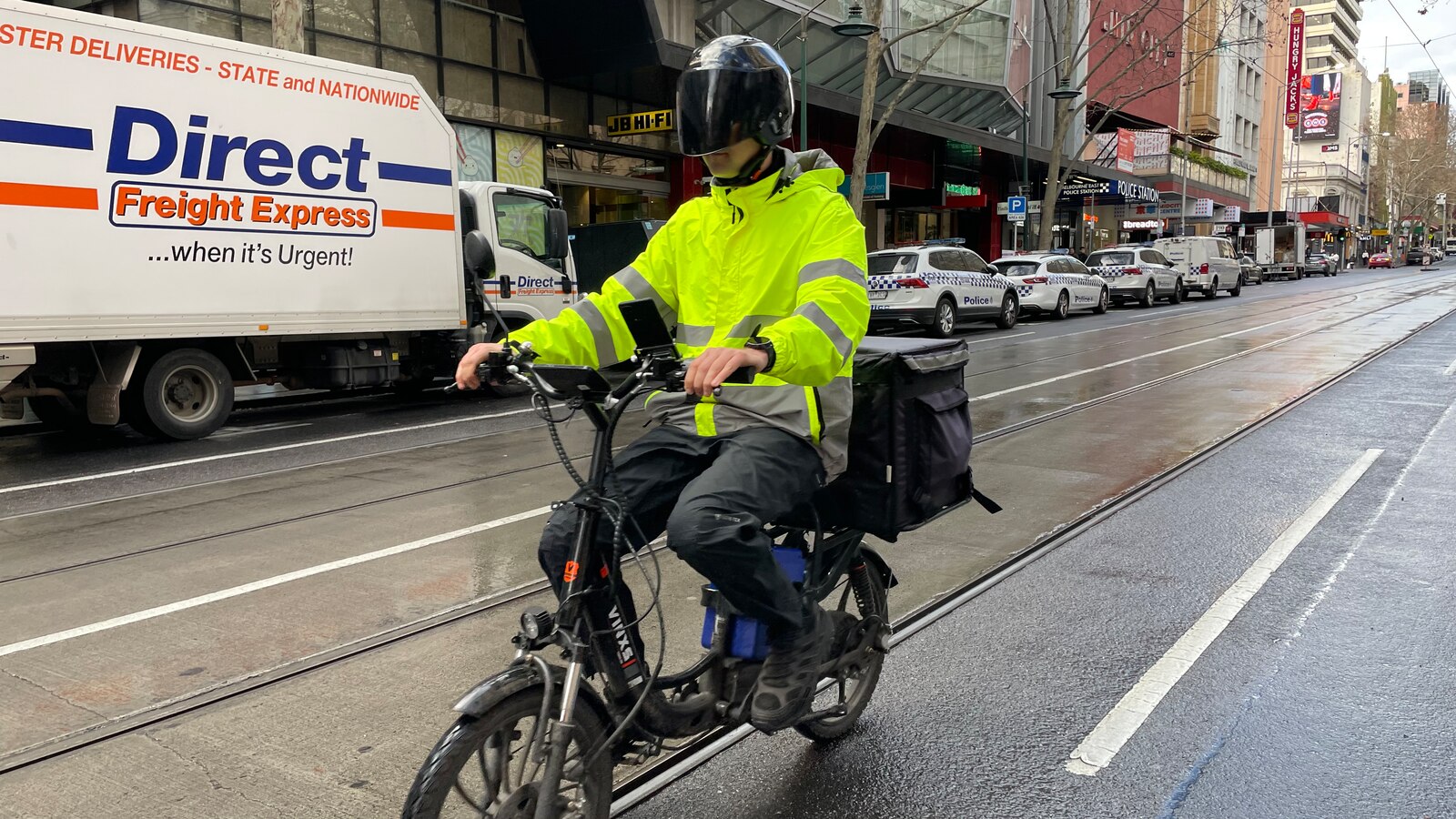
Image context: the cover is a real photograph of delivery rider Davis Clayton on a wet Melbourne street, made by ABC News photographer Iskhandar Razak. It shows the work environment discussed here—traffic, weather, protective gear, and a worker-supplied vehicle—without turning the story into a symbolic app graphic.[7]
Status Check
| Record | What it establishes | Confidence boundary |
|---|---|---|
| Fair Work Commission decision, July 8 | The expert panel decided to publish a notice of intent and a draft minimum standards order broadly based on the proposal negotiated by the Transport Workers' Union, Uber Eats, and DoorDash.[1] | High on the panel's reasoning; this is not the final order. |
| Draft order, July 8 | Proposed commencement is August 10, with initial hourly safety-net rates of A$31.30 for pedal bikes, e-bikes, and scooters; A$31.50 for combustion motorcycles or scooters; and A$32.00 for cars and other vehicles up to one tonne.[2] | High on the current draft; rates and terms can still change. |
| Commission case page | Written submissions on the draft are due July 29.[3] | High on the published timetable; later directions can alter it. |
| Fair Work Act | The commission must publish a draft and give affected parties a reasonable opportunity to comment before making an employee-like worker order.[4] | High on the statutory process; the Act does not predetermine the final terms. |
Read The Rate In Three Steps
1. Ask whether the job is covered
The draft covers “employee-like” workers who accept app-arranged jobs to collect and promptly deliver food, beverages, alcohol, or groceries. It includes shopping or selecting groceries as part of collection. It does not cover rideshare trips, general parcel work outside that definition, or a vehicle with more than one tonne of carrying capacity.[2]
That boundary is deliberate. Australia changed the Fair Work Act in 2024 so the commission could set legally binding standards for some contractors without converting them into employees. A person must still satisfy the Act's employee-like test, which looks for at least two features such as low bargaining power, pay at or below comparable employee rates, and low authority over how the work is performed.[1][4]
2. Count engaged time, not login time
Under the draft, engaged time begins when a worker accepts a job and ends when the job is completed. If the rider accepts another order while still completing an earlier one, the second clock begins only when the first job ends. Ordinary travel to the pickup, normal restaurant waiting after acceptance, and the trip to the customer therefore sit inside the clock.[2]
Time between offers does not. Neither do breaks, time after a cancellation once the worker has been notified—unless the platform requires return duties—or delays attributed to the worker, such as an unrelated stop of more than five minutes on an unreasonable route. Before excluding alleged “non-engaged time,” a platform would have to issue notifications and provide the information behind its view; the draft creates a staged process rather than an invisible one-click deduction.[2]
This distinction is the heart of the policy. “A$31.30 an hour” can sound like a guarantee for the whole shift. It is instead a floor for the portion of the shift attached to accepted work. A rider who is online but receives few worthwhile offers can still have a much lower rate when total street time is used as the denominator.
3. Apply the top-up across the earnings period
Platforms could keep paying per delivery, including surge and incentive payments. At the end of an earnings period—no longer than 21 days—the platform would multiply the worker's total engaged hours by the relevant vehicle rate. If actual pay fell short, it would owe a top-up in the next earnings period or within seven days after that period.[1][2]
Consider a deliberately simple example. An e-bike rider is logged in for four hours, spends 2.5 hours on accepted deliveries, and receives A$68. The draft floor for that engaged time is A$78.25 (2.5 × A$31.30), so the top-up would be A$10.25. The resulting A$78.25 is A$31.30 per engaged hour, but only about A$19.56 per logged-in hour, before the rider's own costs. The arithmetic is illustrative; real earnings periods can contain many jobs, incentives, and disputed time records.
What Changes Beyond The Pay Number
The draft would make each offer more legible. Before acceptance, a platform would have to show the pickup name and location, the approximate delivery area, whether the job includes alcohol or bulky items, the estimated minimum fee, and estimated completion time. It would also have to retain seven years of records covering gross and net pay, deductions, engaged hours, excluded time, account activation, and reasons for deactivation.[2]
There is a representation layer too. Covered platforms would establish a feedback forum that meets four times a year with platform, worker-delegate, and union representatives. Platforms would fund personal accident insurance at a “reasonable minimum” level, although the draft expressly says that cover need not equal statutory workers' compensation. Disputes would begin inside the platform and could then go to the commission for mediation, conciliation, an opinion, or a recommendation; arbitration would require both sides to agree.[2]
The Transport Workers' Union presents these provisions as a historic first floor for tens of thousands of workers and notes that the notice followed a joint proposal with Uber Eats and DoorDash.[5] That support is important evidence of an unusual negotiated path, but it is a stakeholder position. The commission's own decision is more guarded.
The Commission's Warning Is Part Of The Story
The panel found that the proposed rates would probably lift earnings for many delivery workers. Evidence before it included individual estimates ranging from roughly A$18 to A$30.33 an hour, and a cited 2023 survey in which 57 percent of food-delivery drivers reported earning below the minimum wage.[1]
But the panel also concluded that the proposed rates do not properly account for necessary costs or for the minimum standards of comparable employees. It rejected the platforms' argument that a worker's existing vehicle should be treated as having zero cost: work use still adds depreciation, and tax deductibility does not reimburse the expense. For a vehicle carrying up to 750 kilograms, the panel observed that a comparable award labour component of A$31.64 would leave less than one dollar of the draft A$32 car rate for cost recovery.[1]
That finding matters in 2026 because operating costs are not theoretical. ABC reported in March that one part-time food courier earned A$140 across ten hours during a fuel-price shock, while drivers described becoming more selective or leaving the apps as fuel and insurance squeezed already narrow margins.[6] Those experiences do not establish every rider's income, but they explain why “engaged pay” and “net earnings across all working time” must be tracked separately.
The panel nevertheless chose to move forward because an imperfect interim floor could raise earnings quickly while preserving per-job flexibility. Its unresolved concern is competitive consistency: on-demand couriers and last-mile contractors can perform materially similar road work, yet the rates proposed in the related last-mile cases are much higher. The commission plans to review any on-demand order after those cases reach the same notice-of-intent stage.[1][2]
Who Should Care, And When
Next 24 hours: riders, platforms, restaurants, and worker advocates should read the draft rather than a rate-only headline. The immediate questions are coverage, the engaged-time definition, and whether existing app records can reproduce every inclusion, exclusion, and top-up.[2]
Next 7 days: affected parties can prepare evidence for the July 29 consultation. The most useful submissions will test the mechanism with real records: acceptance-to-drop-off time, waiting between jobs, vehicle class, kilometres and expenses, multi-app overlap, cancellations, alleged delay, and the effect of an earnings period that can run for three weeks.[2][3]
Next 30 days: the key event is a final order—or a changed timetable—after consultation. Workers should not assume August 10 is locked until the commission publishes the final text. Platforms should be ready for offer-card disclosures, time and pay records, top-up calculations, insurance, dispute handling, and worker representation if the order takes effect substantially as drafted.[2][3]
Three Paths From Here
Base case: submissions produce limited revisions, the commission makes the order, and the A$31.30–A$32.00 engaged-time floor begins close to August 10. The first proof will be whether workers can reconcile platform records with their own jobs and see correct top-ups without losing visibility into per-delivery pay.
Upside case: clean records and transparent offers make low-paying jobs easier to identify, while the later review supplies a credible method for vehicle costs and comparable employee standards. The trigger is not the headline rate alone; it is evidence that net earnings rise without platforms sharply restricting access to work.
Downside case: consultation exposes a material defect, forcing a redraft or delay, or platforms respond to higher engaged-time costs by tightening offer access, acceptance rules, or incentives. Another downside would be nominal compliance that leaves riders unable to audit excluded time. The triggers are a revised notice, a moved start date, unexplained gaps between rider and platform records, or falling total earnings despite top-ups.
Before Treating The Floor As Settled
- Check the commission's case page after July 29 for a final order, revised draft, or new directions.[3]
- Compare logged-in time, engaged time, gross delivery pay, top-ups, kilometres, and direct costs as separate fields.
- Do not describe the proposal as employee status, a wage for every online hour, or full workers' compensation.[1][2][4]
- Watch the last-mile cases, because their rate methodology is the explicit trigger for reviewing any on-demand standard.[1][2]
- Treat the union's “world-first” framing as advocacy; the operational test is whether a binding, auditable order takes effect and improves outcomes.[5]
The invalidation condition is clear: if the commission does not make the order, changes the August 10 commencement, materially rewrites engaged time or the rates, or restarts consultation, this explainer's operating assumptions need updating. Until a final instrument appears, Australia's gig-delivery floor is best understood as a serious, advanced proposal—and as a pay floor with a smaller clock than its headline suggests.
Sources
- Fair Work Commission, Application by the Transport Workers' Union of Australia, [2026] FWCFB 167 (8 July 2026) — decision, evidence, cost-recovery findings, competitive issues, and interim-order reasoning.
- Fair Work Commission, Notice of Intent and Draft On-Demand Delivery Employee-like Worker Minimum Standards Order (8 July 2026) — proposed coverage, engaged-time definition, rates, records, insurance, representation, disputes, and commencement.
- Fair Work Commission, “TWU regulated worker minimum standards orders applications (MS2024/1–3)” — live case page, consultation deadline, documents, and related last-mile timetable.
- Australian Government, Fair Work Act 2009, current compilation — employee-like worker test and statutory consultation process for minimum standards orders.
- Transport Workers' Union, “Food delivery workers to get world-first minimum standards on pay and conditions from August” (8 July 2026) — worker-side response, negotiated-proposal history, and claimed scale.
- ABC News, “Rideshare and delivery drivers rethink gig economy amid sky-high petrol prices” (20 March 2026) — reporting on fuel pressure, worker earnings, operating costs, and platform responses.
- ABC News, “Gap in work conditions between gig workers and white-collar professions widens” (24 July 2024) — background on Australia's employee-like worker reforms and source of Iskhandar Razak's documentary cover photograph.