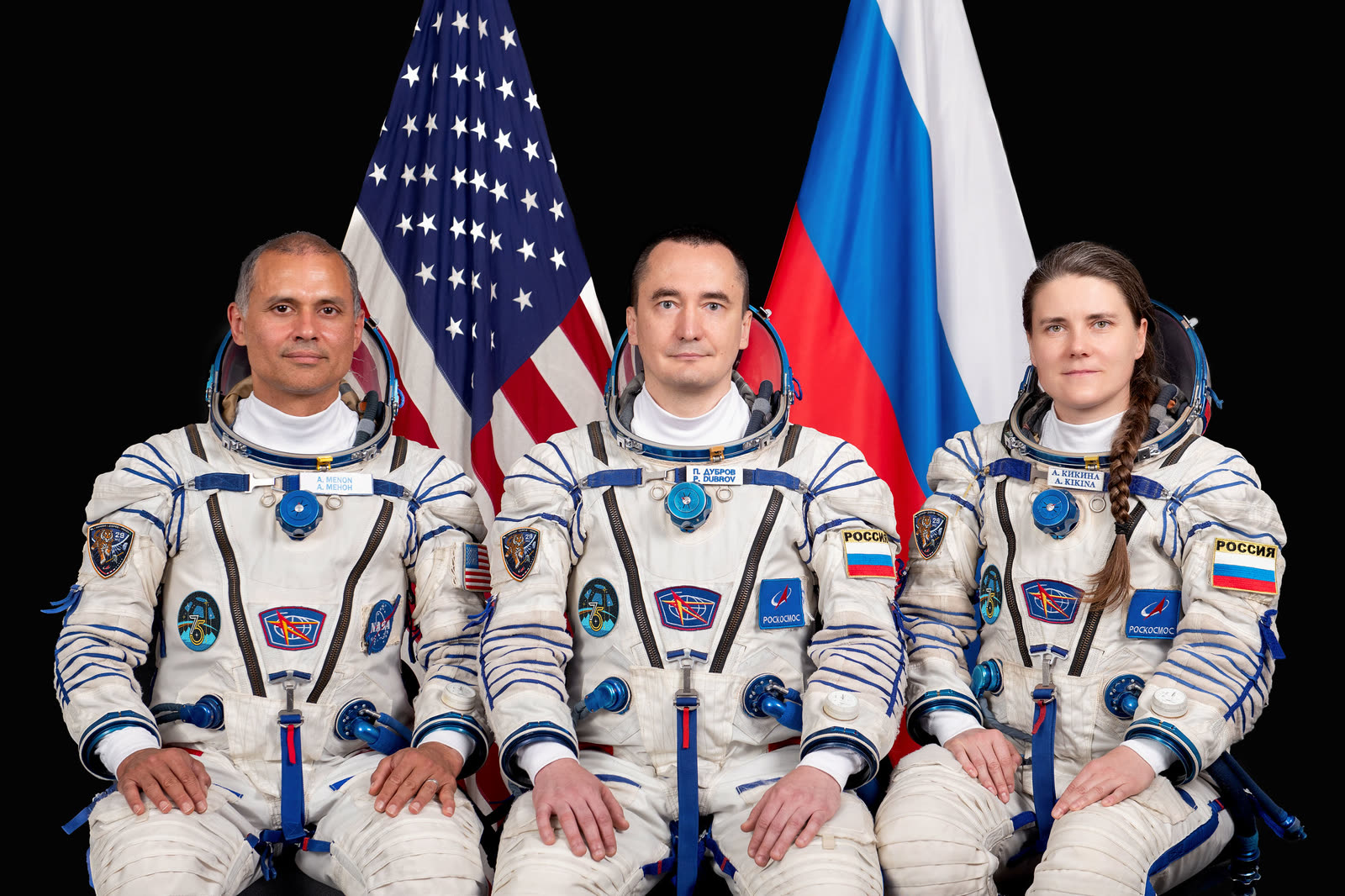
As of 2026-07-10 00:34 UTC, NASA has put a tight public clock around Soyuz MS-29. NASA astronaut Anil Menon is scheduled to launch with Roscosmos cosmonauts Pyotr Dubrov and Anna Kikina on Tuesday, July 14, lift off from Baikonur at 10:47 a.m. EDT, dock to the station's Prichal module at 1:56 p.m., and open hatches at 3:55 p.m. if real-time operations hold.[1]
The news is not just that another seat is leaving Kazakhstan. It is that the International Space Station's crew rotation is again being managed as a fast handoff: launch, two-orbit rendezvous, docking, welcome, and immediate absorption into a crowded Expedition 74/75 work plan. NASA says Menon, Dubrov, and Kikina are expected to spend about eight months aboard the orbital complex before returning in April 2027.[1]
The uncertainty boundary is straightforward: this is a scheduled launch, not a completed mission. NASA's own coverage plan says the times are subject to change based on real-time operations.[1] Until the spacecraft is safely docked and hatches are open, the important verbs are "scheduled," "planned," and "expected."
Image context: the cover uses the official Soyuz MS-29 prime-crew portrait from the Gagarin Cosmonaut Training Center in Russia. The image fits because this story is about a named three-person crew, a specific launch vehicle, and a near-term station handoff. It is real operational portraiture, not a symbolic space graphic.[1]
Fact File
| Timestamp / source | Key signal | Confidence note |
|---|---|---|
| NASA media advisory, 9 July 2026 | Soyuz MS-29 launch coverage begins at 9:45 a.m. EDT on 14 July; launch is scheduled for 10:47 a.m.; docking coverage begins at 1:10 p.m.; docking is scheduled for 1:56 p.m.; hatch coverage begins at 3:30 p.m.; hatch opening is scheduled for 3:55 p.m.[1] | High for NASA's current coverage schedule; operational timing can move. |
| NASA media advisory, 9 July 2026 | Menon, Dubrov, and Kikina are expected to make a two-orbit, roughly three-hour trip to Prichal and then join Jessica Meir, Jack Hathaway, Chris Williams, Sophie Adenot, Sergey Kud-Sverchkov, Sergei Mikaev, and Andrey Fedyaev aboard the station.[1] | High for planned crew roster and docking target; crew status can change if launch slips. |
| NASA prelaunch interview advisory, 15 June 2026 | Menon was scheduled for media interviews from the Gagarin Cosmonaut Training Center and was described as preparing for Expeditions 74/75 aboard Soyuz MS-29.[2] | High for prelaunch posture; the newer 9 July advisory supersedes older timing details. |
| NASA astronaut biography | Menon is an emergency medicine physician, mechanical engineer, U.S. Space Force colonel, former NASA flight surgeon, and former SpaceX flight surgeon; this is his first ISS mission as a flight engineer.[3] | High for biography; the mission assignment is current as of NASA's bio page. |
| NASA ISS overview | The station has passed 25 years of continuous human presence, operates roughly 250 miles above Earth, travels at about 17,500 mph, and has hosted nearly 300 astronauts and thousands of experiments.[5] | High for ISS background; these are contextual anchors rather than launch-specific updates. |
Why It Matters
The headline attraction is Menon's first spaceflight, but the operational story is broader. Menon arrives as a physician-engineer whose career has already touched crew health from the ground side: NASA flight surgeon work, SpaceX medical organization building, emergency medicine, aerospace medicine, and military medical transport.[2][3][4] That background makes this mission unusually coherent. The astronaut is not simply going to the station to "do science"; he is moving into an orbiting laboratory where crew health, autonomy, remote procedures, and medical contingency planning are part of the research agenda.
NASA's July 9 release makes that explicit. Menon's planned work includes refining in-space production of semiconductor crystals, using augmented reality and artificial intelligence for ultrasound, helping researchers understand blood-flow changes in space, and testing bioprinting of vascular constructs in microgravity.[1] Those are different projects, but they share a theme: how much complex work can be made repeatable away from Earth's normal support systems.
That is why the docking clock matters. A smooth July 14 launch and same-day docking would not prove the research program by itself. It would, however, keep crew handoff friction low. The station is a schedule-dense environment, and even small slips can cascade into sleep shifting, handover compression, training refreshes, payload timing, ground-team replanning, and public-coverage changes. In that sense, the first test is not dramatic. It is whether the new crew arrives cleanly enough that the mission can become routine quickly.
The ISS context also makes the flight more than a bilateral U.S.-Russia seat arrangement. NASA describes the station as an international program built from multiple crews, launch vehicles, ground facilities, communications networks, engineering teams, and scientific communities.[5] Soyuz MS-29 enters that system as one moving part. The arrival crew will join NASA, ESA, and Roscosmos personnel already aboard, and the real success condition is not the welcome event; it is a stable transfer from transport into laboratory work.[1][5]
Decision Impact
Next 24 hours: media teams, educators, spaceflight watchers, and mission-tracking desks should treat the NASA schedule as the baseline and not as proof of launch. The useful check is whether NASA, Roscosmos, or station channels revise coverage times, crew status, or the docking target. The key uncertainty is operational readiness, not the existence of the assignment.[1][2]
Next 7 days: the focus narrows to four observable gates: launch, orbital insertion and rendezvous, Prichal docking, and hatch opening. A delay before launch is inconvenient but manageable. A post-launch rendezvous issue would be a different category because it would compress the arrival sequence while the vehicle is already in flight. The public should also distinguish between launch success and mission start: Menon's Expedition work begins in practical terms only after the crew is aboard and integrated.[1]
Next 30 days: the question becomes whether Menon's research lane starts as a medical-autonomy story or gets swallowed by general crew-transition coverage. NASA's release points to ultrasound with AI and augmented reality, blood-flow studies, semiconductor crystal work, and vascular bioprinting.[1] The strongest early signal would be station updates showing those investigations moving from prelaunch promise into actual crew activity.
Scenarios
Base case: Soyuz MS-29 launches on July 14, docks the same day, hatches open on schedule or close to it, and Menon, Dubrov, and Kikina settle into Expedition 74/75. In this branch, the story quickly shifts from launch coverage to whether planned research tasks appear in station operations updates.[1][5]
Upside case: the fast rendezvous and welcome sequence run cleanly, and NASA uses the mission's first weeks to make the research agenda legible. Menon's medical background would give NASA a strong public frame for explaining why ultrasound autonomy, blood-flow studies, and bioprinting matter for longer missions and for Earth applications.[1][3][6]
Downside case: launch slips, docking moves, or hatch opening is delayed enough to force schedule compression. That would not automatically mean a mission problem, but it would change the first-week story from research handoff to operations recovery. The trigger to watch is whether NASA changes the launch time, docking target, or crew timeline in a way that pushes the handoff beyond routine schedule management.[1]
Action Checklist
- Use NASA's July 9 coverage advisory as the live baseline, and re-check it before quoting launch, docking, or hatch times.[1]
- Keep the crew distinction clear: Menon is on his first spaceflight; Dubrov and Kikina have flown before.[1]
- Treat older assignment material carefully. NASA's July 2025 assignment release is useful for background, but the July 2026 advisory carries the current launch date and coverage schedule.[1][4]
- Separate transport milestones from research milestones. Docking is necessary; it is not evidence that the listed experiments have begun.[1]
- Watch for station updates after hatch opening. The mission becomes more interesting when Menon's health, ultrasound, blood-flow, semiconductor, or bioprinting work enters the daily operating rhythm.[1][6]
The invalidation condition is narrow: if NASA or Roscosmos changes the July 14 launch plan, crew assignment, docking target, or return timeline, this brief needs updating. Until then, the cleanest reading is that Soyuz MS-29 is a near-term ISS handoff story with one unusually visible research angle: a doctor-engineer astronaut whose first flight is built around making hard work more autonomous in orbit.[1][2][3]
Sources
- NASA, "NASA Sets Coverage for Astronaut Anil Menon Launch to Space Station" (9 July 2026) - launch, docking, hatch, crew, mission-duration, research, and official GCTC crew-image details.
- NASA, "NASA Astronaut Anil Menon Available for Prelaunch Virtual Interviews" (15 June 2026) - prelaunch posture, Gagarin Cosmonaut Training Center interviews, Expeditions 74/75 context, and Menon's background.
- NASA, "Anil Menon" astronaut biography - education, medical and engineering background, NASA and SpaceX flight-surgeon experience, and Expedition 75 assignment.
- NASA, "NASA Assigns Astronaut Anil Menon to First Space Station Mission" (1 July 2025) - original assignment announcement, first-flight context, and Expedition 75 role.
- NASA, "International Space Station" - station overview, operating context, partnership structure, orbit facts, continuous human presence, and Expedition 74 reference.
- NASA, "3D Bioprinting" (20 December 2023) - ISS research context for bioprinting, microgravity tissue growth, and the BioFabrication Facility.