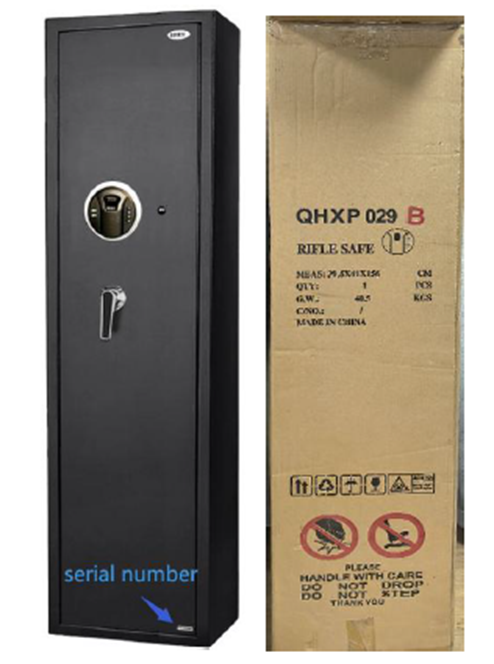
As of 2026-07-11 12:42 UTC, the U.S. Consumer Product Safety Commission has recalled 9,100 BBRKIN and MouTec biometric firearm safes because an unauthorized user can open the biometric lock. The QHXP029B is not a small pistol box: it is a 57-inch-tall steel cabinet sold on Amazon from March 2020 through February 2024 for $260 to $409. CPSC reports no incidents or injuries for this model, but tells owners to stop using its biometric feature, remove the batteries, use only the key for firearm storage, and obtain a free repair kit.[1]
The immediate notice is clear. The deeper record is not. This is BBRKIN's second recall for the same outward hazard in less than two and a half years, and the new cabinet falls into a category that the active voluntary youth-resistance standard expressly excludes. CPSC staff asked ASTM in April 2024 to close that scope gap. A February 2026 meeting log shows the standards group was still discussing whether to bring larger containers and gun safes inside it; its next meeting was still to be determined.[2][5][7]
That does not prove the missing standard caused this defect. It does reveal an uncomfortable sequence: the market produced another fail-open biometric firearm container while the safety requirement intended to prevent unpaired biometric access stopped at a 20-inch product boundary.
What Failed — And What Has Not Been Shown
CPSC's new recall says only that unauthorized users can open the QHXP029B's biometric lock. BBRKIN's recall FAQ is more specific: the module allows an unpaired fingerprint to open the safe until an owner programs a fingerprint. The company says the repair kit is a replacement module that owners can install; unlike buyers of its earlier QCJJ01 model, QHXP029B owners are offered repair only, not a replacement safe.[1][4]
That distinction matters. The public record reviewed for this article does not show that a properly enrolled QHXP029B later accepted a stranger's fingerprint, and the current recall lists no reported incident. Nor does it disclose how CPSC or BBRKIN discovered the condition, when they first confirmed it, or what tests the new module must pass. The recall population is evidence of exposure to a hazardous product design, not evidence that 9,100 safes failed in homes.
It is also not a reason to treat enrollment as a sufficient home fix. The agency's instruction is to disable use of the biometric system while waiting for the repair: remove the batteries and use the key. That official remedy supersedes any assumption that an owner can make the recalled module safe merely by registering a print.[1]
The First BBRKIN Case Had A Child On The Other Side Of The Door
In February 2024, CPSC recalled about 2,200 MouTec-branded BBRKIN QCJJ01 safes. That model was only 15 inches tall, but the hazard language was the same: an unauthorized user could open the biometric lock. The reported incident was not theoretical. The firm received a report that a six-year-old boy opened one of the safes.[2]
KETV's earlier investigation supplied the consequence missing from the recall's short description. The child took a firearm from the safe to an Iowa school. Shenandoah police told the station that the child's thumb opened the safe and that an officer's unregistered print opened it again during an inspection. The father said he had followed the setup instructions. In an email the father said he exchanged with BBRKIN and supplied to KETV, the company said it had changed the chip program around January 2023 so a new safe would remain locked until enrollment. BBRKIN did not respond to the station's requests for comment. A later QCJJ01 purchased and programmed by KETV rejected nearly a dozen other people's prints in the newsroom's limited test.[3]
That account suggests BBRKIN had changed an earlier chip program before the 2024 recall; it does not independently establish why the program was changed. It also does not establish that the current QHXP029B uses the same chip, fails after enrollment in the same way, or caused another school incident. The two models share a company and an unauthorized-access hazard; their exact failure mechanisms should not be merged without test records.
More Than Half A Million Units Across Six Waves
The latest 9,100 cabinets are small beside the wider record. Adding the distinct CPSC recall and warning populations for this unauthorized-biometric-access hazard since October 2023 yields about 514,590 biometric safes and firearm-storage containers and at least 216 reports of unauthorized opening. These are rounded product-population figures, not a count of defective units still in homes, and the notices span different manufacturers, models, remedies, and technical failure modes.[1][8][9][10][11][12]
| CPSC action | Approximate units | Unauthorized-opening record |
|---|---|---|
| Fortress recall, October 2023 | 61,000 | 39 reports; CPSC also cited a lawsuit alleging that a 12-year-old died after obtaining a firearm from one of the safes.[8] |
| Awesafe, Bulldog, Machir, and first BBRKIN wave, February 2024 | 120,520 | 91 reports across four recall populations, including the BBRKIN incident involving a six-year-old.[2][9] |
| Sanctuary and Sports Afield recall, June 2024 | 133,370 | 77 reports; no injuries reported in that recall.[10] |
| Owsoo and Cacagoo warning, August 2024 | 7,600 | Six reports; CPSC said the foreign sellers it contacted did not respond to requests for a recall.[11] |
| Stack-On warning, January 2025 | 183,000 | Three reports, including a five-year-old who required surgery after a self-inflicted gunshot; CPSC said Stack-On refused an acceptable recall.[12] |
| Second BBRKIN recall, July 2026 | 9,100 | No incidents reported for QHXP029B.[1] |
The table shows recurrence, not a universal verdict on fingerprint readers. Some notices describe a default-open state before enrollment; others say programming can fail without the consumer realizing it. One is a company-coordinated recall, another an agency warning issued when a seller would not agree to an acceptable recall. The common safety outcome is narrower and well documented: a container purchased to separate an unauthorized person from a firearm can present as locked while accepting the wrong finger.[8][9][10][11][12]
The Standard Has The Right Test Inside The Wrong Perimeter
ASTM F2456-20 is the active voluntary specification for youth-resistant firearm containers. Its scope covers lockable containers intended to prevent unauthorized firearm access and establishes testing and certification requirements. But it expressly does not apply to full-size light gun cabinets, gun safes, high-security gun safes, or firearm containers longer than 508 millimeters, or 20 inches.[6]
Inside that perimeter, the biometric rule points directly at the recurring hazard. CPSC staff's April 2024 letter described section 5.5 as requiring that a biometric lock must not open through the biometric interface until an authorized user has programmed a unique biometric method. Staff argued that every firearm container using a biometric lock should meet that requirement, including the larger products then excluded. The letter also carried an important institutional caveat: it was a staff recommendation, not a position reviewed or approved by the Commission.[5]
The current BBRKIN cabinet's 57-inch dimension exceeds the standard's 20-inch cutoff by 37 inches, and the product is marketed to hold about five firearms.[1] Its recall therefore cannot honestly be called proof that QHXP029B violated ASTM F2456. The model sits outside F2456's scope. The sharper finding is that it exhibits the precise default-access hazard the standard addresses for smaller containers.
By February 19, 2026, an ASTM task group with CPSC staff participating was still debating wider coverage for larger and heavier containers and potentially gun safes. The group also had to work through consequences that do not arise with a small lockbox: tip-over attacks, drop-test design, glass-front display cabinets, realistic firearm test blocks, and whether protection should extend through age 12 rather than age 11. The log says biometric clarifications would move toward a ballot, while scope changes and test modifications would remain under discussion; the next meeting was listed as TBD.[7]
Those are legitimate engineering questions. A floor-standing long-gun cabinet cannot simply inherit every test written for a portable box. But they do not change the access-control principle. Whether a container is 15 inches or 57 inches tall, an unpaired fingerprint should not function as a key.
What The Recall Leaves Unanswered
Three missing pieces now matter more than the announcement's headline number.
First, discovery: when did BBRKIN or CPSC identify the QHXP029B condition, and what prompted a July 2026 recall for a product whose listed sales ended in February 2024? The documents do not say. The roughly 28-to-29-month interval is a reporting question, not evidence by itself of delayed disclosure.[1]
Second, remedy verification: what changes inside the replacement module, and how will owners know it has been fitted and enrolled correctly? BBRKIN describes an owner-installed module, but neither its FAQ nor CPSC's notice publishes a false-accept test, a default-state test protocol, or post-installation verification steps.[1][4]
Third, standards closure: will the next F2456 revision extend the no-unpaired-entry principle to long-gun cabinets, and if so, how will scope, age, tip-over, and durability tests be reconciled? The February log records work, not adoption.[7]
Three Paths From Here
Base case: BBRKIN distributes the replacement module while QHXP029B remains a no-incident recall, and ASTM's active 20-inch scope boundary stays in place as the task group continues its work. The confirming signals would be stable CPSC incident data, a functioning repair program, and further meeting or ballot records without a new active standard.[1][4][6][7]
Better case: a revised F2456 extends the no-unpaired-entry requirement to full-size biometric firearm containers and publishes tests appropriate to their weight, dimensions, and use. The trigger is not another discussion log; it is an active replacement standard with an expanded scope and corresponding test requirements.[5][6][7]
Worse case: CPSC records an incident for QHXP029B, owners encounter a remedy that is difficult to obtain or verify, or another large biometric-safe population enters a recall or unilateral warning before the standards boundary changes. Any new CPSC notice, incident update, or remedy-status change would be the evidence—not the existence of risk in the abstract.[1][4]
Action And Invalidation Check
- For owners now: check the front label for model QHXP029B and the serial range SQC200034980 through SQC202319171. If matched, stop using the biometric feature, remove the batteries, use the key for firearm storage, and contact BBRKIN for the free kit.[1]
- When a kit arrives: follow the recall instructions and retain a record of the repair. Do not treat fingerprint enrollment alone as a substitute for CPSC's stated remedy.[1][4]
- For standards watchers: look for a published active revision that changes both scope and testing; a task-group meeting by itself does not move the boundary.[6][7]
- Invalidation condition: the article's claim that the active standard excludes this class of full-size cabinet ceases to be current if ASTM publishes a superseding F2456 edition that covers it. The recall history would remain factual, but the standards-gap conclusion would need updating.[6][7]
Until then, the accountability test is simple: whether the next recalled full-size cabinet arrives before the 20-inch line finally moves.
Sources
- U.S. Consumer Product Safety Commission, "Biometric Gun Safes Recalled Due to Serious Injury Hazard and Risk of Death; Sold Exclusively on Amazon.com by BBRKIN" (July 9, 2026) — current QHXP029B population, dimensions, sales period, serial range, remedy, incident status, and official product photograph.
- U.S. Consumer Product Safety Commission, "Biometric Gun Safes Recalled Due to Serious Injury Hazard and Risk of Death; Sold Exclusively on Amazon.com by BBRKIN" (February 22, 2024) — prior QCJJ01 recall, 2,200-unit population, and six-year-old's unauthorized access.
- Sarah Fili, KETV via KTVZ, "This is about accountability: Father wants safe recalled after son unlocks it, takes gun to school" (May 22, 2023) — police verification, family account, BBRKIN chip-program email, and KETV's later test.
- BBRKIN, "FAQs" — company's description of the unpaired-fingerprint condition and model-specific repair or replacement options.
- U.S. Consumer Product Safety Commission staff, letter to ASTM F15.55 (April 10, 2024) — F2456 biometric requirement, excluded product categories, 20-inch boundary, and request to widen coverage.
- ASTM International, "F2456-20: Standard Specification for Youth-Resistant Firearms Containers" — active standard's purpose and scope exclusions.
- U.S. Consumer Product Safety Commission, "ASTM F15.53 and F15.55 Task Group Meeting on Scope and Tip-Over Testing" log (February 19, 2026) — biometric clarification, proposed scope expansion, test-design questions, and next steps.
- U.S. Consumer Product Safety Commission, "Fortress Safe Announces Recall of Biometric Gun Safes" (October 19, 2023) — 61,000-unit population, 39 unauthorized-access reports, and alleged death described in litigation.
- CPSC Commissioner Richard Trumka, "Biometric Gunsafes Malfunction, Allowing Anyone to Open" (February 22, 2024) — synthesis of the four-company 120,520-unit wave and its 91 incident reports.
- U.S. Consumer Product Safety Commission, "SA Consumer Products Recalls Sanctuary Quick Access and Sports Afield Biometric Gun Safes" (June 6, 2024) — 133,370-unit population and 77 unauthorized-access reports.
- U.S. Consumer Product Safety Commission, warning on Owsoo and Cacagoo biometric gun safes (August 1, 2024) — 7,600-unit population, six reports, and seller-response boundary.
- U.S. Consumer Product Safety Commission, warning on Stack-On biometric gun safes (January 30, 2025) — 183,000-unit population, three reports, severe child injury, and the absence of an agreed recall.